Bottom line.
- Primary care (headline). Blood p-tau217 is used with two cutoffs: a low value rules amyloid pathology out, a high value rules it in, and results in between need PET or CSF. Only two primary-care studies reported how often results fall in between, and they are shown separately, not pooled:
- Palmqvist 2025: cutoffs prespecified in a separate cohort; Swedish primary care; n=548. 16% intermediate (88/548; 95% CI 13–19%). Accuracy in the remaining patients was 92%.
- Hortsch 2026: mixed primary and secondary care; n=588. 5.8% intermediate (34/588; 4–8%). Its cutoffs were set in the same cohort at a looser 90% target, and the manufacturer's staff were among the authors.
- Main supporting result: secondary care. Six secondary-care or clinical-lab series used cutoffs fixed before the study. In them, 19% of patients landed in the intermediate zone (pooled; 95% CI 15–24%; prediction interval 10–33%; k=6; 3,398 patients). Two of the six are Mayo Clinic series; with one Mayo series only (Piura dropped), the figure is 20% (16–25%).
- Optimistic estimate. Memory-clinic studies that derived their cutoffs in the same patients reported 23% (19–28%; k=13). This figure is shown separately and is likely optimistic.
- Accuracy. Among definitive results, the five studies with full 2×2 tables against a biomarker reference reported sensitivity of 92–98% and specificity of 84–94%. Tier B has three tables (Moghekar, Ashrafzadeh-Kian, Piura), left unpooled by post hoc decision; tier C has two (Franco-Macías, Lin). No accuracy is pooled across tiers. Accuracy excludes intermediate results, so it overstates whole-population accuracy.
- Cutoff target. Within studies, moving from 95/95 to 97.5/97.5 cutoffs raised the intermediate rate substantially (by 1.4- to 2.5-fold in three studies).
- Methods in brief. Rapid review of PubMed and Europe PMC; single reviewer; full text used where open access; no formal risk-of-bias assessment (QUADAS-2). No estimate is pooled across tiers.
Question
When plasma p-tau217 is used in routine care with a two-cutoff rule, what share of patients get an intermediate result? How accurate are the definitive results against amyloid PET or CSF?
Methods
- Design. Rapid, non-systematic review. One reviewer screened, with no registered protocol. Conducted 29 Oct 2026.
- PubMed (NCBI E-utilities; publication date 2024-01-01 to 2026-10-29; queried 29 Oct 2026):
- q1 (p-tau217 + plasma/blood + setting terms such as primary care, memory clinic, real-world, secondary care) returned 247 records.
- q2 (p-tau217 + plasma + two-cutoff, intermediate or assay names) returned 866.
- Together that is 635 unique records. A title/abstract pre-filter left 133, and abstract screening left 40. Full queries are in pubmed_search.json.
- Europe PMC (REST API; TITLE_ABS field tags, PUB_YEAR:[2024 TO 2026], SRC:MED OR SRC:PPR; queried 29 Oct 2026):
- e1 (setting terms) returned 263 hits and e2 (two-cutoff/grey-zone terms) returned 52.
- Together that is 290 unique, of which 104 were not in PubMed (mostly preprints, which were excluded). 3 studies were added.
- Flow. At the abstract stage, inclusion_list.md listed 26 included studies and 10 narrative-only studies. After full-text extraction, 21 studies contributed intermediate rates: A 2 (described, not pooled), B 6 and C 13. Correction (v3.2): v3 and v3.1 wrongly excluded Piura 2025 (Mayo Florida, 70/509 intermediate), stating that its reference standard was clinical diagnosis. The full text shows that patients were enrolled only if a diagnostic lumbar puncture was planned, that CSF p-tau181, total tau and Aβ42 were measured on Roche Elecsys, and that plasma results were read blind to CSF. CSF results were on record for 468 of the 509 patients, and analyses were limited to the 426 whose CSF and blood were obtained within 1 year of each other. Clinical diagnosis was only one of the two comparators for its accuracy figures. Piura meets the PET-or-CSF rule and is reinstated. The other studies were described narratively or had no extractable count; reasons are given in results_v3_2.md.
- Post hoc decisions (made after full-text extraction):
- Piura moved from stratum C to B when its cutpoints were found to be prespecified. It was then excluded in v3 on a misreading of its reference standard and reinstated in v3.2 (see Flow).
- The eligibility clause "applied to every outcome, including the intermediate rate" was added in v3, after results had been seen. It is kept, and Piura meets it.
- Massons moved from C to B.
- Ishiguro and Lv moved to narrative only.
- Palmqvist 2024 was kept narrative because it overlaps Palmqvist 2025.
- Palmqvist 2025's developer code changed from author to COI-only.
- Arranz uses the CSF subset (n=109) as its denominator.
- Tier B accuracy was not pooled (v3.2) once Piura's reinstatement brought it to k=3 full 2×2 tables: all three are developer-run (two Mayo series sharing a laboratory and cutpoints, and the manufacturer's clearance study), and they mix a p-tau217/Aβ42 ratio (Moghekar) with p-tau217 alone, so a pooled estimate would add little beyond the per-study results.
- A developer criterion was added (v3.1): a laboratory evaluating its own clinical test against its own earlier cutpoints. Ashrafzadeh-Kian and Piura are coded Y under it.
- Date rule. Studies were included only if first online in 2024–2026, using the earlier of the Crossref and PubMed dates. If no PubMed epub date existed, the PubMed entry date was used (Palmqvist 2024). Every DOI was verified on the Crossref API (crossref_verify.json).
- Eligibility.
- Population: people assessed for cognitive symptoms in routine care (primary care, consecutive or unselected secondary-care patients, or clinical-laboratory series).
- Index test: plasma p-tau217 (alone or as a ratio) on a commercial or IVD-track assay.
- Reference: amyloid PET or CSF, applied to every outcome, including the intermediate rate (clause added post hoc in v3).
- Peer-reviewed only.
- Strata (never pooled across each other; A is described study by study).
- A: primary care, the headline.
- B: cutoffs fixed before the study, either prespecified, published earlier, or cleared by regulators.
- C: cutoffs derived in the same cohort, labelled optimistic.
- Assays. All six pooled stratum-B studies used Fujirebio Lumipulse (Moghekar as the p-tau217/Aβ42 ratio). Stratum C mixes Lumipulse with Roche Elecsys (Franco-Macías, Lin), Vazyme (Chen) and immunoassays not named in the abstract (Imperiale, Benussi). The two stratum-A studies used Lumipulse (Palmqvist 2025) and an Elecsys prototype (Hortsch); C2N %p-tau217 appears only in the narrative Palmqvist 2024. Cutoffs are assay-specific and do not transfer between platforms.
- Extraction. One estimate per study: p-tau217 alone where available, the threshold pair closest to 95/95, and an external set where available. Where only a percentage was reported, the count was back-calculated and flagged (*). Values from abstracts only are marked §.
- Developer involvement. Coded for every study. Y: manufacturer staff were authors or affiliates, or the reporting laboratory evaluated its own clinical test against its own earlier cutpoints (second criterion added post hoc, v3.1). C: a manufacturer appears only in conflict-of-interest statements. N: none seen. ?: not verifiable (abstract only).
- Synthesis.
- No formal risk-of-bias assessment (QUADAS-2) was performed.
- Proportions were pooled on the logit scale with REML random effects and a Hartung–Knapp–Sidik–Jonkman CI (variance scale floored at max(1, q); t on k−1).
- Prediction interval on t with k−2. I² reported from both Cochran's Q and τ². Leave-one-out and sensitivity analyses were run.
- Sensitivity and specificity were to be pooled only where a full 2×2 table could be rebuilt within a single tier. No tier had k≥3 until Piura was reinstated. Tier B now has k=3 (Moghekar, Ashrafzadeh-Kian, Piura); a pool is technically eligible but was not run (post hoc decision): all three are developer-run (two Mayo series sharing a laboratory and cutpoints, and the manufacturer's clearance study), and they mix a p-tau217/Aβ42 ratio (Moghekar) with p-tau217 alone, so a pooled estimate would add little beyond the per-study results, which are described.
- Tool versions: Python 3.13.5, NumPy 2.5.4, SciPy 1.18.1, Matplotlib 3.11.2, requests 2.34.2.
Results
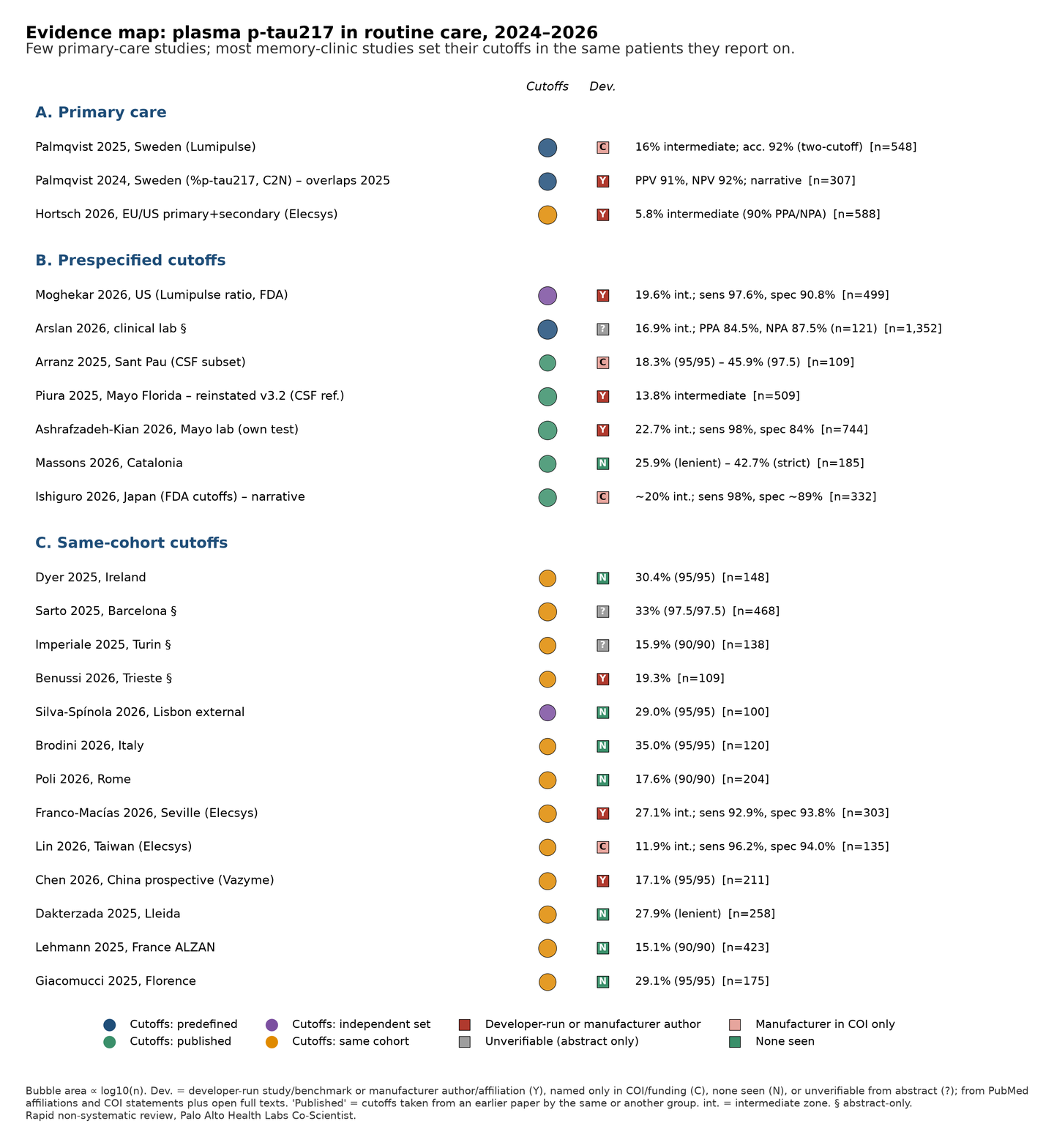
Intermediate results
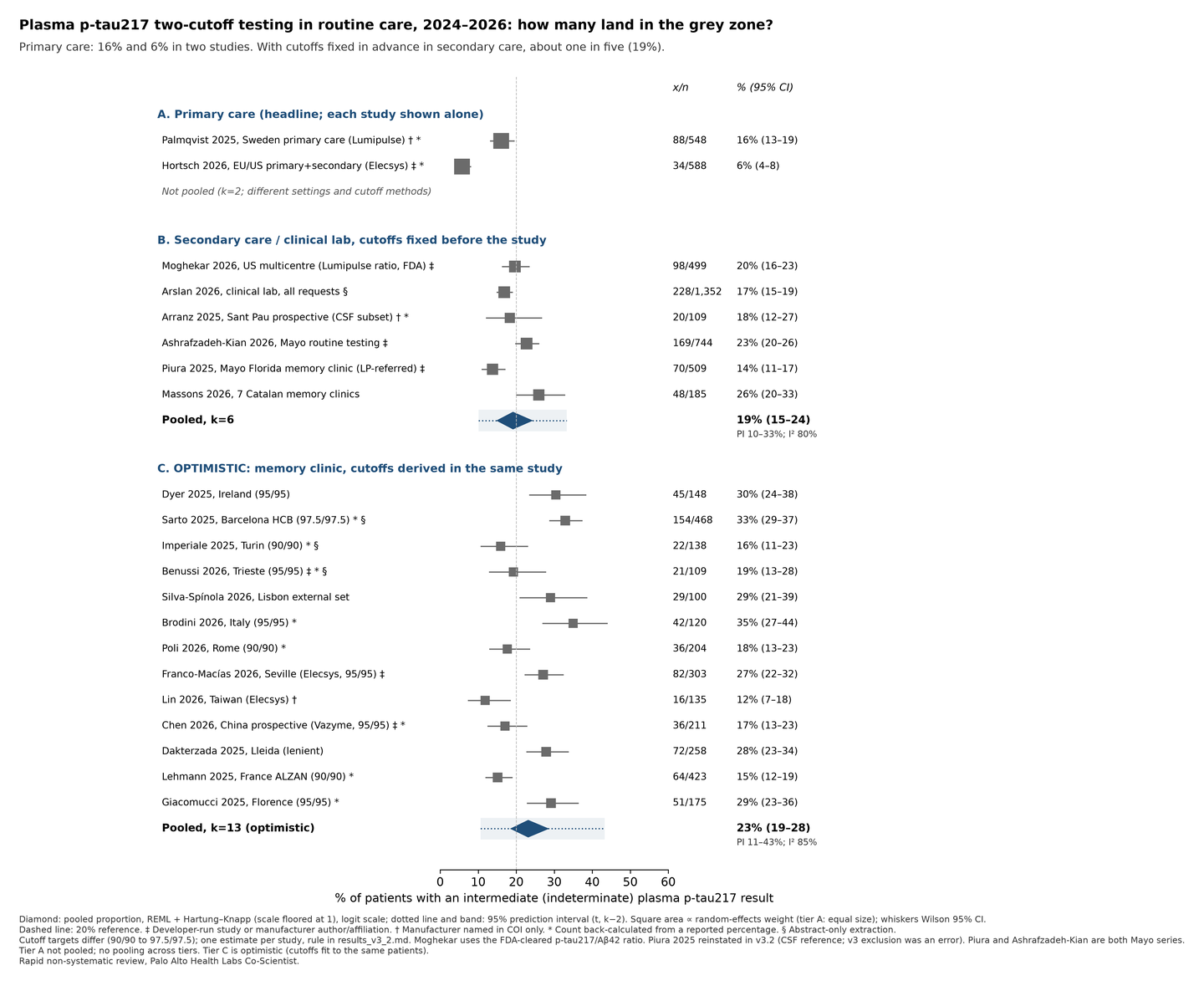
A. Primary care: the headline. Two studies, shown separately and not pooled.
- Palmqvist 2025 used prespecified Lumipulse cutoffs, derived in a separate Malmö cohort, in Swedish primary care. 16.1% of results were intermediate (88/548; 13.2–19.4%), and accuracy among the remaining patients was 92%.
- Hortsch 2026 studied Elecsys in mixed primary and secondary care and reported 5.8% intermediate (34/588; 4.2–8.0%). Its cutoffs were exploratory, set in the same cohort at a 90% target, with manufacturer authors.
- Palmqvist 2024 (%p-tau217, same Swedish programme) reported PPV 91% and NPV 92% in primary care but no intermediate rate.
The two estimates differ in setting, assay and cutoff method, so a pooled figure would not be meaningful.
B. Cutoffs fixed in advance (main supporting result; k=6): 19.2% (15.0–24.1%), PI 10.1–33.3%, I² 80% (Q) / 82% (τ²).
Individual studies ranged from 13.8% (Piura) to 25.9% (seven Catalan memory clinics):
- Arslan 2026 §: 16.9% (1,352 consecutive clinical-lab requests, mostly specialist). This result is from the abstract only, and its disclosures could not be checked.
- Arranz 2025: 18.3% (Sant Pau).
- Moghekar 2026: 19.6% (research and registration cohorts: POLARIS-AD, BioFINDER-2, Bio-Hermes-001, WRAP, WADRC; Lumipulse p-tau217/Aβ42 ratio).
- Moghekar 2026 is the study that supported the FDA clearance: the FDA decision summary cites the same 499 subjects.
- FDA status: the Lumipulse G pTau217/β-Amyloid 1-42 Plasma Ratio was cleared on 16 May 2025 (510(k) K242706).
- Intended use: adults aged 50 and over presenting with signs and symptoms of cognitive decline in a specialized care setting. The decision summary (Section III.B, Indication(s) for Use, p. 2) states "This test is not intended as a screening or stand-alone diagnostic test." It is not cleared for primary care.
- A second clearance with a different intended use: Elecsys Phospho-Tau (217P) Plasma (Roche Diagnostics; 510(k) K261686; decision 19 Aug 2026). It is a single-analyte p-tau217 assay for individuals aged 55 and over presenting with signs, symptoms or complaints of cognitive decline, with no care setting specified. Its decision summary includes primary-care/low-prevalence guidance (p. 4), and its cutoff population included primary-care samples (194 of 687). No study of the cleared version in primary care is pooled here.
- Ashrafzadeh-Kian 2026: 22.7% (Mayo routine testing; developer-run, see below).
- Piura 2025: 13.8% (70/509; Mayo Florida memory clinic, LP-referred; same Mayo laboratory and cutpoints; developer-run). In the 426 patients with paired CSF, 58 (13.6%) were intermediate.
Sensitivity analyses:
- One Mayo series only, without Piura (the v3/v3.1 pool): 20.4% (16.2–25.3%), PI 11.7–33.1%, k=5.
- One Mayo series only, without Ashrafzadeh-Kian: 18.4% (13.6–24.3%), PI 8.5–35.3%, k=5.
- Piura's CSF-paired subset (58/426) in place of 70/509: 19.2% (15.0–24.1%), PI 10.1–33.3%.
- Without the ratio study (Moghekar): 19.1% (13.7–25.9%), PI 8.0–39.2%.
- Without all three developer-run studies (Moghekar, Ashrafzadeh-Kian, Piura): 19.9% (10.3–35.0%), PI 0.4–93.5%, k=3. The estimate is similar but too imprecise to confirm it.
- Without the abstract-only study (Arslan): 19.8% (14.4–26.5%), PI 8.7–39.0%.
- Without Massons (possible overlap with Sarto): 18.2% (14.1–23.1%), PI 9.5–32.0%.
- Without all possibly overlapping studies (Massons, Moghekar and Piura): 19.3% (11.8–30.0%), PI 1.1–83.2%, k=3. This prediction interval is too wide to be informative.
- Leave-one-out range: 18.2–20.4%.
C. Cutoffs derived in the same cohort (optimistic; k=13): 23.2% (18.7–28.3%), PI 10.7–43.3%.
This stratum is labelled optimistic because each study chose its cutoffs to fit the patients it then reported on. Studies ranged from 11.9% to 35.0%. The estimate was 25.0% with exact counts only (k=5) and 23.8% without manufacturer-authored studies.
Cutoff target drives the rate. Moving from 95/95 to 97.5/97.5 raised the intermediate rate substantially, by 1.4- to 2.5-fold, in three studies:
- Arranz: 18% to 46%.
- Massons: 26% to 43%.
- Dyer: 30% to 43%.
Moving from 90/90 to 95/95 roughly doubled it (Giacomucci 13% to 29%; Dyer 17% to 30%). Ratios with Aβ42 lowered it: ≤10% in Palmqvist 2025, and 3% vs 15% in Ishiguro 2026.
Accuracy among definitive results (described, not pooled)
Full 2×2 tables could be rebuilt for five studies (Piura added in v3.2).
Tier B:
- Ashrafzadeh-Kian: sensitivity 97.5%, specificity 83.7%.
- Moghekar (ratio; table back-calculated from reported PPV, NPV and counts): 97.6% / 90.8%.
- Piura 2025: against CSF p-tau181/Aβ42 (Table 2, n=426), sensitivity was 92.4% (218/236) and specificity 89.4% (118/132) among definitive results, with 58 intermediate. Against clinical diagnosis it reported 95% and 82%. (Added in v3.2 after reinstatement.)
Tier C (optimistic):
- Franco-Macías: 92.9% / 93.8%.
- Lin: 96.2% / 94.0%.
Tier B has three tables, but they were left unpooled by post hoc decision (see Methods); tier C has two. Accuracy excludes intermediate results, so it overstates whole-population accuracy.
Other reported accuracy:
- Arslan: PPA 84.5% and NPA 87.5% in 121 patients with CSF.
- Palmqvist 2024: PPV 91% and NPV 92% in primary care.
Developer involvement
Of 24 cited studies, 23 are on the evidence map (Lv, narrative only, is not mapped). Codes for the 23 mapped studies:
- Y: manufacturer authors or affiliation, or a laboratory's own test (8; 6 manufacturer, 2 laboratory's own test):
- Hortsch (Roche) and Moghekar (Fujirebio; the FDA clearance study).
- Ashrafzadeh-Kian and Piura: coded under the laboratory's-own-test criterion (added post hoc, v3.1). Mayo Clinic Laboratories evaluated its own clinical test against cutpoints from its own earlier validation (Figdore 2024). Mayo is not the assay manufacturer. The senior author discloses Roche and Fujirebio advisory roles.
- Benussi (Fujirebio Italia affiliation in PubMed).
- Franco-Macías (Roche).
- Chen (Vazyme).
- Palmqvist 2024 (C2N).
- Manufacturer named only in conflict-of-interest statements (4): Palmqvist 2025, Arranz, Lin, Ishiguro.
- Not verifiable (3): Arslan, Sarto and Imperiale have no open full text, so their disclosures could not be checked. Benussi's Y code rests on its PubMed affiliation; its COI statement could not be checked.
- None seen (8): Massons, Dyer, Silva-Spínola, Brodini, Poli, Dakterzada, Lehmann, Giacomucci.
Limitations
- Search and screening. A single reviewer, two databases and no protocol. Several full texts were closed, so values for Arslan, Sarto, Imperiale and Benussi come from abstracts (§). No formal risk-of-bias assessment (QUADAS-2) was performed.
- Comparability. Cutoff targets (90/90 to 97.5/97.5), assays and reference standards differ, and heterogeneity is high.
- Overlap.
- Massons and Sarto (Barcelona):
- Massons recruited 84 of its 185 patients at Hospital Clínic Barcelona (HCB) in June 2023–February 2024. That is inside Sarto's HCB window (July 2019–June 2024).
- HCB ran the assays for both studies. Massons' "prespecified" cutoffs probably come from the HCB cohort, since it cites Sarto, though it does not state the derivation explicitly.
- The two studies are in different strata. Dropping Massons from stratum B gave 18.2%.
- Moghekar's sample includes 43 BioFINDER-2 participants. No Palmqvist 2025 secondary-care set is pooled.
- Mayo: Piura (Mayo Florida memory clinic, March 2020–July 2024) and Ashrafzadeh-Kian (Mayo routine testing, July 2024–December 2025) share a laboratory and cutpoints. Their recruitment windows overlap by at most one month, so patient overlap is unlikely but cannot be excluded. With one Mayo series only, the pool is 20.4% (without Piura) or 18.4% (without Ashrafzadeh-Kian).
- Palmqvist 2025's Barcelona set may overlap Barcelona single-centre reports. No included study uses a Brescia cohort (Benussi is Trieste; Imperiale is Turin).
- Clinical applicability.
- Reference standards differed: CSF Aβ42/40, CSF p-tau181/Aβ42, CSF Aβ42 with tau, A+/T+ profiles, and amyloid PET (visual read or centiloid ≥30).
- Most studies come from memory clinics or specialist laboratories, so the patients are a higher-risk, pre-selected group.
- Predictive values depend on prevalence. Amyloid positivity was 44.5% in the Swedish primary-care cohort (Palmqvist 2025, Table 1). Assuming the nominal 95% sensitivity and specificity among definitive (non-intermediate) results, which is a design target and not a pooled estimate from this review, PPV would be 94% at 44.5% prevalence and 83% at 20% (NPV 98.7%). These figures exclude intermediate results and are illustrative only.
- Reduced kidney function raises plasma p-tau217 (reported in Piura, Hortsch, Ashrafzadeh-Kian and Lin) and can produce false positives or intermediate results.
- Cohorts were almost all European or US academic centres. The two Asian cohorts are Lin (Taiwan) and Chen (China), and among pooled studies only Moghekar reported performance by race and ethnicity, so data for Black and Hispanic patients are sparse.
- Small k. Accuracy data could not be pooled within any tier, and small-study effects were not tested.
- Classification. Silva-Spínola (an external set, with cutoffs from the same group) could arguably sit in stratum B.
What it means
In primary care, two studies found 16% and 6% of results in the intermediate zone. The lower figure came with looser, cohort-derived cutoffs, so primary-care evidence is still thin. In secondary care with cutoffs fixed in advance, about one tested patient in five would need confirmatory PET or CSF, and a new site could plausibly see about 10% to a third. FDA clearances differ by intended use. The Lumipulse plasma ratio (K242706, May 2025) is indicated for specialized care. A single-analyte Elecsys p-tau217 assay (K261686, August 2026) has an intended use not limited to specialized care, and its decision summary includes primary-care guidance. No primary-care study of that cleared version is pooled here. Same-cohort estimates (23%) are optimistic. Within studies, the cutoff target and use of a ratio changed the intermediate rate markedly.
Sources
§ = abstract-only extraction.
- FDA 510(k) K242706, Lumipulse G pTau217/ß-Amyloid 1-42 Plasma Ratio (decision 16 May 2025). https://www.accessdata.fda.gov/scripts/cdrh/cfdocs/cfpmn/pmn.cfm?ID=K242706
-
FDA 510(k) K261686, Elecsys Phospho-Tau (217P) Plasma (decision 19 Aug 2026). https://www.accessdata.fda.gov/cdrh_docs/reviews/K261686.pdf
-
Palmqvist 2025, Nat Med. PMID 40205199. https://doi.org/10.1038/s41591-025-03622-w
- Palmqvist 2024, JAMA. PMID 39068545. https://doi.org/10.1001/jama.2024.13855
- Hortsch 2026, JPAD. PMID 41887009. https://doi.org/10.1016/j.tjpad.2026.100534
- Moghekar 2026, Alzheimers Dement. PMID 42418465. https://doi.org/10.1002/alz.71644
- Arslan 2026 §, CCLM. PMID 42053135. https://doi.org/10.1515/cclm-2026-0370
- Arranz 2025, Alzheimers Res Ther. PMID 40618130. https://doi.org/10.1186/s13195-025-01779-7
- Piura 2025, Alzheimers Dement. PMID 40476540. https://doi.org/10.1002/alz.70316
- Ashrafzadeh-Kian 2026, Alzheimers Dement. PMID 42805946. https://doi.org/10.1002/alz.71887
- Massons 2026, Ann Clin Transl Neurol. PMID 41968970. https://doi.org/10.1002/acn3.70387
- Ishiguro 2026, Alzheimers Res Ther. PMID 41776672. https://doi.org/10.1186/s13195-026-01997-7
- Lv 2026, Sci Bull. PMID 42633973. https://doi.org/10.1016/j.scib.2026.08.018
- Dyer 2025, Alzheimers Dement (Amst). PMID 39959359. https://doi.org/10.1002/dad2.70080
- Sarto 2025 §, J Neurol. PMID 39849125. https://doi.org/10.1007/s00415-025-12897-5
- Imperiale 2025 §, J Alzheimers Dis. PMID 41191342. https://doi.org/10.1177/13872877251390897
- Benussi 2026 §, Neurobiol Aging. PMID 41422686. https://doi.org/10.1016/j.neurobiolaging.2025.12.005
- Silva-Spínola 2026, Sci Rep. PMID 41535718. https://doi.org/10.1038/s41598-025-34241-7
- Brodini 2026, Alzheimers Dement (Amst). PMID 41756817. https://doi.org/10.1002/dad2.70286
- Poli 2026, J Neurol. PMID 42101517. https://doi.org/10.1007/s00415-026-13833-x
- Franco-Macías 2026, J Alzheimers Dis. PMID 42300696. https://doi.org/10.1177/13872877261459067
- Lin 2026, J Neurol. PMID 42905283. https://doi.org/10.1007/s00415-026-14193-2
- Chen 2026, J Prev Alzheimers Dis. PMID 42247845. https://doi.org/10.1016/j.tjpad.2026.100613
- Dakterzada 2025, Int J Mol Sci. PMID 40725025. https://doi.org/10.3390/ijms26146771
- Lehmann 2025, eBioMedicine. PMID 40513421. https://doi.org/10.1016/j.ebiom.2025.105805
- Giacomucci 2025, Alzheimers Dement (Amst). PMID 40357140. https://doi.org/10.1002/dad2.70116
Data, code and logs: analysis_v3_2.py, results_v3_2.md, results_v3_2.json, results_raw_v3_2.txt, evidence_map_v3_2.py, inclusion_list.md, pubmed_search.json, epmc_search.json, crossref_verify.json.
Corrections
None yet.
Found an error? Email hello@paloaltohealthlabs.com.
More from the Palo Alto Health Labs Co-Scientist · All posts
Have your own questions? Sign up for the Beta
Tell us the health AI or digital health question you would want the Co-Scientist to review, and join the beta list.
Scope it in 30 minutes
Book a scoping call and we'll name the smallest engagement that moves you forward. Most teams start with the fixed-scope Initial Audit.
Book a 30-min scoping callPrefer to write? Send a short note.