Prepared with the Palo Alto Health Labs Co-Scientist. Screening and data extraction were done by AI. Searched 23 November 2026.
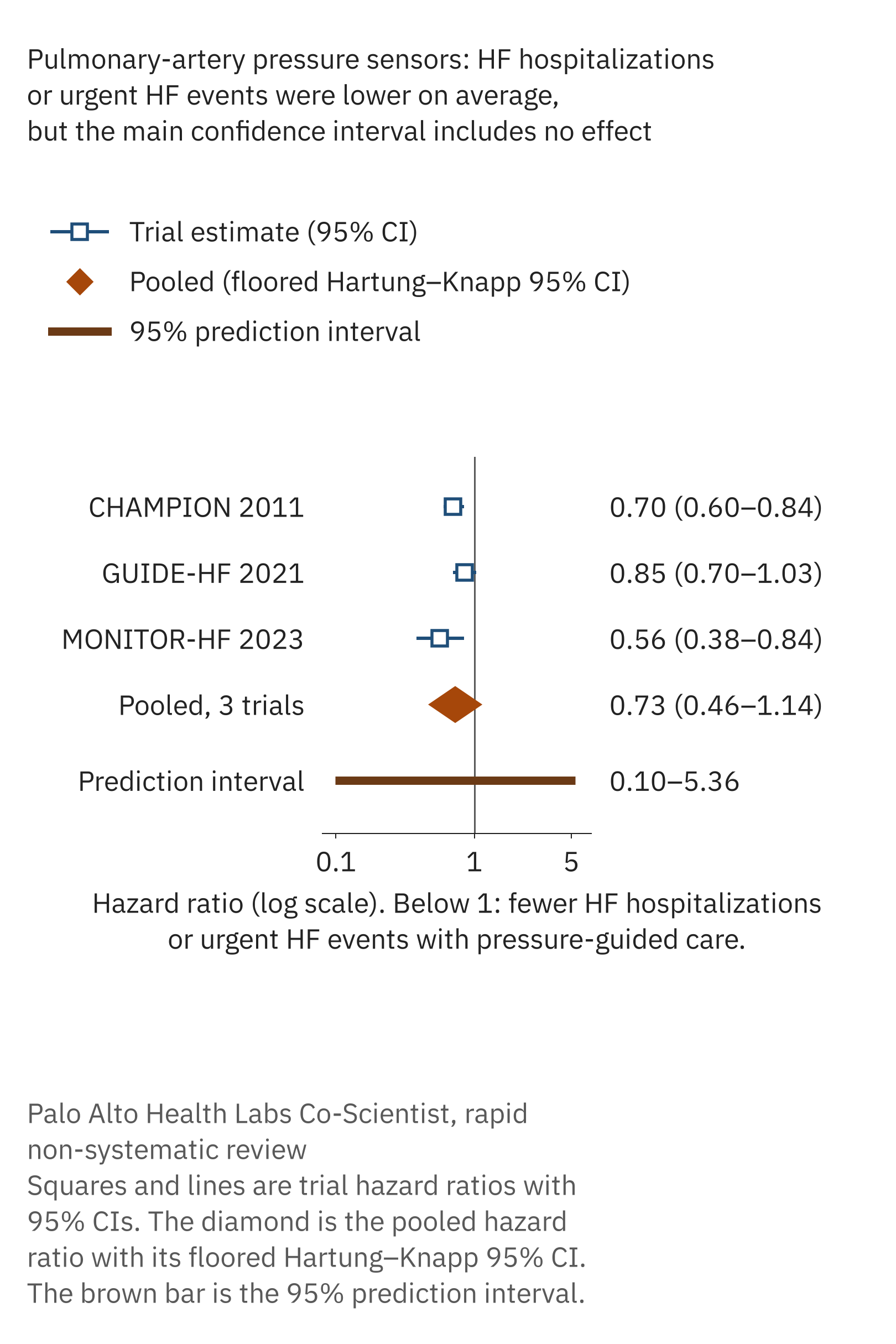
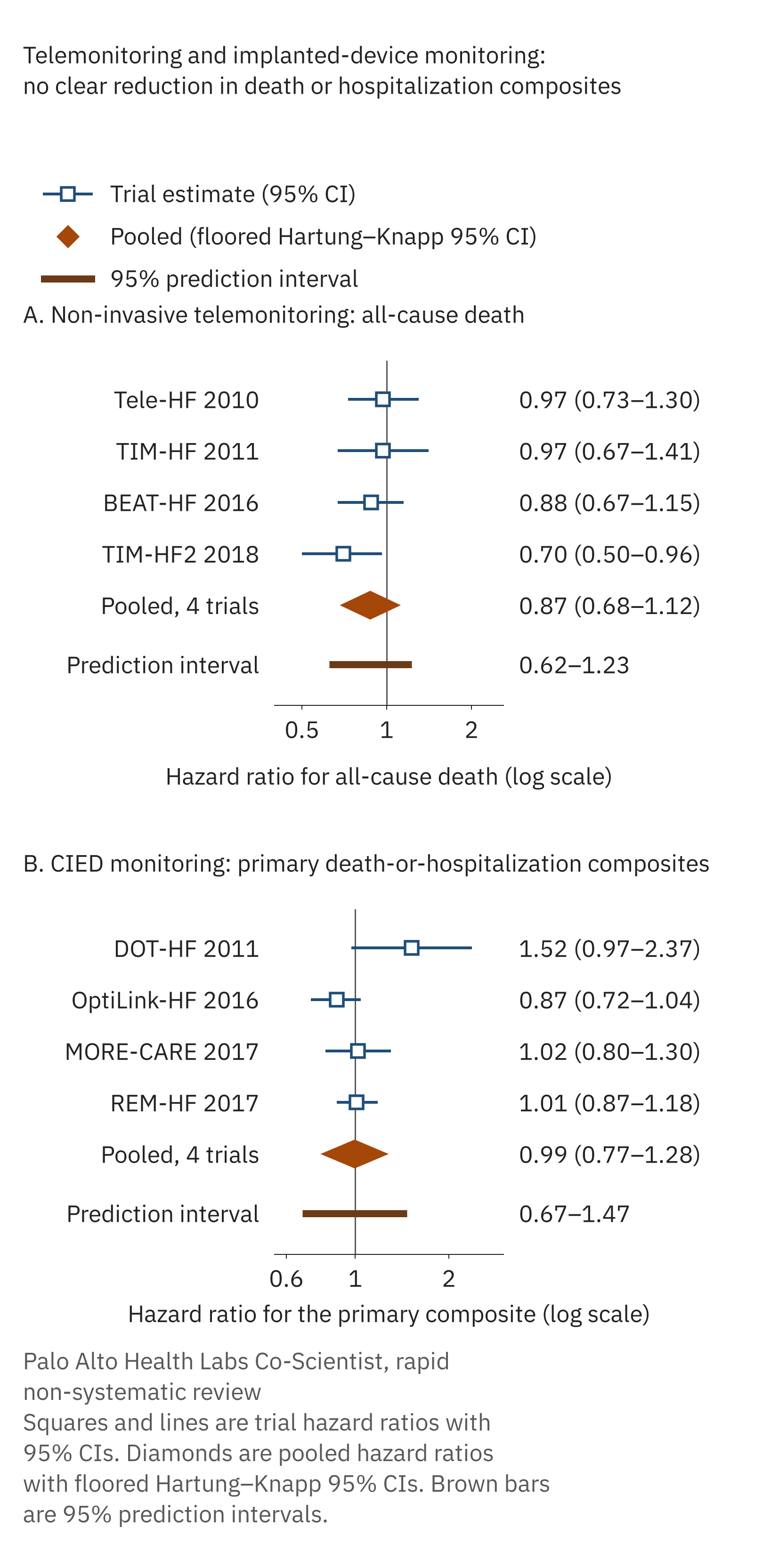
Key message: Remote monitoring of heart failure does not have a single answer. Across three randomized trials of pulmonary-artery pressure sensors, heart-failure hospitalizations or urgent heart-failure events were lower on average (hazard ratio 0.73), but the main floored Hartung-Knapp 95% confidence interval (0.46 to 1.14) included no effect; the Wald interval (0.60 to 0.88) did not. In four large non-invasive telemonitoring trials, all-cause death was not clearly reduced (0.87, 0.68 to 1.12). In four trials of implanted cardioverter-defibrillator or resynchronization-device monitoring with a heart-failure pathway, the trials' primary death-or-hospitalization composites showed no clear difference (0.99, 0.77 to 1.28).
Results
Pulmonary-artery pressure sensors: heart-failure hospitalizations or urgent events were lower on average, but the main interval includes no effect. Three randomized trials of a wireless pulmonary-artery pressure sensor versus usual care, or usual care without access to the pressure readings, were similar enough to pool on heart-failure hospitalizations or urgent heart-failure events. CHAMPION (2011) reported a 6-month primary hazard ratio of 0.70 (95% CI 0.60 to 0.84) for heart-failure-related hospitalizations (83 events in 270 patients in the treatment group, 120 events in 280 in the control group). GUIDE-HF (2021) did not reduce the cumulative incidence of heart-failure events in the overall analysis (0.85, 0.70 to 1.03; 497 vs 503 patients); the trial's own primary composite of all-cause death and total heart-failure events was 0.88 (0.74 to 1.05). MONITOR-HF (2023), in 176 vs 172 patients in the Netherlands, reported 117 vs 212 total heart-failure hospitalizations or urgent intravenous-diuretic visits over a mean 1.78 years (0.56, 0.38 to 0.84). All-cause death in MONITOR-HF was 42 vs 45 (0.96, 0.63 to 1.46) and was not pooled with the hospitalization estimates. CHAMPION and GUIDE-HF were single-blind (only patients were masked; GUIDE-HF investigators were aware of assignment) and MONITOR-HF was open-label, so this pool's outcome, which depends on clinicians' admission decisions, is the outcome in this review most exposed to performance bias.
Pooling these three hospitalization estimates with a random-effects model (REML) gave a hazard ratio of 0.727. The main 95% CI, a Hartung-Knapp interval with the max(1, q) floor, was 0.463 to 1.142 (q = 1.134, so the floor did not widen it). The Wald 95% CI was 0.599 to 0.882. Between-trial spread was moderate (tau 0.123, I² 53.4% [τ²-based 53.1%]). The 95% prediction interval, the range where a new similar trial would likely land, was very wide: 0.099 to 5.361. Dropping any one trial moved the pooled hazard ratio only between 0.675 and 0.767.
Two sensitivity analyses (chosen during extraction, not pre-registered) change how certain the reduction looks. Using CHAMPION's entire-follow-up estimate (mean 15 months; 153 vs 253 hospitalizations; 0.64, 0.55 to 0.75) instead of the 6-month primary gave 0.693 (floored Hartung-Knapp 0.417 to 1.153; Wald 0.550 to 0.874). Replacing GUIDE-HF's overall heart-failure-event estimate with its pre-COVID-19 impact analysis (0.76, 0.61 to 0.95) gave 0.703 (floored Hartung-Knapp 0.532 to 0.929; Wald 0.619 to 0.798; q = 0.871, so the floor was applied; tau 0). That last check is the only A-pool interval that excludes no effect; it is a sensitivity, not the main result. GUIDE-HF itself describes the pre-COVID-19 impact analysis as prespecified, and its abstract links it to a treatment interaction with the pandemic period (p for interaction 0.11); it covers only the pre-pandemic follow-up, not the full randomized follow-up.
Two earlier implantable hemodynamic-monitor trials could not be pooled: COMPASS-HF (2008; Chronicle sensor, 134 vs 140 of 274 patients) reported a nonsignificant 21% lower rate of heart-failure-related events (p = 0.33) without an extractable hazard ratio or confidence interval in the fetched abstract, and REDUCEhf (2011; 202 vs 198 patients) reported that the rate of heart-failure equivalents was not different between groups, again without an extractable interval.
Non-invasive telemonitoring: no clear reduction in all-cause death among four large trials. Fifty-three included trials used non-invasive telemonitoring (weight, blood pressure, symptoms, or wearable or app data reviewed so that care could be adjusted). Four large trials versus usual care published an all-cause-death hazard ratio and were pooled: Tele-HF (2010; 0.97, 0.73 to 1.30; 92 vs 94 deaths at 180 days in 826 vs 827 patients), TIM-HF (2011; 0.97, 0.67 to 1.41; 354 vs 356 patients), BEAT-HF (2016; unadjusted 180-day mortality 0.88, 0.67 to 1.15; 100 vs 114 deaths in 715 vs 722 patients), and TIM-HF2 (2018; 0.70, 0.50 to 0.96; full analysis set 765 vs 773). The pooled hazard ratio was 0.874 (floored Hartung-Knapp 95% CI 0.681 to 1.122; q = 0.862, so the floor was applied; unfloored 0.693 to 1.102). The Wald 95% CI was 0.750 to 1.019. Between-trial variance was estimated at zero (tau 0, I² 0%). The 95% prediction interval was 0.624 to 1.225. Leave-one-out pooled estimates ranged from 0.839 to 0.931; dropping TIM-HF2, the only one of the four whose interval excluded no effect, moved the pool to 0.931.
The other 49 telemonitoring trials were summarized narratively and were not pooled, because they were smaller, used a different comparator, reported a different outcome or time window, or lacked an extractable hazard ratio and confidence interval. Two recent results sit outside the mortality pool and should not be buried. HERMeS (2025) found that mobile-health telemonitoring plus structured video follow-up after a heart-failure discharge reduced cardiovascular death or a worsening heart-failure event at 6 months (43 of 255 vs 102 of 251; hazard ratio 0.35, 95% CI 0.24 to 0.50). That trial was funded by an unrestricted grant from Novartis; the same PubMed record also states "We declare no competing interests." Ribeiro 2025, a 127-patient trial in public hospitals in Brazil, reported fewer heart-failure rehospitalizations at 180 days with a nurse-led telephone programme (26% vs 46%; relative risk 0.56, p < 0.02) but did not report a 95% confidence interval in the fetched abstract.
Implanted-device monitoring with a heart-failure pathway: no clear difference in the hospitalization composite. Eleven trials evaluated remote monitoring of an ICD or CRT device with a pathway intended to adjust heart-failure care, not only technical follow-up. Four trials reported a primary time-to-event composite of death and heart-failure or cardiovascular hospitalization and were pooled: DOT-HF (2011; 1.52, 0.97 to 2.37; 48 [29%] vs 33 [20%] events), OptiLink-HF (2016; 0.87, 0.72 to 1.04; 227 [45.0%] vs 239 [48.1%] events among 1002 patients), MORE-CARE (2017; 1.02, 0.80 to 1.30; 437 vs 428 patients), and REM-HF (2017; 1.01, 0.87 to 1.18; 349 of 826 vs 347 of 824). The pooled hazard ratio was 0.995 (floored Hartung-Knapp 95% CI 0.772 to 1.281; q = 1.554, so the floor did not widen it; Wald 0.878 to 1.127). Between-trial spread was moderate (tau 0.064, I² 46.0% Q-based; 24.5% τ²-based). The 95% prediction interval was 0.675 to 1.465. Leave-one-out estimates ranged from 0.963 to 1.045.
IN-TIME (2014) was not entered in that pool because its primary outcome was a Packer composite (all-cause death, overnight heart-failure admission, NYHA class change, and patient global self-assessment), not a death-or-hospitalization hazard ratio. In 333 vs 331 patients, the composite worsened in 63 (18.9%) vs 90 (27.2%) (odds ratio 0.63, 95% CI 0.43 to 0.90), and 10 vs 27 patients died. The trial was funded by Biotronik SE & Co. KG. No death-only hazard ratio was given in the fetched abstract, and none was invented.
Figures
Summary table
| Analysis | Trials | Hazard ratio | Floored Hartung-Knapp 95% CI | Wald 95% CI | tau | I² (Q-based) [τ²-based] | q | 95% prediction interval |
|---|---|---|---|---|---|---|---|---|
| A. Pulmonary-artery pressure sensors, heart-failure hospitalizations or urgent heart-failure events (main) | 3 | 0.727 | 0.463 to 1.142 | 0.599 to 0.882 | 0.123 | 53.4% [53.1%] | 1.134 | 0.099 to 5.361 |
| A, sensitivity: CHAMPION entire follow-up | 3 | 0.693 | 0.417 to 1.153 | 0.550 to 0.874 | 0.165 | 68.7% [68.5%] | 0.991 | 0.052 to 9.155 |
| A, sensitivity: GUIDE-HF pre-COVID-19 heart-failure events | 3 | 0.703 | 0.532 to 0.929 | 0.619 to 0.798 | 0 | 0% | 0.871 | 0.309 to 1.601 |
| B. Non-invasive telemonitoring, all-cause death | 4 | 0.874 | 0.681 to 1.122 | 0.750 to 1.019 | 0 | 0% | 0.862 | 0.624 to 1.225 |
| C. CIED monitoring, the trials' primary death-or-hospitalization composites | 4 | 0.995 | 0.772 to 1.281 | 0.878 to 1.127 | 0.064 | 46.0% [24.5%] | 1.554 | 0.675 to 1.465 |
Hartung-Knapp intervals in the table use the max(1, q) floor, so they are never narrower than the Wald interval. For the main A and C analyses q was greater than 1, so the floor did not change the interval. For B and for the GUIDE-HF pre-COVID-19 sensitivity, q was less than 1 and the floor was applied. Unfloored intervals are in analysis/pool_results_v1c.md and analysis/pool_results_v1c.json.
Caveats
- The three sensor trials are not identical. The main A pool mixes CHAMPION's 6-month primary heart-failure-hospitalization estimate, GUIDE-HF's overall heart-failure-event incidence (which was not statistically significant), and MONITOR-HF's total hospitalizations plus urgent intravenous-diuretic visits. With only three trials, the Hartung-Knapp interval is much wider than the Wald interval, and the prediction interval is too wide to usefully forecast a new setting.
- Care teams were not masked. CHAMPION and GUIDE-HF were single-blind (patients were masked; in GUIDE-HF, investigators were aware of assignment), MONITOR-HF was open-label, and TIM-HF2 was unmasked, as each record states. The other pooled telemonitoring and implanted-device records do not describe masking in the fetched abstract; in these designs the monitoring data go to the care team, so clinicians could not be masked to the intervention. Hospital admission is a clinician decision, so unmasked care teams can shift admission thresholds (performance bias); all-cause death is not affected in that way.
- Composites and follow-up windows differ within pools. Pool C combines each trial's own primary composite: DOT-HF, all-cause mortality or heart-failure hospitalization; OptiLink-HF, all-cause death or cardiovascular hospitalization; MORE-CARE, death or cardiovascular or device-related hospitalization; REM-HF, death from any cause or unplanned cardiovascular hospitalization. Follow-up as reported: A, 6 months (CHAMPION primary), 12 months (GUIDE-HF primary endpoint) and a mean 1.78 years (MONITOR-HF); B, 180 days (Tele-HF and BEAT-HF), a median 26 months (TIM-HF) and up to 393 days (TIM-HF2); C, a mean 14.9 months (DOT-HF), an average 1.9 years (OptiLink-HF), a median 24 months (MORE-CARE) and a median 2.8 years (REM-HF). Hazard ratios over these windows were pooled because a published hazard ratio summarizes the relative event rate over each trial's follow-up rather than a risk at one landmark time; the differing composites and windows remain a limitation.
- Most telemonitoring trials were not pooled. The B mortality pool is four large usual-care trials with a published death hazard ratio, not a summary of all 53 telemonitoring trials. Results such as HERMeS and Ribeiro 2025 are reported narratively because the outcome, time window, or completeness of the interval did not match the pre-specified pool.
- Funders as stated in the PubMed records. CHAMPION, CardioMEMS; GUIDE-HF, Abbott; MONITOR-HF, the Dutch Ministry of Health, Health Care Institute (Zorginstituut) and Abbott Laboratories; Tele-HF, the National Heart, Lung, and Blood Institute and a National Institute on Aging K23 grant; TIM-HF2, the German Federal Ministry of Education and Research; IN-TIME, Biotronik SE & Co. KG; HERMeS, an unrestricted grant from Novartis (the same record states "We declare no competing interests"). The BEAT-HF record lists grants from the US National Institutes of Health and the Agency for Healthcare Research and Quality, and the REM-HF record lists a Department of Health (NIHR) grant. TIM-HF, DOT-HF, OptiLink-HF and MORE-CARE give no funding statement in the fetched record. The GUIDE-HF and MONITOR-HF records also declare author consulting or grants involving the sensor manufacturer. Many other included records have no funding or conflict statement in the fetched PubMed record. This is a standard caveat, not a judgment on any single trial.
- Endpoint choices can change the story. IN-TIME's Packer composite improved and raw deaths were 10 vs 27, but that trial was not pooled with the CIED hospitalization composites. BEAT-HF's primary 180-day all-cause readmission result (adjusted hazard ratio 1.03, 0.88 to 1.20) was not the estimate entered in the mortality pool.
- Abstract-level data. Most numbers come from PubMed abstracts. Open-access full text was read where it was needed to recover a hazard ratio or a table that the abstract omitted (Tele-HF, BEAT-HF, REM-HF, MONITOR-HF). REM-HF's death-only hazard ratio lived in a figure and was not extracted as text, so it was not used.
- AI did the screening and coding. One AI screener and extractor, with no human double-check. Screening and extraction were not validated and were not independent. Every pooled number is matched to a verbatim quote in the fetched source (self_check_v1f.md and sources_v2.csv).
- One database. Only PubMed was searched, on 23 November 2026, so trials indexed only elsewhere may have been missed. Landmark names were added as a separate query after earlier queries missed trials that used "telemedical" or "telemedicine" rather than "telemonitor."
- No protocol was registered, and no formal risk-of-bias tool was applied. This is a rapid non-systematic review.
Methods
Design. A rapid non-systematic review, prepared with the Palo Alto Health Labs Co-Scientist. No protocol was registered.
Search. PubMed through NCBI E-utilities, searched 23 November 2026 (America/Los_Angeles). Seven queries (work/Q1.txt to work/Q7.txt) returned 459, 328, 121, 41, 166, 70 and 368 records. After combining, there were 855 unique PMIDs: 851 PubmedArticle records and 4 PubmedBookArticle records (excluded as E1). Q6 was added because the original telemonitor* terms missed TIM-HF 2011 (which describes "telemedical" management). Q7 was added because those queries missed OptiLink-HF 2016 (indexed with telemedicine).
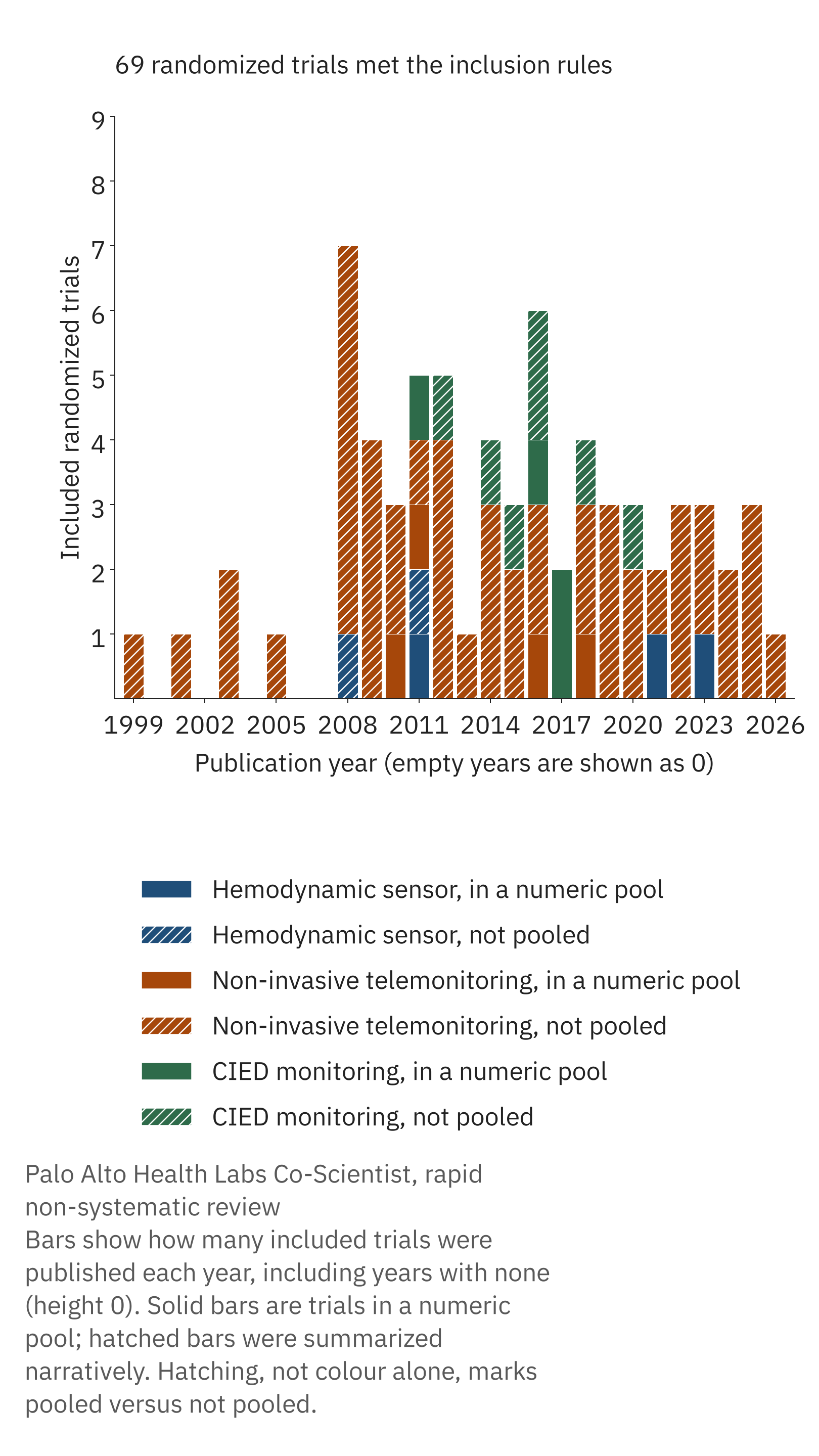
Eligibility (screening/criteria.md). Primary reports of randomized trials in adults with heart failure, comparing remote monitoring that transmits clinical or physiologic data and has a pathway for care to be adjusted, with usual care or the same care without that remote-monitoring component, and reporting all-cause death, heart-failure hospitalization, a composite of death and heart-failure hospitalization, or all-cause hospitalization. Modalities were pre-specified and not pooled together: A, invasive hemodynamic monitors (pulmonary-artery or left-atrial pressure); B, non-invasive telemonitoring, including interactive voice-response systems that collect weight or symptoms; C, ICD or CRT remote monitoring with a heart-failure management pathway, not solely technical device follow-up. Excluded: not a randomized trial, reviews, editorials, or book records (E1, 54); protocols or design papers without outcomes (E2, 94); secondary, subgroup, quality-of-life-only, economic, or IPD analyses of an already included trial (E3, 94); populations that were not heart failure (E4, 13); interventions without transmitted monitoring and a care-response pathway (E5, 333); comparators that were not usual care or no remote monitoring (E6, 3); and no relevant clinical outcome in the fetched record (E7, 195). Included: 69 trials (5 A, 53 B, 11 C). Every decision is in screening/screening_log.csv. Screening was done by a single AI screener and was not validated or independent.
DOI check. DOIs were taken only from each PubMed record's own PubmedData/ArticleIdList/ArticleId[@IdType='doi'], with ELocationID as fallback, never a recursive search that could pick up reference-list DOIs. Each DOI was checked against Crossref for title (similarity at least 0.9, including Crossref subtitle or the leading part of a title when Crossref omits a trial-name subtitle) and first-author surname (doi_check.csv). Of 69 included trials, 65 DOIs met both checks; 3 records had no DOI in PubMed and are cited by their PubMed URL; 1 DOI (SmartCare) is the record's own ArticleIdList DOI but Crossref lists the Italian title of the same article while PubMed lists the English translation, so it was not marked verified against title and, because a DOI that fails the check is fixed or dropped, it is cited by its PubMed URL instead.
Analysis. Effect measure: hazard ratio on the log scale, from the trial's published ratio and confidence interval. Random-effects model with REML between-trial variance. The main 95% CI is Hartung-Knapp with t on k−1 degrees of freedom and the max(1, q) floor, where q = Σ w_i (y_i − μ)² / (k − 1) and the standard error is multiplied by sqrt(max(1, q)), so the interval is never narrower than the Wald interval. The unfloored Hartung-Knapp interval, q, the Wald (z) 95% CI, tau, I² and a 95% prediction interval on t with k−2 degrees of freedom, using t(k−2)×sqrt(τ² + Wald SE²) with no floor, are reported alongside. I² is the Q-based (Q − df)/Q statistic; the τ²-based value is given in brackets where it differs. Pooling required at least 3 comparable trials sharing design class, comparator type, outcome construct and time-point window, and the same modality; otherwise the trial was summarized narratively. One row per independent trial. Code: analysis/meta_pools_v1c.py (Python 3.13.5, NumPy 2.5.5, SciPy 1.18.1); figures: figures_src/make_figures_v1e.py, which is figures_src/make_figures_v1c.py with only label text changed (the Fig 1 title and x-axis outcome wording and the Fig 2 panel B title); make_figures_v1c.py is figures_src/make_figures_v2.py with the prediction-interval values taken from the unfloored Wald-SE interval at full precision and the two-decimal labels rounded from that full-precision value (matplotlib 3.11.2, IBM Plex Sans). At a display width of 720 pixels, the capital-letter cap height of a 20-point capital H is 15.56 pixels (minimum 14). Every colour used in the figures has a contrast ratio of at least 3:1 on white.
References (included trials)
- Sideris 2026 (LINK-HF2). JACC Heart Fail 2026. PMID 42853165. https://doi.org/10.1016/j.jchf.2026.103422 (not pooled)
- Ribeiro 2025. J Am Heart Assoc 2025. PMID 40055862. https://doi.org/10.1161/JAHA.124.036241 (not pooled)
- Rustambekova 2025 (M-Cardio). Kardiologiia 2025. PMID 40627426. https://doi.org/10.18087/cardio.2025.6.n2928 (not pooled)
- Yun 2025 (HERMeS). Lancet Digit Health 2025. PMID 40374486. https://doi.org/10.1016/j.landig.2025.02.006 (not pooled)
- Achury-Saldaña 2024 (ControlVit). Comput Inform Nurs 2024. PMID 38657019. https://doi.org/10.1097/CIN.0000000000001115 (not pooled)
- Yoon 2024. J Med Internet Res 2024. PMID 38683665. https://doi.org/10.2196/52075 (not pooled)
- Angermann 2023 (E-INH). JACC Heart Fail 2023. PMID 36718715. https://doi.org/10.1016/j.jchf.2022.10.016 (not pooled)
- Brugts 2023 (MONITOR-HF). Lancet 2023. PMID 37220768. https://doi.org/10.1016/S0140-6736(23)00923-6
- Upshaw 2023 (SPAN-CHF III). Am Heart J 2023. PMID 36842486. https://doi.org/10.1016/j.ahj.2023.02.007 (not pooled)
- Asch 2022 (EMPOWER). JAMA Intern Med 2022. PMID 35532915. https://doi.org/10.1001/jamainternmed.2022.1383 (not pooled)
- Krzesiński 2022. Eur J Heart Fail 2022. PMID 34617373. https://doi.org/10.1002/ejhf.2358 (not pooled)
- Völler 2022 (CardioBBEAT). Telemed J E Health 2022. PMID 35325562. https://doi.org/10.1089/tmj.2022.0021 (not pooled)
- Lindenfeld 2021 (GUIDE-HF). Lancet 2021. PMID 34461042. https://doi.org/10.1016/S0140-6736(21)01754-2
- Radini 2021 (SmartCare). G Ital Cardiol (Rome) 2021. PMID 33687375. https://pubmed.ncbi.nlm.nih.gov/33687375/ (not pooled) (cited by PubMed URL: the record's DOI failed the Crossref title check because Crossref lists the Italian title — see doi_check.csv)
- Galinier 2020 (OSICAT). Eur J Heart Fail 2020. PMID 32438483. https://doi.org/10.1002/ejhf.1906 (not pooled)
- Jiménez-Marrero 2020. J Telemed Telecare 2020. PMID 30193564. https://doi.org/10.1177/1357633X18796439 (not pooled)
- Tajstra 2020 (RESULT). Europace 2020. PMID 32304216. https://doi.org/10.1093/europace/euaa072 (not pooled)
- Mizukawa 2019. Int Heart J 2019. PMID 31735786. https://doi.org/10.1536/ihj.19-313 (not pooled)
- Nouryan 2019. Telemed J E Health 2019. PMID 30036166. https://doi.org/10.1089/tmj.2018.0099 (not pooled)
- Pekmezaris 2019. Telemed J E Health 2019. PMID 30418101. https://doi.org/10.1089/tmj.2018.0219 (not pooled)
- Hansen 2018 (InContact). BMC Cardiovasc Disord 2018. PMID 29954340. https://doi.org/10.1186/s12872-018-0864-7 (not pooled)
- Koehler 2018 (TIM-HF2). Lancet 2018. PMID 30153985. https://doi.org/10.1016/S0140-6736(18)31880-4
- Kotooka 2018 (HOMES-HF). Heart Vessels 2018. PMID 29450689. https://doi.org/10.1007/s00380-018-1133-5 (not pooled)
- Olivari 2018. Int J Cardiol 2018. PMID 29506685. https://doi.org/10.1016/j.ijcard.2017.10.099 (not pooled)
- Boriani 2017 (MORE-CARE). Eur J Heart Fail 2017. PMID 27568392. https://doi.org/10.1002/ejhf.626
- Morgan 2017 (REM-HF). Eur Heart J 2017. PMID 28575235. https://doi.org/10.1093/eurheartj/ehx227
- Böhm 2016 (OptiLink-HF). Eur Heart J 2016. PMID 26984864. https://doi.org/10.1093/eurheartj/ehw099
- Comín-Colet 2016. J Telemed Telecare 2016. PMID 26350543. https://doi.org/10.1177/1357633X15600583 (not pooled)
- Domenichini 2016 (LIMIT-CHF). Europace 2016. PMID 26683599. https://doi.org/10.1093/europace/euv293 (not pooled)
- Kraai 2016 (IN TOUCH). Int J Med Inform 2016. PMID 26514079. https://doi.org/10.1016/j.ijmedinf.2015.10.001 (not pooled)
- Ong 2016 (BEAT-HF). JAMA Intern Med 2016. PMID 26857383. https://doi.org/10.1001/jamainternmed.2015.7712
- Sardu 2016 (TELECART). Int J Clin Pract 2016. PMID 27291327. https://doi.org/10.1111/ijcp.12823 (not pooled)
- Hägglund 2015. Scand Cardiovasc J 2015. PMID 25968968. https://doi.org/10.3109/14017431.2015.1035319 (not pooled)
- Lüthje 2015. Europace 2015. PMID 25983310. https://doi.org/10.1093/europace/euv039 (not pooled)
- Pedone 2015. J Am Geriatr Soc 2015. PMID 26031737. https://doi.org/10.1111/jgs.13432 (not pooled)
- Blum 2014. J Card Fail 2014. PMID 24769270. https://doi.org/10.1016/j.cardfail.2014.04.016 (not pooled)
- Hindricks 2014 (IN-TIME). Lancet 2014. PMID 25131977. https://doi.org/10.1016/S0140-6736(14)61176-4 (not pooled)
- Villani 2014. J Telemed Telecare 2014. PMID 25339632. https://doi.org/10.1177/1357633X14555644 (not pooled)
- Vuorinen 2014. J Med Internet Res 2014. PMID 25498992. https://doi.org/10.2196/jmir.3651 (not pooled)
- Madigan 2013. Home Health Care Serv Q 2013. PMID 23438509. https://doi.org/10.1080/01621424.2012.755144 (not pooled)
- Boyne 2012 (TEHAF). Eur J Heart Fail 2012. PMID 22588319. https://doi.org/10.1093/eurjhf/hfs058 (not pooled)
- Dendale 2012 (TEMA-HF). Eur J Heart Fail 2012. PMID 22045925. https://doi.org/10.1093/eurjhf/hfr144 (not pooled)
- Landolina 2012 (EVOLVO). Circulation 2012. PMID 22626743. https://doi.org/10.1161/CIRCULATIONAHA.111.088971 (not pooled)
- Lyngå 2012 (WISH). Eur J Heart Fail 2012. PMID 22371525. https://doi.org/10.1093/eurjhf/hfs023 (not pooled)
- Seto 2012. J Med Internet Res 2012. PMID 22356799. https://doi.org/10.2196/jmir.1909 (not pooled)
- Abraham 2011 (CHAMPION). Lancet 2011. PMID 21315441. https://doi.org/10.1016/S0140-6736(11)60101-3
- Adamson 2011 (REDUCEhf). Congest Heart Fail 2011. PMID 21906250. https://doi.org/10.1111/j.1751-7133.2011.00247.x (not pooled)
- Koehler 2011 (TIM-HF). Circulation 2011. PMID 21444883. https://doi.org/10.1161/CIRCULATIONAHA.111.018473
- Wade 2011. Am J Manag Care 2011. PMID 21504262. https://pubmed.ncbi.nlm.nih.gov/21504262/ (not pooled) (no DOI in the PubMed record; cited by PubMed URL)
- van Veldhuisen 2011 (DOT-HF). Circulation 2011. PMID 21931078. https://doi.org/10.1161/CIRCULATIONAHA.111.043042
- Chaudhry 2010 (Tele-HF). N Engl J Med 2010. PMID 21080835. https://doi.org/10.1056/NEJMoa1010029
- Tompkins 2010. J Healthc Manag 2010. PMID 21077581. https://pubmed.ncbi.nlm.nih.gov/21077581/ (not pooled) (no DOI in the PubMed record; cited by PubMed URL)
- Weintraub 2010 (SPAN-CHF II). J Card Fail 2010. PMID 20350694. https://doi.org/10.1016/j.cardfail.2009.12.012 (not pooled)
- Dar 2009 (Home-HF). Eur J Heart Fail 2009. PMID 19174529. https://doi.org/10.1093/eurjhf/hfn050 (not pooled)
- Giordano 2009. Int J Cardiol 2009. PMID 18222552. https://doi.org/10.1016/j.ijcard.2007.10.027 (not pooled)
- Mortara 2009 (HHH). Eur J Heart Fail 2009. PMID 19228800. https://doi.org/10.1093/eurjhf/hfp022 (not pooled)
- Scherr 2009. J Med Internet Res 2009. PMID 19687005. https://doi.org/10.2196/jmir.1252 (not pooled)
- Antonicelli 2008. J Telemed Telecare 2008. PMID 18776075. https://doi.org/10.1258/jtt.2008.071213 (not pooled)
- Balk 2008. Eur J Heart Fail 2008. PMID 18790668. https://doi.org/10.1016/j.ejheart.2008.08.003 (not pooled)
- Bourge 2008 (COMPASS-HF). J Am Coll Cardiol 2008. PMID 18342224. https://doi.org/10.1016/j.jacc.2007.10.061 (not pooled)
- Kashem 2008. J Card Fail 2008. PMID 18325458. https://doi.org/10.1016/j.cardfail.2007.10.014 (not pooled)
- Schwarz 2008. Prog Cardiovasc Nurs 2008. PMID 18326990. https://doi.org/10.1111/j.1751-7117.2008.06611.x (not pooled)
- Soran 2008 (HFHC/Soran). J Card Fail 2008. PMID 18995174. https://doi.org/10.1016/j.cardfail.2008.06.448 (not pooled)
- Woodend 2008. Heart Lung 2008. PMID 18206525. https://doi.org/10.1016/j.hrtlng.2007.04.004 (not pooled)
- Cleland 2005 (TEN-HMS). J Am Coll Cardiol 2005. PMID 15893183. https://doi.org/10.1016/j.jacc.2005.01.050 (not pooled)
- Benatar 2003. Arch Intern Med 2003. PMID 12578516. https://doi.org/10.1001/archinte.163.3.347 (not pooled)
- Goldberg 2003 (WHARF). Am Heart J 2003. PMID 14564327. https://doi.org/10.1016/S0002-8703(03)00393-4 (not pooled)
- Jerant 2001. Med Care 2001. PMID 11606877. https://doi.org/10.1097/00005650-200111000-00010 (not pooled)
- de Lusignan 1999. Stud Health Technol Inform 1999. PMID 10747531. https://pubmed.ncbi.nlm.nih.gov/10747531/ (not pooled) (no DOI in the PubMed record; cited by PubMed URL)
Corrections
None yet.
Found an error? Email hello@paloaltohealthlabs.com.
More from the Palo Alto Health Labs Co-Scientist · All posts
Have your own questions? Sign up for the Beta
Tell us the health AI or digital health question you would want the Co-Scientist to review, and join the beta list.
Scope it in 30 minutes
Book a scoping call and we'll name the smallest engagement that moves you forward. Most teams start with the fixed-scope Initial Audit.
Book a 30-min scoping callPrefer to write? Send a short note.