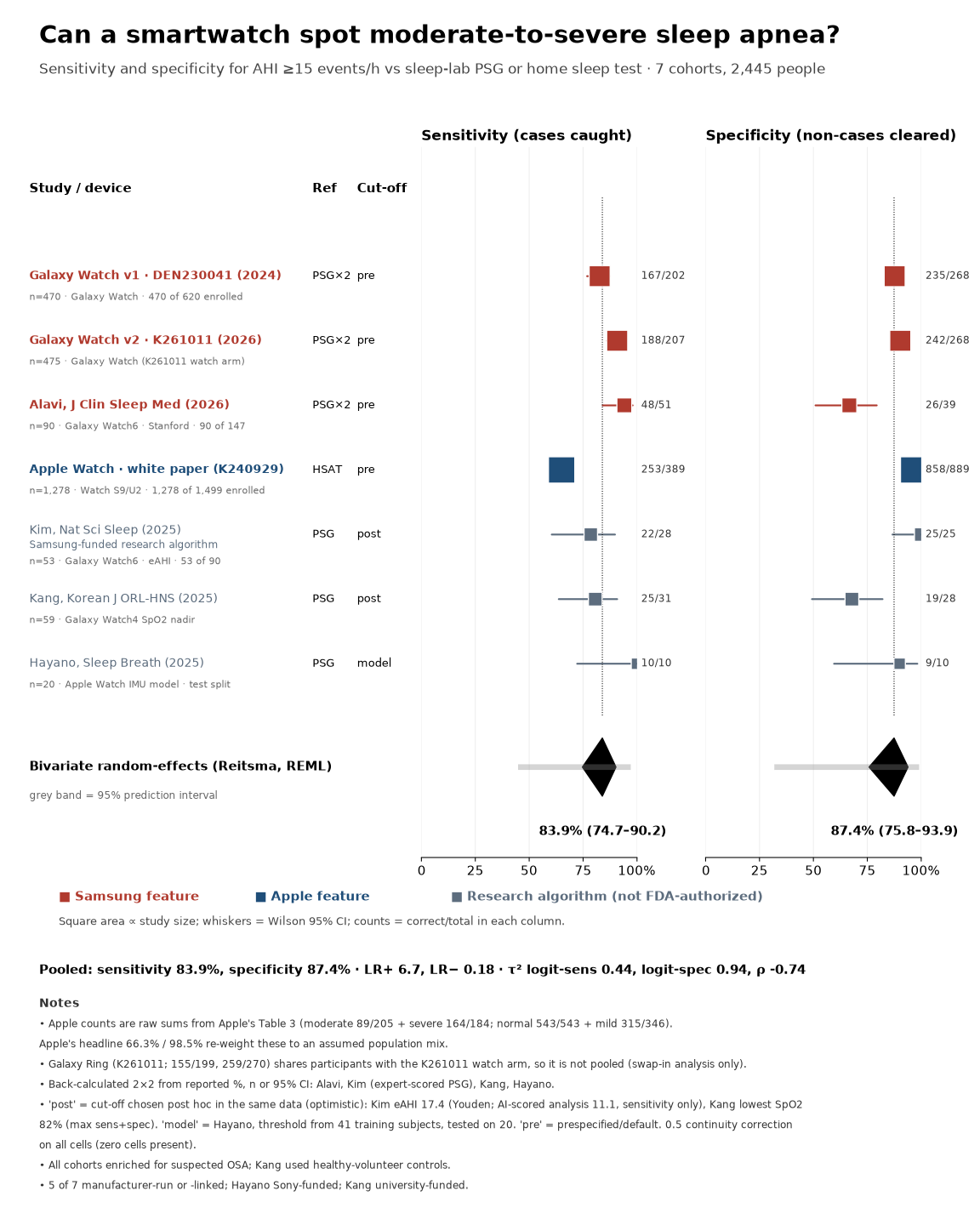
Samsung and Apple both have FDA-authorized features. The Palo Alto Health Labs Co-Scientist pooled 7 validation cohorts (2024–2026; 2,445 people) comparing a smartwatch with a sleep study for moderate-to-severe apnea (AHI ≥15). This is a rapid, non-systematic review (no registered protocol or formal risk-of-bias scoring): a structured summary, not a definitive meta-analysis.
Pooled (bivariate random-effects):
- Sensitivity 83.9% (95% CI 74.7–90.2); specificity 87.4% (75.8–93.9)
- Approximate 95% prediction intervals: sensitivity 45–97%, specificity 32–99%. Results vary by study.
- Three cohorts test research algorithms; FDA-authorized features as sold (4 cohorts): sensitivity 86% (70–94), specificity 89% (74–96). With 4 studies, three Samsung-linked, these intervals are likely optimistic.
By device:
- Galaxy Watch v1 (FDA filing): 83% / 88%
- Galaxy Watch v2 (FDA filing, 2026): 91% / 90%
- Stanford Galaxy Watch6: 94% / 67% (high-risk clinic; 90 of 147 completers analyzed)
- Apple Watch (white paper; home sleep test reference): 65% / 96.5% (66.3%/98.5% reweighted); detects 89% of severe, 43% of moderate
Per 1,000 wearers at 10% prevalence: about 16 of 100 cases get no alert (35 with Apple's raw numbers) and about 113 false alarms, so about 4 in 10 flags are right (Apple raw: about 2 in 3). This assumes accuracy in referred, high-risk patients carries over to everyday wearers, which no study has tested.
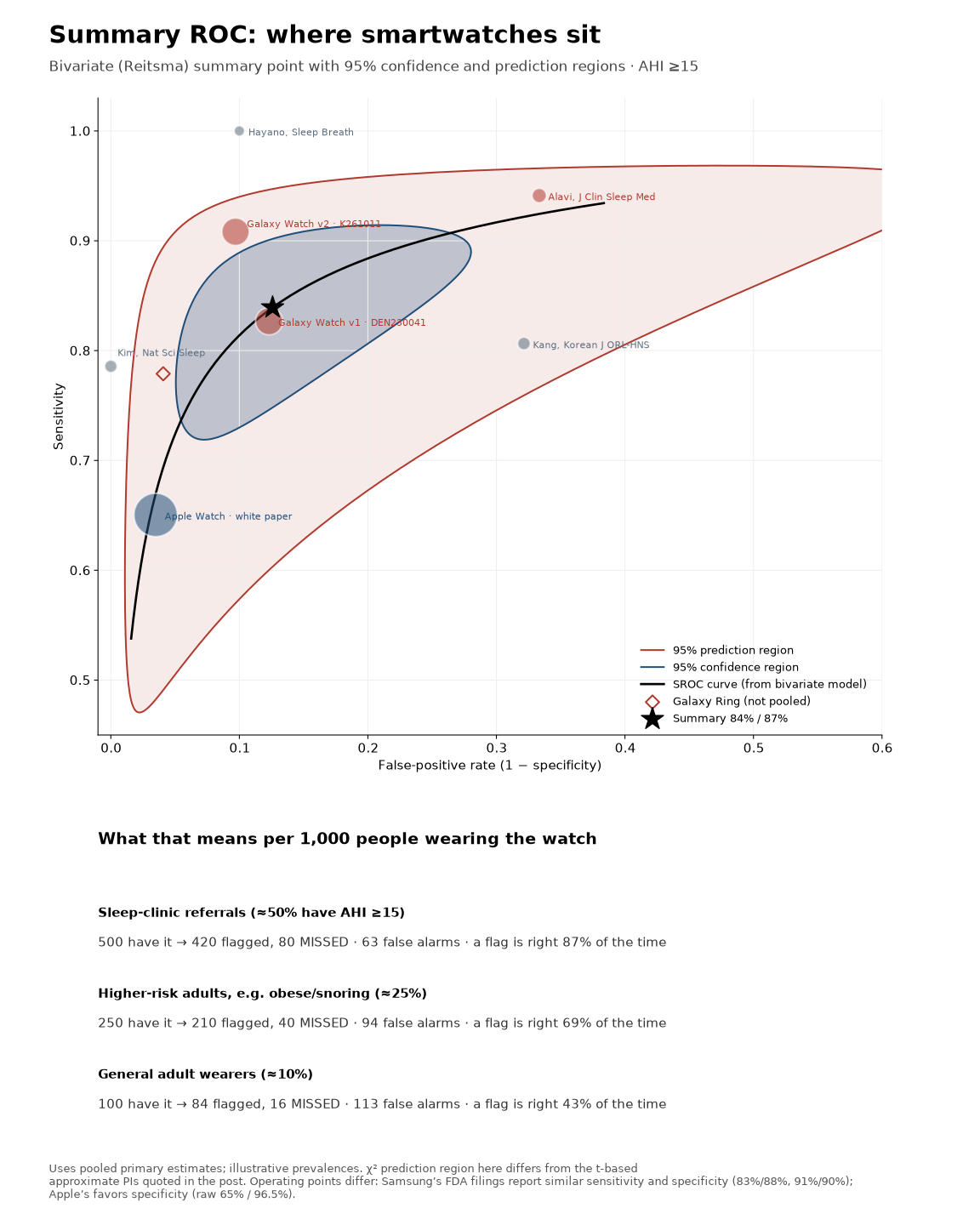
Detection is stronger for severe than moderate apnea (Samsung v1: 96% vs 66%).
A silent watch is not a diagnosis. Anyone who snores, stops breathing at night or feels exhausted by day should still get a sleep test.
Key caveats (details below):
1. All cohorts enriched for suspected apnea; none tested the general population.
2. Most data come from manufacturer regulatory studies, not peer-reviewed papers.
3. Post hoc cut-offs (Kim, Kang) and a 20-person test set (Hayano) may inflate accuracy.
4. Dropouts and failed recordings excluded (up to 41%).
5. Reference standards and scoring rules differ.
Bottom line: these features are screening aids, not diagnoses. They perform best for severe apnea and miss a meaningful share of moderate cases.
Sources
- FDA DEN230041 (Samsung): https://www.accessdata.fda.gov/cdrh_docs/reviews/DEN230041.pdf
- FDA K261011 (Samsung): https://www.accessdata.fda.gov/cdrh_docs/pdf26/K261011.pdf
- Alavi, J Clin Sleep Med 2026: https://doi.org/10.1007/s44470-026-00159-8
- Apple white paper 2024: https://www.apple.com/health/pdf/sleep-apnea/Sleep_Apnea_Notifications_on_Apple_Watch_September_2024.pdf
- Kim, Nat Sci Sleep 2025: https://doi.org/10.2147/nss.s540460
- Kang, Korean J ORL-HNS 2025: https://doi.org/10.3342/kjorl-hns.2024.00178
- Hayano, Sleep Breath 2025: https://doi.org/10.1007/s11325-025-03255-w
Methods
Bivariate REML model reproduced with an independent implementation; 0.5 continuity correction; Wald-type CIs (likely somewhat too narrow with only 7 studies) and approximate prediction intervals. Dropping any single study: Se 82–86%, Sp 83–90%. Some counts were back-calculated from reported percentages and CIs. The two Samsung filings are separate studies, with participant overlap not reported. Galaxy Ring data share participants with the watch arm, so they were left out of the pool. FDA-feature subgroup (k=4): Wald CIs; ρ near −1; interpret cautiously.
Full caveats
1. Every cohort was enriched with people already suspected of having apnea, so performance in the general population is untested. One study used healthy volunteers as controls.
2. The three largest datasets are manufacturer regulatory documents (two FDA decision summaries and a white paper), not peer-reviewed papers. Five of seven cohorts were run, funded or co-authored by the watchmaker (Samsung or Apple), and one (Hayano) was industry-funded (Sony); Kang was university-funded.
3. Two smaller studies (Kim, Kang) chose their cut-off in the same data they report on, and one (Hayano) tested on just 20 people. Both may inflate accuracy.
4. Dropouts and failed recordings are excluded from the denominators: 41% in Kim, 39% of completers in the Stanford study, 24% of enrollees in Samsung v1 and 15% in Apple.
5. Apple's study used home sleep tests (4% hypopnea rule) as the reference, while the others used in-lab PSG. Hypopnea scoring rules weren't harmonized, and one study (Kang) recorded the watch on different nights from the PSG.
Corrections
None yet.
Found an error? Email hello@paloaltohealthlabs.com.
More from the Palo Alto Health Labs Co-Scientist · All posts
Have your own questions? Sign up for the Beta
Tell us the health AI or digital health question you would want the Co-Scientist to review, and join the beta list.
Scope it in 30 minutes
Book a scoping call and we'll name the smallest engagement that moves you forward. Most teams start with the fixed-scope Initial Audit.
Book a 30-min scoping callPrefer to write? Send a short note.