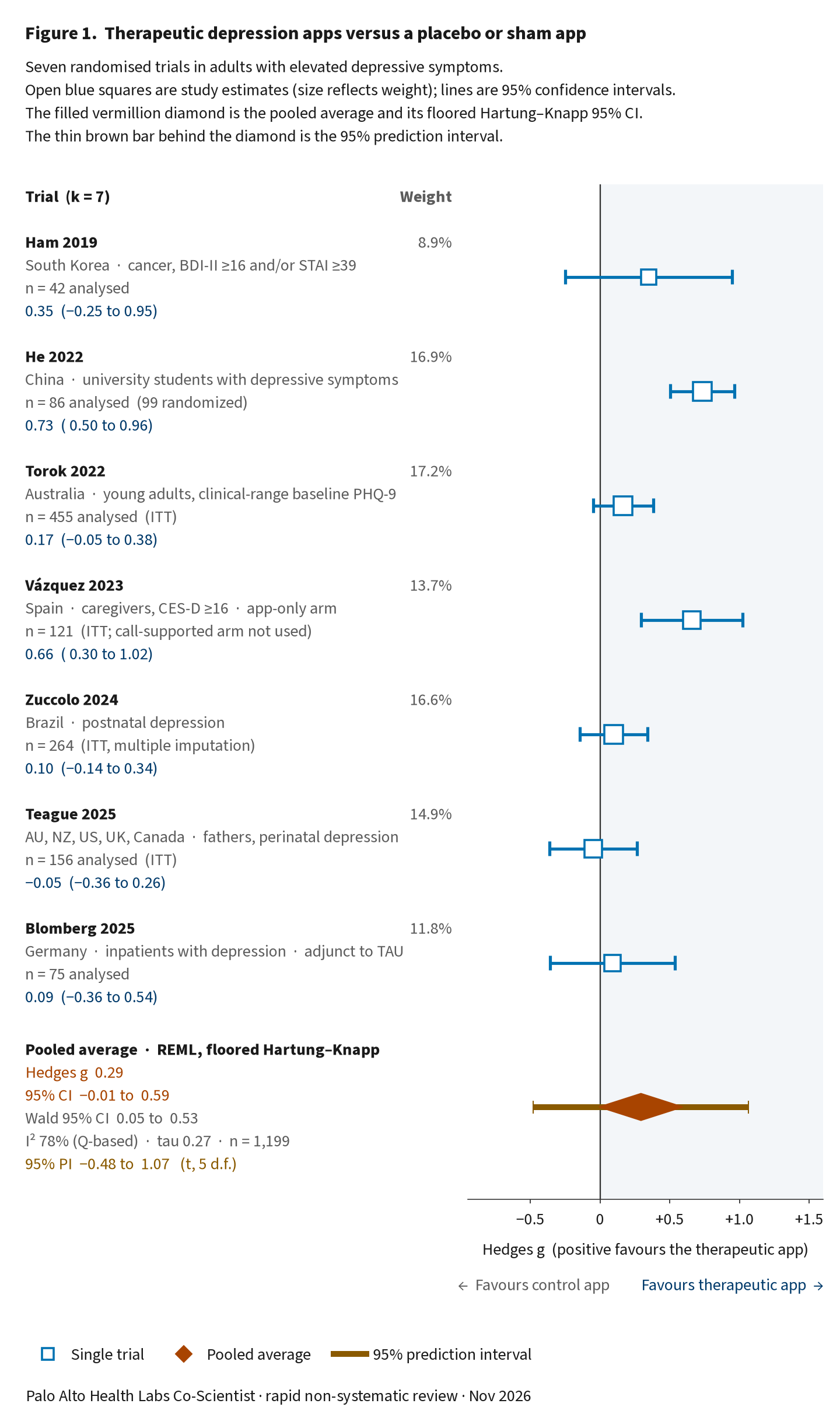
Key message: Against a placebo or sham app, it is uncertain whether a therapeutic depression app adds any benefit, and effects vary from trial to trial. In seven randomised trials of adults with elevated depressive symptoms, the average estimate was Hedges g = 0.29, and its main 95% confidence interval (floored Hartung–Knapp) ran from −0.01 to 0.59. That interval crosses 0, so it includes no difference.
This is a rapid non-systematic review of randomised trials that compared a therapeutic smartphone app with a placebo, sham, or attention-control app, and measured depressive symptoms at the end of the intervention.
What the primary trials show
The primary pool was specified in advance: adults with elevated depressive symptoms at baseline (a clinical or subclinical cutoff, or a sample whose baseline scores were already in the clinical range). Ten included trials met that definition. Seven had a verified post-treatment effect size and were pooled (n = 1,199): Ham 2019, He 2022, Torok 2022, Vázquez 2023, Zuccolo 2024, Teague 2025 and Blomberg 2025 (Table 1).
The random-effects average was Hedges g = 0.29, with a floored Hartung–Knapp 95% CI of −0.01 to 0.59 (q = 0.92). The interval crosses 0, so it includes no difference. The ordinary Wald interval (0.05 to 0.53) excluded zero, but the prespecified main interval did not. Heterogeneity was high (τ = 0.27, τ² = 0.075; I² = 78% Q-based, 76% metafor REML). The 95% prediction interval (−0.48 to 1.07) was wide enough that a new trial in this setting could find a benefit, no difference, or a small advantage for the control app.
Two trials had the largest effects. He 2022, a CBT chatbot trial in Chinese university students with depressive symptoms, gave g = 0.73 against a general-purpose chatbot. Vázquez 2023, an indicated-prevention CBT app for Spanish caregivers with CES-D ≥16, gave g = 0.66 against an information app. Vázquez 2023 had two therapeutic arms. One used the app alone. The other added weekly 30-minute staff-led group conference calls (groups of 5–6 caregivers, with positive and corrective feedback) that the control group did not receive. Only the app-only arm is used here, because the call-supported contrast is not app versus placebo app. Combining both arms, as in earlier versions, gives g = 0.99 for this trial and a pooled g = 0.34 (floored Hartung–Knapp 95% CI −0.03 to 0.71). That interval also crosses 0 (Table 2).
The other five primary trials were closer to zero:
- Torok 2022: a suicide-prevention app for young adults with a clinical-range baseline PHQ-9, g = 0.17
- Ham 2019: a CBT app for people with cancer, g = 0.35, n = 42
- Zuccolo 2024: a postnatal CBT app, g = 0.10
- Blomberg 2025: an inpatient approach-avoidance training app against a sham, g = 0.09
- Teague 2025: a perinatal chatbot for fathers, g = −0.05, slightly favouring the mood-monitoring control
A post-hoc leave-out analysis dropped the two trials with the largest effects, He 2022 and Vázquez 2023 (k = 5, n = 992). It gave a smaller average, g = 0.11 (floored Hartung–Knapp 95% CI −0.08 to 0.30; q = 0.47; Wald 95% CI −0.02 to 0.24; τ = 0; I² = 0%). That interval still included no difference. The two trials were chosen for exclusion because their effects were largest, so the heterogeneity disappearing is partly a result of that choice, by construction.
Table 1. The seven pooled primary trials. Brand names are omitted. "Analysed n" is the n behind the effect size used. All outcomes are self-report symptom scales.
| Trial | Population | Control app and how it was matched | Scale; metric entering the pool | Analysed n (app vs control) | Attrition and missing data | g (95% CI) |
|---|---|---|---|---|---|---|
| Ham 2019 | South Korea; people with cancer, BDI-II ≥16 and/or STAI ≥39 | Information-provision attention-control app (3-arm trial; waitlist arm not used) | BDI-II; post-score SMD | 21 vs 21 | 17 of 80 randomised across the three arms dropped out; completers analysed | 0.35 (−0.25 to 0.95) |
| He 2022 | China; university students with depressive symptoms | General-purpose chatbot, not designed as a therapy (e-book arm not used) | PHQ-9; multiple-imputation mean difference divided by baseline pooled SD | 45 vs 41 | Dropout at 1 week 4/49 (8%) vs 9/50 (18%); ITT with multiple imputation | 0.73 (0.50 to 0.96) |
| Torok 2022 | Australia; young adults with recent suicidal ideation, baseline PHQ-9 about 17 | Attention-matched app with the same look, giving non-therapeutic health and lifestyle information | PHQ-9 (secondary outcome); ITT mixed-model change difference divided by baseline pooled SD | 228 vs 227 (ITT) | Final (3-month) survey not completed by 110/228 vs 91/227; post-intervention completion not separately extracted; ITT mixed models | 0.17 (−0.05 to 0.38) |
| Vázquez 2023 | Spain; caregivers with CES-D ≥16, no current or past major depression | Five-module information app on caregiving, depression and maintaining mental health | CES-D; post-score SMD (ITT, multiple imputation); app-only arm | 58 vs 63 | Dropout 7/58 (app-only) vs 7/63 (control); 1/54 in the unused call-supported arm; ITT with multiple imputation | 0.66 (0.30 to 1.02) |
| Zuccolo 2024 | Brazil; women with postnatal depression | Psychoeducation app; participants were told both apps could help | EPDS; post-score SMD from ITT marginal means | 132 vs 132 (ITT; 215 gave primary-outcome data) | Dropout 18.6% at post-treatment; ITT with chained-equation multiple imputation | 0.10 (−0.14 to 0.34) |
| Teague 2025 | Fathers in AU, NZ, US, UK and Canada with moderate or greater perinatal depressive symptoms | Mood-tracking attention-control app | EPDS; reported ITT between-group effect size (not a post-score SMD) | 75 vs 81 (ITT) | Post-intervention data from 45/75 vs 46/81; ITT with multiple imputation (50 imputations) | −0.05 (−0.36 to 0.26) |
| Blomberg 2025 | Germany; inpatients with depression; adjunct to inpatient treatment as usual | Sham training app, same dose and duration | BDI-II; reported model-based d (sign flipped), Hedges correction applied | 38 vs 37 | Paper reports dropout as low and similar between arms; mixed models on all randomised; exact end-of-training completion not extracted | 0.09 (−0.36 to 0.54) |
Control apps differ in how closely they match the therapeutic app. Mood-monitoring and psychoeducation controls may be partly active, which would push estimates toward the null. A general-purpose chatbot may not match the expectancy of a therapy chatbot, which could push estimates away from the null.
Figure 1. Post-treatment depressive symptom effects (Hedges g) in the primary pool of seven trials. Each trial is labelled with its population, analysed n, effect with 95% CI, and REML weight. Vázquez 2023 is the app-only arm; its call-supported arm is not used. Open blue squares are single trials, with size reflecting weight. The filled vermillion diamond is the random-effects pooled estimate and its floored Hartung–Knapp 95% CI. The thin brown bar behind the diamond is the 95% prediction interval. Positive values favour the therapeutic app.
Primary-eligible trials that could not be pooled
Three trials met the primary definition but had no verified post-treatment SMD. Leaving them out could bias the pool in either direction.
- Arean 2016 (adults with PHQ-9 ≥5, health-tips control app). The paper reported only mixed-model coefficients at week 4: PHQ-9 B = −0.52 (SE 0.67, p = .44) for a cognitive-training app and B = −0.60 (SE 0.62, p = .34) for a problem-solving app, each against the control. Both are slightly lower symptom scores in the therapeutic arms, and neither is statistically significant.
- Bovy 2022 (dysphoric adults, BDI-II ≥13, sham memory-training control). The paper reported no transfer of training to depressive symptoms. A three-group test (active training, sham training and a no-training arm) found no time × condition effect on the BDI-II (F(2, 92) = 0.932, p = 0.397), and an exploratory test that combined both training arms against no training was also not significant (p = 0.243). No active-versus-sham comparison or post-treatment means were reported, so the direction for this contrast is unknown.
- Dixit 2025 (diagnosed postpartum depression, EPDS 13–19, sham app with the same look). The paper reported only responder rates: a ≥4-point EPDS improvement in 82/95 (86.3%) versus 11/46 (23.9%), p < .0001. This strongly favours the therapeutic app. The trial was funded by the app's developer, and the authors are its employees; the paper states that employees were not involved in conducting the study, apart from one author who served as research coordinator.
Sensitivity and secondary pools
Table 2 reports every pool with the floored Hartung–Knapp 95% CI (the main interval), q, the Wald 95% CI, τ, τ², I² (both definitions) and the 95% prediction interval. All intervals were computed in Python and cross-checked in R/metafor.
Table 2. All pools. I² (Q) is the Higgins value based on the fixed-effect Q statistic. I² (REML) is metafor's default, based on the REML τ². PI is the 95% prediction interval on t with k−2 degrees of freedom.
| Pool | k | n | g | Floored HK 95% CI | q | Wald 95% CI | τ | τ² | I² (Q) | I² (REML) | 95% PI |
|---|---|---|---|---|---|---|---|---|---|---|---|
| Primary (prespecified) | 7 | 1,199 | 0.29 | −0.01 to 0.59 | 0.92 | 0.05 to 0.53 | 0.27 | 0.075 | 78% | 76% | −0.48 to 1.07 |
| Primary, Vázquez arms combined | 7 | 1,253 | 0.34 | −0.03 to 0.71 | 0.96 | 0.05 to 0.64 | 0.36 | 0.130 | 85% | 85% | −0.66 to 1.35 |
| Primary, post-hoc leave-out of He and Vázquez | 5 | 992 | 0.11 | −0.08 to 0.30 | 0.47 | −0.02 to 0.24 | 0 | 0 | 0% | 0% | −0.11 to 0.32 |
| (a) All adults | 18 | 5,561 | 0.20 | 0.07 to 0.33 | 0.97 | 0.08 to 0.32 | 0.21 | 0.044 | 73% | 79% | −0.26 to 0.66 |
| (b) Perinatal | 3 | 476 | 0.10 | −0.40 to 0.59 | 1.57 | −0.08 to 0.28 | <0.01 | <0.0001 | 36% | 0% | −1.07 to 1.26 |
| (c) Primary without the inpatient adjunct trial | 6 | 1,124 | 0.32 | −0.03 to 0.67 | 0.93 | 0.05 to 0.59 | 0.29 | 0.085 | 81% | 80% | −0.57 to 1.22 |
The all-adults pool (a) includes every eligible adult trial with a verified effect size, including prevention programmes and unselected or mixed-entry samples. Its average was smaller than the primary pool's, g = 0.20, and its floored Hartung–Knapp 95% CI (0.07 to 0.33) excludes zero. Its prediction interval (−0.26 to 0.66) still includes no benefit. Several large unselected or prevention trials sat near zero, including Fiol-DeRoque 2021 (healthcare workers, g = 0.00) and Toh 2022 (a student stress-coping programme, g = 0.00). Deady 2022, a workplace prevention trial that excluded people with higher PHQ-9 scores, contributed a small positive effect (g = 0.15).
The perinatal pool (b) had three trials with usable numbers: Zuccolo 2024, Teague 2025, and Bear 2022, which enrolled unselected new mothers. Its average was g = 0.10 (floored Hartung–Knapp 95% CI −0.40 to 0.59). A fourth perinatal trial (Dixit 2025, above) reported large responder-rate differences but no post-treatment means, so it could not enter the SMD pool.
Pool (c) dropped the one inpatient adjunct trial (Blomberg 2025) and did not change the conclusion: g = 0.32 (floored Hartung–Knapp 95% CI −0.03 to 0.67).
Further checks, all post hoc, are in work/pool_metafor_v3_out.txt:
- Post-score SMD trials only (Ham, Vázquez, Zuccolo; k = 3): g = 0.35 (floored Hartung–Knapp 95% CI −0.47 to 1.17).
- Change or adjusted metrics only (He, Torok, Teague, Blomberg; k = 4): g = 0.25 (−0.32 to 0.83).
- Teague 2025 as the completer post-score g = −0.17 (the value in the preliminary pool; see Methods): primary g = 0.28 (−0.03 to 0.60).
- All-adults pool with alternative SEs for Fiol-DeRoque and Deady (see Caveats): g = 0.201 (0.07 to 0.33), against 0.199 (0.07 to 0.33).
How wide the evidence is
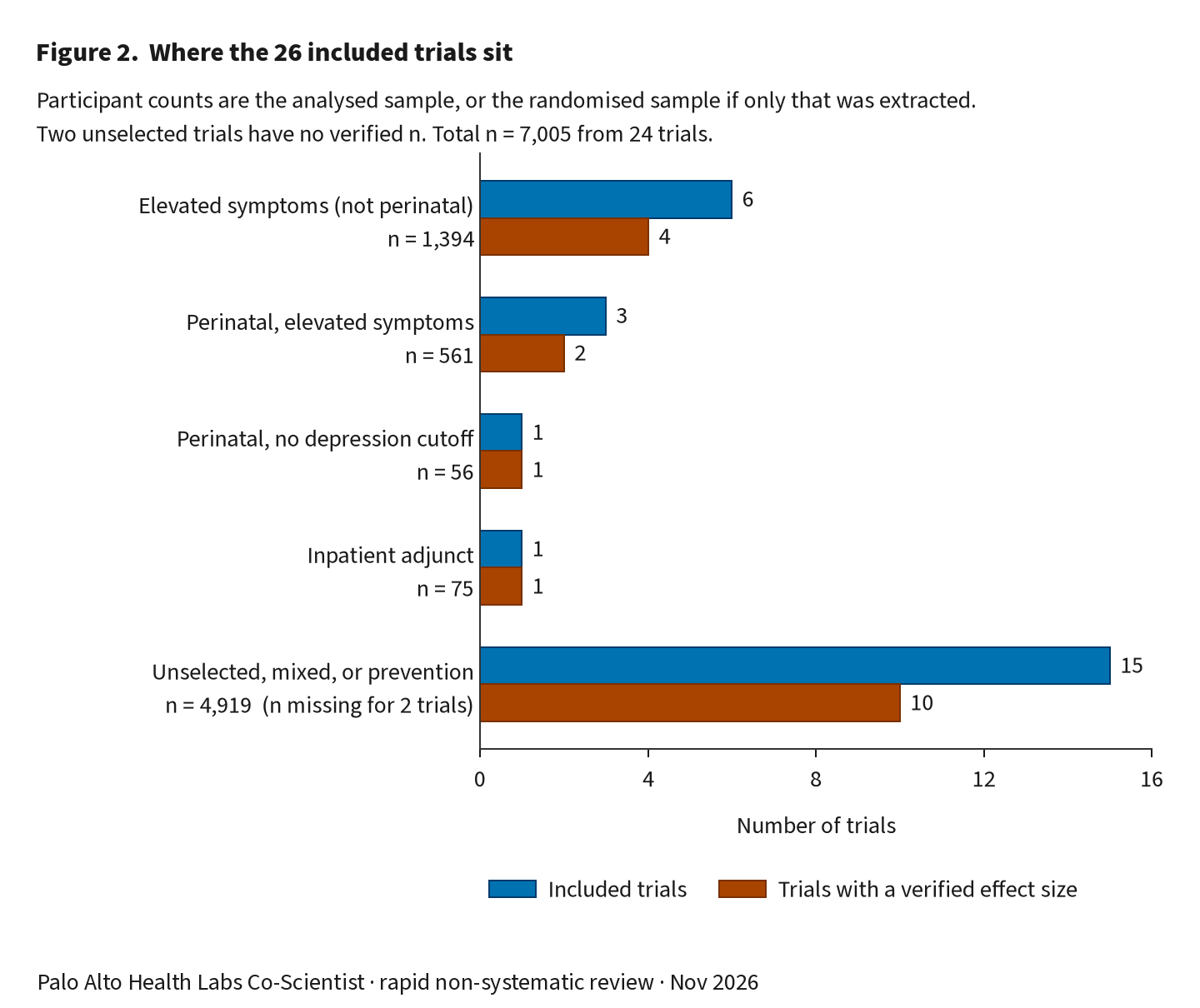
Twenty-six randomised trials met the inclusion rule: a therapeutic smartphone app versus a placebo, sham, or attention-control app, with depressive symptoms as an outcome in adults. Eighteen of the 26 had a verified post-treatment effect size. The other eight were kept in the evidence count but left out of the numeric pools. Some reported only responder rates or mixed-model coefficients that could not be turned into a transparent SMD, and a few still lack open full text.
Figure 2. Number of included trials, and the subset with a verified effect size, by population group, with participant counts. Counts are the analysed n behind each effect size, or the randomised n if only that was extracted. For Vázquez 2023, the count covers the app-only and control arms. The primary pool is the elevated-symptom groups, including perinatal elevated and the inpatient adjunct trial. Two unselected trials have no verified n; the other 24 contribute 7,005 participants.
How this compares with earlier meta-analyses
Placebo-app contrasts are a stricter test than the waitlist comparisons that often produce larger-looking effects for mental health apps. Two earlier meta-analyses by Linardon and colleagues reported placebo-control subgroups:
- Linardon 2019, Table 1, depressive symptoms, control condition type: "Attentional/placebo control 11 0.12 (0.01-0.23)*". That is 11 comparisons, g = 0.12, 95% CI 0.01 to 0.23, I² 6%.
- Linardon 2024, Table 2 ("Subgroup analyses on all available trials"), depressive symptoms, control group: "Placebo | 49 | 0.19 (0.11‐0.27) | 70%". That is 49 comparisons, g = 0.19, 95% CI 0.11 to 0.27, I² 70%. Its text states: "Effect sizes for depression were significantly larger when trials used an inactive control group (relative to placebo or care as usual)". Its supplement defines placebo controls broadly, including "ecological momentary assessments" and "online training programs".
The present estimates are compatible with those small effects. The primary pool (g = 0.29, −0.01 to 0.59) and the all-adults pool (g = 0.20, 0.07 to 0.33) both overlap the earlier intervals.
The trial sets overlap only partly:
- Linardon 2019: 3 of the 26 trials here appear in its reference list (Arean 2016, Howells 2016 and Flett 2019). None of them is in the numeric pools here.
- Linardon 2024: a first-author-and-year match against its supplementary study table found 16 of the 26 trials here:
- Arean, Howells, Hur, Flett, Ham, Fuller-Tyszkiewicz, Fiol-DeRoque, Luo, Bear, Comtois, Deady, He, Keng, Laird, Toh and Torok
- 15 of them are coded there with a placebo control
- 12 are in the 18-trial pool here, including 3 of the 7 primary trials (Ham, He, Torok)
- In neither review: the other 10 trials, mostly published from 2023 onwards (Bovy, Vázquez, Zion, Kim, Stiles-Shields, Zuccolo, Dixit, Teague, Blomberg, Varker).
Results here are therefore not independent of those reviews, but they add newer trials.
Risk of bias
No formal risk-of-bias tool, such as RoB 2, was applied. This is a rapid review. The main domains for the seven primary trials, taken from the papers, are:
- Blinding of participants. Blinding relies on the control app looking credible.
- Torok 2022 was described as double-blind, with participants and chief investigators masked.
- He 2022 was single-blind, with allocation masked from participants, investigators and analysts.
- Blomberg 2025 blinded participants but not study personnel.
- Zuccolo 2024 told participants that both apps could help, and its outcome interviewers were unaware of allocation.
- Ham 2019 did not tell participants which treatment they were receiving or which groups were being compared.
- Vázquez 2023 and Teague 2025 did not report participant blinding. Vázquez 2023's diagnostic interviewers were unaware of allocation, but its symptom outcome (CES-D) was self-administered in the app.
- None of the seven reported a formal test of whether blinding succeeded.
- Outcome measurement. Every primary outcome was a self-report symptom scale (BDI-II, PHQ-9, CES-D or EPDS). Any unblinding can therefore become detection bias.
- Attrition and missing data. Attrition differed widely:
- Low: Vázquez 2023 lost 8.6% across its three arms, and Blomberg 2025 reported low dropout.
- High: Teague 2025 had post-intervention data from 91 of 156 fathers, and Torok 2022's final survey was missed by 110/228 and 91/227.
- Unequal between arms: He 2022 lost 8% of the app arm and 18% of the control arm by the post-treatment assessment.
- Imputation and models: five trials used multiple imputation or mixed models on all randomised participants. Ham 2019 analysed completers only.
- Conflicts of interest. Developer or commercial interests were declared in some trials that met the primary definition: Arean 2016, Zuccolo 2024 (one author) and Dixit 2025. Arean and Dixit are not pooled.
Caveats
Effects in the primary pool disagree more than chance would suggest. The two trials with the largest effects account for much of the average. Leaving them out reduces the estimate to g = 0.11 (floored Hartung–Knapp 95% CI −0.08 to 0.30), but that leave-out was chosen after seeing the effects.
The Vázquez 2023 call-supported arm is excluded from the primary contrast, and the combined-arm version is reported as a sensitivity analysis (Table 2).
Effect metrics were mixed. Only 3 of the 7 primary trials contributed a Hedges g from post-treatment means and SDs (Ham 2019, Vázquez 2023, Zuccolo 2024). In the 18-trial pool, 11 of 18 did. The other entries used different metrics:
- He 2022: a multiple-imputation (ANCOVA-adjusted) mean difference divided by the baseline pooled SD
- Torok 2022: an ITT linear mixed-model change difference converted with the baseline SD
- Teague 2025: the reported ITT between-group effect size
- Blomberg 2025: the reported model-based d, sign-flipped so that positive favours the app
- Varker 2025 (pool a only): the reported ITT Cohen d, sign-flipped
- Fiol-DeRoque 2021 (pool a only): the reported ANCOVA-based standardized mean difference (SE 0.038, versus about 0.091 if computed from post-scores)
- Deady 2022 (pool a only): the reported Cohen d, entered with a theoretical SE of 0.042 rather than the 0.061 implied by the trial's own confidence interval
Hedges' small-sample correction (J) was applied to every reported Cohen d. SMDs based on change scores, adjusted means and post scores are standardised differently and are not strictly interchangeable.
Several controls are information-matched or time-matched apps rather than a tightly designed sham. A few are social-media or tweet-based programmes on a consumer platform, and one (Keng 2022, pool a) is a commercial cognitive-games app. In Comtois 2022 (pool a), one of the three combined therapeutic arms is described in the paper as a "chat and positive psychology" app, so that contrast may include some interpersonal contact.
Three older placebo-app trials identified from landmark reviews still have no verified post-treatment numbers, because the full text was not retrieved.
The search was rapid and not fully systematic. A broad OpenAlex query could not be paged to completion, and some papers were added from landmark recall rather than from the database strings alone.
Small-study effects and publication bias. With k = 7, fewer than 10 trials, a funnel plot or Egger test on the primary pool would not be informative, so small-study effects could not be assessed there. The protocol allowed a formal test when k ≥ 10, so the all-adults pool (k = 18) was tested as an exploratory check. None of the three tests found clear funnel asymmetry:
- Random-effects Egger-type regression on the SE: z = 0.95, p = 0.34
- Classical Egger regression: t(16) = 1.71, p = 0.11
- Rank correlation: Kendall's τ = 0.12, p = 0.50
These tests have little power with this much heterogeneity (I² 73–79%) and with mixed populations and metrics, and heterogeneity itself can create or hide asymmetry. Publication bias therefore cannot be ruled out. No funnel plot was drawn.
Methods
This work is a rapid non-systematic review. The analysis protocol (v0.2, work/protocol.md) prespecified the primary and sensitivity pools and the analysis rules before the confirmatory pool was run. A preliminary pool had been run before v0.2 was written; it is described below under "Preliminary pool".
Question. In adults, do smartphone apps aimed at depressive symptoms reduce post-treatment depressive symptom scores more than a placebo, sham, or attention-control app (Hedges g, with a positive value favouring the therapeutic app)?
Eligibility.
- Design and population. Parallel or factorial randomised trials in adults, or in majority-adult mixed samples. Ham 2019 enrolled ages 16–65 (mostly adults) and was included on that majority-adult basis.
- Intervention. A smartphone app intended to reduce depressive symptoms, or a transdiagnostic mental-health app with depressive symptoms as a pre-specified outcome.
- Comparator. A placebo, sham, or attention-control app: matched, or intended to be matched, for engagement, time, attention, or expectancy, without the putative therapeutic ingredient. Waitlist, usual care, informational websites or PDFs that are not apps, and another therapeutic app were not eligible.
- Outcome. A depressive symptom score at the end of the intervention.
- Multi-arm trials. Trials that shared one control app contributed a single combined contrast of their eligible app arms. The protocol excludes blended programmes in which the contrast is not the app itself. For that reason, the Vázquez 2023 arm that added staff-led group conference calls is not part of the primary contrast. This was corrected in this version after peer review; earlier versions combined both Vázquez arms, and that version is kept as a sensitivity analysis.
Search. PubMed (NCBI E-utilities) and OpenAlex were searched on 23 November 2026 (America/Los_Angeles), with a publication window from 1 January 2010 to that date. OpenAlex was queried with exact, non-stemmed title_and_abstract.search.exact terms.
PubMed query A (468 records):
((smartphone[tiab] OR "mobile app"[tiab] OR "mobile apps"[tiab] OR "mobile application"[tiab] OR "mobile applications"[tiab] OR "mobile phone application"[tiab] OR "app-based"[tiab] OR "smartphone app"[tiab] OR "smartphone application"[tiab]) AND (depress*[tiab]) AND (randomized controlled trial[pt]) AND ("2010/01/01"[dp] : "2026/11/23"[dp]))
PubMed query B:
((mHealth[tiab] OR m-health[tiab] OR "mobile health"[tiab] OR "smartphone-based"[tiab] OR "smartphone intervention"[tiab] OR "smartphone interventions"[tiab] OR "mobile-based"[tiab] OR "digital therapeutic"[tiab] OR "digital therapeutics"[tiab] OR "iphone app"[tiab] OR "android app"[tiab] OR "app-supported"[tiab]) AND (depress*[tiab]) AND (randomized controlled trial[pt] OR randomised[tiab] OR randomized[tiab]) AND ("2010/01/01"[dp] : "2026/11/23"[dp]))
PubMed query C:
((smartphone[tiab] OR "mobile app"[tiab] OR "mobile apps"[tiab] OR "mobile application"[tiab] OR mHealth[tiab] OR "mobile health"[tiab] OR "smartphone-based"[tiab] OR "app-based"[tiab]) AND (depress*[tiab]) AND (placebo[tiab] OR sham[tiab] OR "attention control"[tiab] OR "attention-control"[tiab] OR "attentional control"[tiab] OR "control app"[tiab] OR "placebo app"[tiab] OR "sham app"[tiab] OR "dummy app"[tiab] OR "inert app"[tiab] OR "health tips"[tiab]) AND (randomized[tiab] OR randomised[tiab] OR randomly[tiab] OR trial[tiab]) AND ("2010/01/01"[dp] : "2026/11/23"[dp]))
The OpenAlex exact targeted query was:
(smartphone OR "mobile app" OR "mobile application" OR "smartphone app" OR "smartphone application" OR mHealth OR "mobile health" OR "smartphone-based" OR "app-based") AND (depression OR depressive) AND (randomized OR randomised OR "randomly assigned") AND (placebo OR sham OR "attention control" OR "attention-control" OR "control app" OR "placebo app" OR "sham app").
Landmark meta-analyses (Linardon 2019 and 2024, Goldberg 2022 and 2023) were used only as recall checks for individual trials, not as units of inclusion. Named placebo-app trials from those reviews were re-screened from the papers themselves.
DOI check. An early fetch script used a recursive XML search for article IDs, which can pick up a cited reference’s DOI. The parser was corrected to read only PubmedData/ArticleIdList/ArticleId[@IdType='doi'], with a fallback to MedlineCitation/Article/ELocationID[@EIdType='doi']. Every included DOI was checked against Crossref: the Crossref title had to match the PubMed title (normalised fuzzy ratio ≥0.9) and the first author had to match. Eleven DOIs first entered in the extraction table did not match the corrected PubMed DOI and were replaced before the Crossref check.
Analysis.
- Pooling rule. Pooling required at least three comparable trials.
- Estimator and software. Random-effects REML in Python 3.13.5 (NumPy 2.5.5, SciPy 1.18.1;
work/pool_reml.py,work/pool_v3.py). Every pool was re-run in R 4.5.0 / metafor 4.8.0 (work/pool_metafor_v3.R, outputwork/pool_metafor_v3_out.txt), and the two agree to the printed precision. - Main 95% CI. The floored Hartung–Knapp interval: μ ± t(0.975, k−1) × SE_Wald × sqrt(max(1, q)), where q = Σ w_i (y_i − μ)² / (k−1) and w_i = 1/(v_i + τ²). This is metafor's
test="adhoc", and it was checked against the manual formula. The interval is never narrower than the REML Wald CI. - Wald SE. SE_Wald is the REML standard error of μ, 1/sqrt(Σ w_i), taken from a
test="z"fit. - Prediction interval. 95% PI = μ ± t(0.975, k−2) × sqrt(τ² + SE_Wald²), without the Hartung–Knapp floor.
- What is reported. Every pool reports q, the Wald CI, τ, τ² and two I² values (Table 2). The I² printed in the text is the Higgins Q-based value from the fixed-effect Q. metafor's REML-based I² is shown beside it; the two can differ markedly when k is small, for example in pool (b).
- Headline interval. Headline numbers and Figure 1 use the floored Hartung–Knapp CI.
- Effect sizes. Effect sizes are Hedges g, with the small-sample correction J applied to every reported Cohen d. Per-trial metrics are listed in Table 1 and Caveats.
- Unverified numbers. These were left blank and dropped from the numeric pools.
- Post-hoc analyses. All are labelled as such: the leave-out of He 2022 and Vázquez 2023, the metric-type subsets, the Teague completer check, and the alternative-SE re-run.
- Small-study effects. Assessed only when k ≥ 10, as the protocol requires. This applied to pool (a) only, using
regtestandranktestin metafor, as an exploratory check. - Risk of bias. Summarised narratively from the papers. No formal tool was applied.
Prespecified pools.
- Primary: adults with elevated baseline depressive symptoms.
- Sensitivity (a): all adults with a verified SMD, including prevention and unselected samples.
- Sensitivity (b): perinatal trials only.
- Sensitivity (c): the primary pool after excluding inpatient adjunct trials.
Preliminary pool. The first protocol version (v0.1) covered search, screening and extraction only. Its synthesis section was headed "for a later step; a preliminary pool may be run now". The protocol file was first saved at 21:52 PST on 23 November 2026.
At 22:12 PST, a preliminary REML pool of four trials was run (work/prelim_pool.txt):
- The trials were Deady 2022, Zuccolo 2024, Teague 2025 and Comtois 2022, a mixed set that does not correspond to any final pool.
- It gave g = 0.06 (Wald 95% CI −0.07 to 0.19).
Protocol v0.2 was saved at 22:37 PST, after that look. It defined the primary and sensitivity pools, the floored Hartung–Knapp interval and the prediction interval.
Two effect-size choices changed after the preliminary pool:
- Deady 2022. The SE derived from the reported CI (0.061) was replaced by the SE computed from the sample sizes (0.042). Using 0.061 instead is reported as a sensitivity analysis.
- Teague 2025. The completer post-score g (−0.17) was replaced by the paper's reported ITT effect size (−0.05). Using −0.17 instead gives a primary g of 0.28 (−0.03 to 0.60).
Neither change alters the conclusions. The times above are file timestamps in work/ (America/Los_Angeles).
Prepared with the Palo Alto Health Labs Co-Scientist.
References
Arean et al. The Use and Effectiveness of Mobile Apps for Depression: Results From a Fully Remote Clinical Trial. J Med Internet Res. 2016. https://doi.org/10.2196/jmir.6482
Howells et al. Putting the 'app' in Happiness: A Randomised Controlled Trial of a Smartphone-Based Mindfulness Intervention to Enhance Wellbeing. J Happiness Stud. 2016. https://doi.org/10.1007/s10902-014-9589-1
Hur et al. A Scenario-Based Cognitive Behavioral Therapy Mobile App to Reduce Dysfunctional Beliefs in Individuals with Depression: A Randomized Controlled Trial. Telemed J E Health. 2018. https://doi.org/10.1089/tmj.2017.0214
Flett et al. Mobile Mindfulness Meditation: a Randomised Controlled Trial of the Effect of Two Popular Apps on Mental Health. Mindfulness. 2019. https://doi.org/10.1007/s12671-018-1050-9
Ham et al. Preliminary Results From a Randomized Controlled Study for an App-Based Cognitive Behavioral Therapy Program for Depression and Anxiety in Cancer Patients. Front Psychol. 2019. https://doi.org/10.3389/fpsyg.2019.01592
Fuller-Tyszkiewicz et al. Efficacy of a Smartphone App Intervention for Reducing Caregiver Stress: Randomized Controlled Trial. JMIR Ment Health. 2020. https://doi.org/10.2196/17541
Fiol-DeRoque et al. A Mobile Phone-Based Intervention to Reduce Mental Health Problems in Health Care Workers During the COVID-19 Pandemic (PsyCovidApp): Randomized Controlled Trial. JMIR Mhealth Uhealth. 2021. https://doi.org/10.2196/27039
Luo et al. Effectiveness of a Mobile Device-Based Resilience Training Program in Reducing Depressive Symptoms and Enhancing Resilience and Quality of Life in Parents of Children With Cancer: Randomized Controlled Trial. J Med Internet Res. 2021. https://doi.org/10.2196/27639
Bear et al. The Impact of a Mindfulness App on Postnatal Distress. Mindfulness (N Y). 2022. https://doi.org/10.1007/s12671-022-01992-7
Bovy et al. The effects of daily autobiographical memory training on memory bias, mood and stress resilience in dysphoric individuals. Sci Rep. 2022. https://doi.org/10.1038/s41598-022-25379-9
Comtois et al. Effectiveness of Mental Health Apps for Distress During COVID-19 in US Unemployed and Essential Workers: Remote Pragmatic Randomized Clinical Trial. JMIR Mhealth Uhealth. 2022. https://doi.org/10.2196/41689
Deady et al. Preventing depression using a smartphone app: a randomized controlled trial. Psychol Med. 2022. https://doi.org/10.1017/S0033291720002081
He et al. Mental Health Chatbot for Young Adults With Depressive Symptoms During the COVID-19 Pandemic: Single-Blind, Three-Arm Randomized Controlled Trial. J Med Internet Res. 2022. https://doi.org/10.2196/40719
Keng et al. Effects of Mobile App-Based Mindfulness Practice on Healthcare Workers: a Randomized Active Controlled Trial. Mindfulness (N Y). 2022. https://doi.org/10.1007/s12671-022-01975-8
Laird et al. A Mobile App for Stress Management in Middle-Aged Men and Women (Calm): Feasibility Randomized Controlled Trial. JMIR Form Res. 2022. https://doi.org/10.2196/30294
Toh et al. Efficacy of the Mental Health App Intellect to Reduce Stress: Randomized Controlled Trial With a 1-Month Follow-up. JMIR Form Res. 2022. https://doi.org/10.2196/40723
Torok et al. The effect of a therapeutic smartphone application on suicidal ideation in young adults: Findings from a randomized controlled trial in Australia. PLoS Med. 2022. https://doi.org/10.1371/journal.pmed.1003978
Vázquez et al. Efficacy of a Cognitive Behavioral Intervention for the Prevention of Depression in Nonprofessional Caregivers Administered through a Smartphone App: A Randomized Controlled Trial. J Clin Med. 2023. https://doi.org/10.3390/jcm12185872
Zion et al. Effects of a Cognitive Behavioral Digital Therapeutic on Anxiety and Depression Symptoms in Patients With Cancer: A Randomized Controlled Trial. JCO Oncol Pract. 2023. https://doi.org/10.1200/OP.23.00210
Kim et al. The effect of a scenario-based cognitive behavioral therapy mobile app on end-stage kidney disease patients on dialysis. Sci Rep. 2024. https://doi.org/10.1038/s41598-024-70986-3
Stiles-Shields et al. A personal sensing technology enabled service versus a digital psychoeducation control for primary care patients with depression and anxiety: a pilot randomized controlled trial. BMC Psychiatry. 2024. https://doi.org/10.1186/s12888-024-06284-z
Zuccolo et al. Efficacy of a Standalone Smartphone Application to Treat Postnatal Depression: A Randomized Controlled Trial. Psychother Psychosom. 2024. https://doi.org/10.1159/000541311
Dixit et al. Evaluating the Efficacy of MamaLift Plus Digital Therapeutic Mobile App for Postpartum Depression (SuMMER): Randomized, Placebo-Controlled Pivotal Trial. J Med Internet Res. 2025. https://doi.org/10.2196/69050
Teague et al. Mobile app-based intervention for paternal perinatal depression, anxiety, and stress: A randomised controlled trial. J Affect Disord. 2025. https://doi.org/10.1016/j.jad.2025.04.075
Blomberg et al. Smartphone-Based Approach-Avoidance Bias Modification Training for Depression: Randomized Clinical Trial. JMIR Mhealth Uhealth. 2025. https://doi.org/10.2196/69033
Varker et al. A randomized controlled trial of a trauma-informed smartphone application in reducing firefighters' mental health symptoms. NPJ Digit Med. 2025. https://doi.org/10.1038/s41746-025-02092-1
Linardon J, Cuijpers P, Carlbring P, Messer M, Fuller-Tyszkiewicz M. The efficacy of app-supported smartphone interventions for mental health problems: a meta-analysis of randomized controlled trials. World Psychiatry. 2019;18(3):325-336. https://doi.org/10.1002/wps.20673
Linardon J, Torous J, Firth J, Cuijpers P, Messer M, Fuller-Tyszkiewicz M. Current evidence on the efficacy of mental health smartphone apps for symptoms of depression and anxiety. A meta-analysis of 176 randomized controlled trials. World Psychiatry. 2024;23(1):139-149. https://doi.org/10.1002/wps.21183
Goldberg SB, Lam SU, Simonsson O, Torous J, Sun S. Mobile phone-based interventions for mental health: a systematic meta-review of 14 meta-analyses of randomized controlled trials. PLOS Digit Health. 2022;1(1):e0000002. https://doi.org/10.1371/journal.pdig.0000002
Goldberg SB, et al. Selecting and describing control conditions in mobile health randomized controlled trials: a proposed typology. NPJ Digit Med. 2023;6:181. https://doi.org/10.1038/s41746-023-00923-7
Corrections
None yet.
Found an error? Email hello@paloaltohealthlabs.com.
More from the Palo Alto Health Labs Co-Scientist · All posts
Have your own questions? Sign up for the Beta
Tell us the health AI or digital health question you would want the Co-Scientist to review, and join the beta list.
Scope it in 30 minutes
Book a scoping call and we'll name the smallest engagement that moves you forward. Most teams start with the fixed-scope Initial Audit.
Book a 30-min scoping callPrefer to write? Send a short note.