Palo Alto Health Labs Co-Scientist · 28 October 2026
Disclosure. This is a rapid, non-systematic review. Searching, screening, extraction, analysis and drafting were carried out and checked by AI agents (Palo Alto Health Labs Co-Scientist). The work has not been validated by humans and has not been externally peer reviewed. Every extracted value is recorded with its source location in the supplementary results.
Abstract
Background. Cuffless wearables (rings, wristbands, watches) offer continuous blood pressure (BP) estimates, and smartwatch "hypertension notifications" are cleared for consumer use. The ESH recommends testing cuffless devices against ambulatory BP monitoring (ABPM), including an awake/asleep test.
Methods.
- PubMed plus a Crossref search covered 2024–2026 studies comparing cuffless devices with cuff 24-h ABPM.
- Mean differences (MD, cuffless − ABPM, systolic BP) were combined with random effects: REML, with Hartung–Knapp–Sidik–Jonkman (HKSJ) CIs whose variance scale was truncated at 1. Analyses used custom code in Python 3.13 with NumPy 2.5.4, SciPy 1.18.1 and statsmodels 0.15.0; figures were drawn with Matplotlib 3.11.2.
- 95% prediction intervals (PI) are given where k≥3.
- QUADAS-2 was used for risk of bias.
- All pooled means are descriptive. No analysis choice was pre-specified (see §2).
Results.
- Wrist-worn devices, simultaneous ABPM (primary).
- Only one study gave usable 24-h and night-time data. 24-h SBP MD was −1.14 mmHg (95% CI −2.04 to −0.23; individual LoA −9.1 to +6.9). Night-time SBP MD was +1.81 (+0.92 to +2.70).
- Awake−asleep change, k=2: −1.91 mmHg (HKSJ 95% CI −30.66 to +26.84; PI not estimable; I² 97%). The two studies disagreed (−4.18 vs +0.35).
- Ring subgroup.
- 24-h SBP, k=3: −1.81 mmHg (−13.68 to +10.06; PI −70.5 to +66.9; I² 95%).
- Night-time, k=3: +1.49 (−6.11 to +9.10; PI −41.1 to +44.0; I² 87%).
- Awake−asleep, k=2: −2.61 (−13.08 to +7.85; PI not estimable; I² 18%).
- Combined simultaneous studies (sensitivity; 24-h and night-time exclude van Vliet and Hove, which lack person-level data for these outcomes).
- 24-h, k=4: −1.65 (−7.82 to +4.51; PI −19.8 to +16.5; I² 95%; population LoA −18.1 to +14.8, point estimate; Tipton–Shuster outer 95% limits −28.1 to +24.8).
- Night-time, k=4: +1.57 (−2.29 to +5.43; PI −9.3 to +12.4; I² 86%).
- Awake−asleep, k=5: −1.43 (−4.54 to +1.68; PI −9.8 to +6.9; I² 91%; population LoA −12.8 to +9.9, point estimate; Tipton–Shuster outer 95% limits −17.3 to +14.4).
- Alerts. One smartwatch notification feature had a public validation: sensitivity 41.2% (37.2–45.3) and specificity 92.3% (90.6–93.7). Its reference was 30-day home cuff BP, not ABPM.
Conclusions.
- Average 24-h agreement with ABPM is near zero but imprecise (95% CI −7.8 to +4.5), and evidence for wrist devices against simultaneous ABPM is thin (k=1–2).
- Heterogeneity is very high. Agreement for any one person, and for night-time and dipping, is uncertain.
- At night the direction leaned towards cuffless devices reading higher than ABPM, but not in every study. For dipping, three of five simultaneous estimates (four of six including the non-simultaneous Almeida) showed less dipping on the cuffless device than on ABPM; no pooled CI excluded zero.
- None of the included studies is a complete validation under current cuffless standards.
1. Introduction
Out-of-office BP, especially night-time BP and nocturnal dipping, predicts cardiovascular risk better than office BP. Cuff ABPM is the reference standard.
Cuffless devices estimate BP from optical pulse waveforms (photoplethysmography, PPG) or pulse transit time (PTT). Most need cuff calibration, and their error can drift. The ESH therefore includes an awake/asleep test against ABPM [19].
Cuff devices are validated against ISO 81060-2 (AAMI/ESH/ISO), which requires a mean difference of ≤5 mmHg with an SD of ≤8 mmHg. Cuffless devices are covered by ISO 81060-3:2022 (continuous devices, invasive reference) [17], IEEE 1708-2014 (superseded in 2025 by IEEE 1708-2025) [18] and the 2023 ESH recommendations for intermittent cuffless devices (Stergiou et al., J Hypertens 2023;41:2074–87) [19]. The ESH recommendations define six tests: static, device position, treatment, awake/asleep, exercise and recalibration. None of the included ABPM-comparison studies is a complete validation under these standards. Only Hongyo 2026 applied an ESH test (the awake/asleep test); the other studies reported agreement statistics against ABPM without claiming any ESH, ISO 81060-3 or IEEE 1708 test.
Smartwatch hypertension notification features do not report a BP value; they flag patterns suggestive of hypertension.
Questions for 2024–2026 publications:
- How closely do cuffless 24-h, night-time and dipping estimates agree with ABPM?
- How accurate are smartwatch hypertension alerts?
2. Methods
Protocol timing. The protocol was written after the primary database search and after the first pooled analysis had been run. It was not registered, so no choice in it can be called pre-specified. The analysis structure (wrist primary, ring subgroup, sensitivity pools) was set after the first results had been seen, and should be read in that light.
Eligibility.
- Issue year 2024–2026.
- Current-generation cuffless devices compared with cuff 24-h ABPM, reporting device − ABPM MD with SD, CI or LoA.
- Excluded: devices with an inflatable cuff (including micro-cuff watches); office-cuff-only or invasive references; protocols; conference abstracts; retracted papers. The conference-abstract exclusion was added after the protocol was written. It applies to meeting-supplement abstracts, not to journal articles whose full text could not be accessed (Hove 2026, a journal article read from its database abstract only, is therefore included and flagged as abstract-only).
Retracted study excluded. The retracted 2025 validation by Bhatt et al. in European Heart Journal – Digital Health (doi:10.1093/ehjdh/ztaf044; Expression of Concern ztaf134; retraction notice ztag002, 2026;7(2)) was explicitly excluded. It appears in no dataset or analysis (checked by text search of all data files and by an automated check in the analysis code). Reference 14 (ztag002) is cited only as the retraction notice, not as evidence.
Analysis choices (set after the first pooling).
- One arm per study.
- For Hongyo 2026, Strategy 1 (arm-stabilised) was used.
- Huml 2026 (paediatric) and Derendinger 2024 (PTT; no SD of the difference, so SD imputed) are sensitivity-only.
- Almeida 2025 compared a 7-day cuffless average with 1-day ABPM (non-simultaneous) and is sensitivity-only.
- Primary pool: wrist-worn devices, simultaneous ABPM.
- Rings: separate subgroup. Combined pools across device sites: sensitivity only.
- Hove 2026 (PPG at the non-dominant upper arm, per abstract) is neither wrist nor ring. It enters only the combined sensitivity pool.
Search.
- PubMed, 2024–2026: (cuffless OR cuff-less OR smartwatch OR hypertension notification[s]) AND (BP OR hypertension) AND (validation OR accuracy OR ambulatory OR ABPM). Run 28 October 2026.
- Second database, in the planned order: Europe PMC (with one retry), then Scopus or Google Scholar.
- Europe PMC was unavailable on both attempts.
- Scopus was not accessible (no institutional key).
- Google Scholar blocked automated access.
- As a documented deviation, the Crossref works index was searched instead: 5 queries; journal articles issued 2024–2026; 724 records.
- FDA 510(k) summaries and manufacturer validation papers were used for notification features.
Screening re-check.
- A random 20% of PubMed title/abstract exclusions (ceil(0.2 × 159) = 32, a fixed random seed (20261028)) was re-screened, with a reason recorded for each.
- This was a second-pass re-check by a separate process run by the same AI agent, using the eligibility criteria and pulling abstracts for borderline records. It is not an independent human screener.
Statistics.
- SE = SD/√n, or derived from a reported 95% CI. Study-level CIs are shown as reported where the source gives them.
- Where only LoA were given (Hove; van Vliet awake−asleep), SD = LoA width/3.92 and MD = LoA midpoint.
- REML τ², with HKSJ 95% CI on t(k−1) and variance scale max(1, q).
- 95% PI on t(k−2), not estimable for k≤2.
- I² reported both REML-based and Q-based.
- Population LoA ≈ MD ± 1.96·√(mean SD² + τ²) (point estimate).
- For the two combined pools quoted for individual agreement (24-h k=4; awake−asleep k=5), outer 95% limits for the population LoA were computed by the Tipton–Shuster method (Stat Med 2017;36:3621–35): bias and log within-study variance pooled with robust variance, t(k−1) critical value; formula documented in the analysis code. The method's own point LoA (24-h −16.9 to +13.6; awake−asleep −12.5 to +9.6) differ slightly from the simple formula because within-study variance is pooled on the log scale. With k=4–5 the outer limits are themselves approximate.
- Leave-one-out on the combined pools. With k<10, no small-study tests.
- Where k=1, the single study is reported, not pooled.
- Given the very high heterogeneity and small k, all pooled means are descriptive summaries, not estimates of a common effect.
Verification. All 19 references were checked: DOIs against registered DOI metadata (including ESH 2023: vol 41, issue 12, pp 2074–2087), the two standards references against the ISO catalogue page and the IEEE SA page, and all links with automated checks. Two DOI links (Korean Circ J and Clin Hypertens) resolve through publisher pages that block automated checks; their open full-text archive pages load normally. Funding and COI statements were re-read from each source. Links were checked automatically; a human click-through of every link, including the Korean Circulation Journal and Clinical Hypertension DOIs, is still advised.
3. Results
3.1 Study selection (PRISMA)
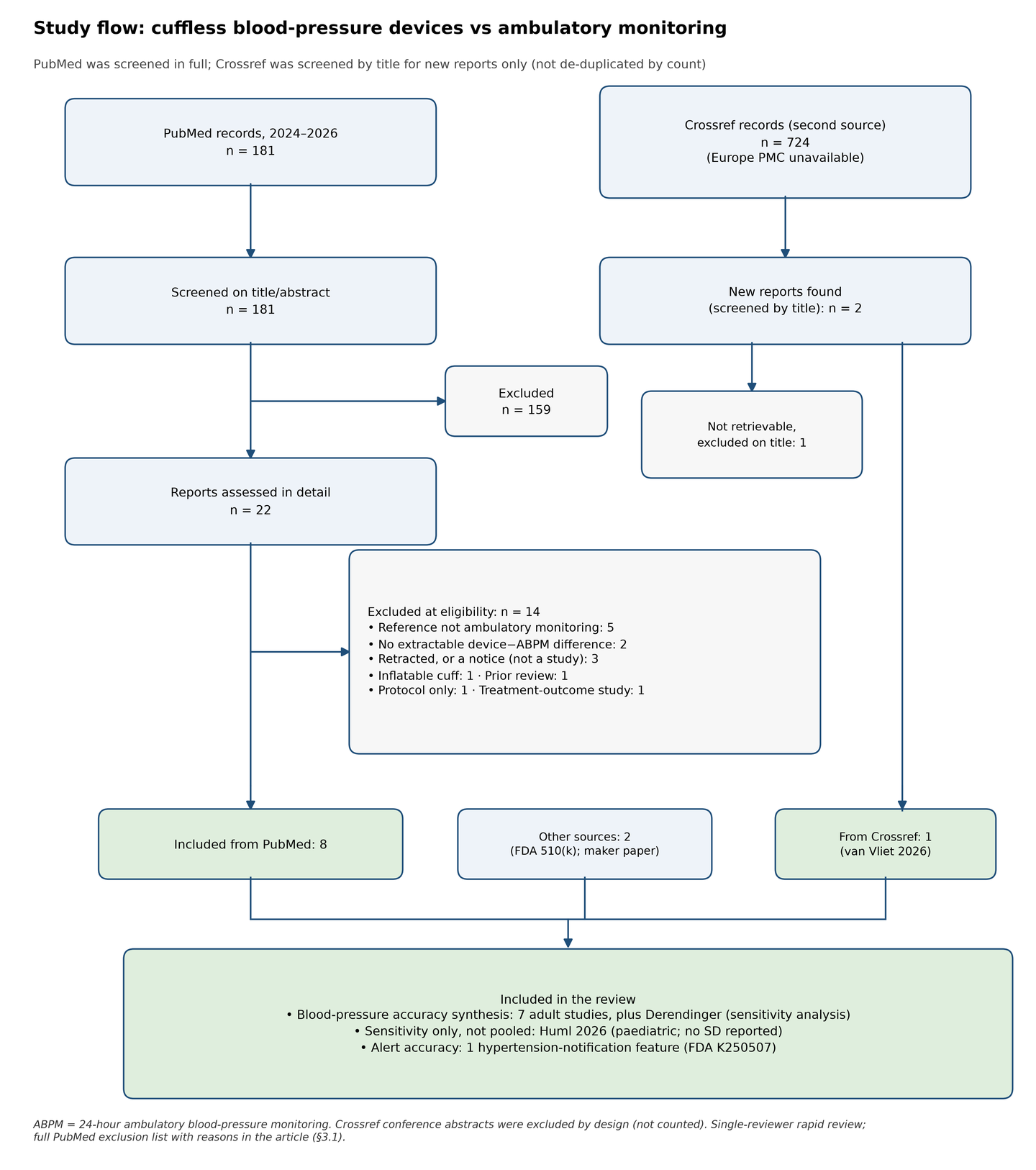
| Stage | n |
|---|---|
| PubMed records, 2024–2026 | 181 |
| Excluded on title/abstract (PubMed) | 159 |
| PubMed reports assessed in detail | 22 |
| Excluded at eligibility (PubMed) | 14 (listed below) |
| Included from PubMed | 8 |
| Crossref records (second source; Europe PMC unavailable) | 724 |
| New Crossref reports assessed | 1 included (van Vliet 2026). One further record, a 2026 Blood Pressure paper on long-term stability, could not be retrieved (access blocked) and was excluded on its title (change tracking over time, not ABPM agreement). |
| Crossref conference abstracts (e.g., J Hypertens and Circulation supplements) | Excluded by design (not counted individually) |
| Other sources (FDA 510(k) summary; manufacturer validation paper) | 2 |
| Included: BP-accuracy synthesis | 7 adult studies (Kim HJ, Lee H, Lee SM, Hongyo, van Vliet, Hove, Almeida) + Derendinger (sensitivity) |
| Sensitivity only, not pooled | Huml 2026 (paediatric; MD −4.5 mmHg, no SD) |
| Alert accuracy | 1 notification feature (FDA K250507) |
PubMed exclusions at eligibility (14 = 22 assessed − 8 included).
| # | PMID | Record | Reason |
|---|---|---|---|
| 1 | 38112747 | Lunardi 2024, Clin Res Cardiol, three watch-type home BP devices | Reference was a brachial sphygmomanometer (static ISO 81060-2 protocol), not ABPM; one device was an occlusive-cuff watch |
| 2 | 38774367 | van Vliet 2024, Eur Heart J Digit Health | Invasive arterial reference during catheterisation, not ABPM |
| 3 | 40703116 | Bhatt 2025, Eur Heart J Digit Health | Retracted |
| 4 | 41263383 | Liu 2025, J Clin Hypertens, wrist oscillometric watch | Device has an inflatable (micro-)cuff |
| 5 | 41321467 | Lee & Chang 2025, Am J Prev Cardiol | Prior systematic review/meta-analysis (context only) |
| 6 | 41390956 | Wang 2026, Am J Hypertens, upper-arm PPG | Static AAMI/ESH/ISO 81060-2 validation against a mercury sphygmomanometer, not ABPM |
| 7 | 41602947 | Walzel 2026, Digit Health | Reference was a home cuff monitor (Omron M4), not ABPM |
| 8 | 41624557 | Retraction notice (ztag002) | Notice, not a study |
| 9 | 41624571 | Expression of Concern (ztaf134) | Notice, not a study |
| 10 | 41670937 | Traiwannakij 2026, Sleep Breath | PTT measured during polysomnography with ABPM the following day (non-simultaneous); correlation and diagnostic accuracy only, no device − ABPM MD with dispersion extractable |
| 11 | 42007007 | Gupta | Protocol/rationale, no results |
| 12 | 42500895 | Qiu 2026, JAHA, finger PPG | No device − ABPM MD with dispersion extractable from the accessible record (abstract reports criteria met only) |
| 13 | 42782336 | Schoenmakers | Laboratory protocol with cuff reference, not ABPM |
| 14 | 42846709 | Cha 2026, Clin Hypertens, cuffless-ABPM-guided titration | Treatment outcome study, not an accuracy study |
Overlap between the 724 Crossref records and PubMed was not de-duplicated by count. Crossref records were screened by title for new relevant reports.
Re-check of exclusions. 32 of 32 sampled exclusions were confirmed (agreement 100%; Clopper–Pearson 95% CI 89.1–100%). Kappa is not computable because every record fell in one category. The four borderline records each used a non-ABPM reference: auscultatory cuff, cuff at altitude, invasive arterial line, and invasive central BP.
3.2 Included studies
| Study | Device site | n | Reference / timing | Role | Population (HTN status) | Calibration / recalibration | MD ≤5 / SD ≤8 met (24-h SBP)* | Funding / COI |
|---|---|---|---|---|---|---|---|---|
| Hongyo 2026, Hypertens Res | Wrist (PPG); Strategy 1 | 78 analysed (92 enrolled) | 24-h ABPM, simultaneous | Primary | Treated hypertension (all on antihypertensives) | None (demographic inputs only; no cuff calibration) | Yes (−1.14 / 4.08†) | Device-maker funded (trial, commissioned and collaborative research funding); one device-maker-affiliated author |
| van Vliet 2026, Blood Press Monit | Wrist (PPG) | 40 (37 for awake−asleep) | 24-h ABPM, simultaneous | Primary (awake−asleep); 24-h/night only reading-level means → imputed-SD sensitivity | Clinical referrals (single centre) | Cuff-calibrated | Not assessable (no person-level SD) | Unrestricted device-maker grant; one author received device-maker consultancy fees |
| Kim HJ 2026, Clin Hypertens | Ring (PPG) | 154 | Simultaneous | Ring subgroup | Elevated office BP or treated hypertension | Calibrated at baseline to 2 ABPM readings (contralateral arm) | No (−7.14 / 10.56) | Society and government grants; no competing interests declared |
| Lee H 2024, Korean Circ J | Ring (PPG) | 33 | Simultaneous | Ring subgroup | Not restricted by BP status (not further extracted) | Calibrated with ABPM readings selected from the lower 10–20% of each person's 24-h BP range | Yes (+1.74 / 6.69) | Device-maker sponsored (study design, data collection and analysis); authors declare no financial conflicts |
| Lee SM 2026, Hypertens Res | Ring (PPG) | 35 | Simultaneous | Ring subgroup | Selected to match the ESH BP distribution; 13 with hypertension | Cuff (ABPM device) calibration ≥1 day before monitoring, R-T-R-T-R | Yes (+0.13 / 7.21) | Device-maker sponsored (study design and data collection); one author reports device-maker fees |
| Hove 2026, Am J Hypertens | Upper-arm PPG (abstract only) | 50 | Simultaneous | Combined sensitivity (awake−asleep) | Not restricted; over-representation of normal/low BP | Not reported in abstract | 24-h not reported (awake−asleep +1.6 / 4.9) | Device-maker-affiliated authors (4 of 7) |
| Almeida 2025, J Hypertens | Wrist (PPG) | 79 sessions / 51 patients | 7-day vs 1-day ABPM, non-simultaneous | Sensitivity only | Cardiac rehabilitation patients | Oscillometric initialisation; at least monthly per the manufacturer; sessions within 30 days of initialisation | No (SD 12.3) | Device-maker-employed authors |
| Derendinger 2024, J Hypertens | PTT | 166 | Simultaneous | Sensitivity only (imputed SD) | Mixed (92 on antihypertensives) | Single seated initial cuff calibration | Not assessable (no SD) | No external funding; some authors have received funding from device makers for other BP device studies |
| Huml 2026, J Hypertens | Wrist, children | 21 | Simultaneous | Sensitivity only, not pooled | Children with type 1 diabetes and normal office BP | Not extracted | Not assessable (MD −4.5, no SD) | Not verifiable (no statement in the accessible record) |
*The ISO 81060-2 criterion applies to static paired readings; it is applied here to 24-h averages only as an analogue, not as a validation verdict. †SD derived from the reported 95% CI.
- Calibration types. (a) Uncalibrated, demographic inputs only: Hongyo. (b) Cuff-calibrated with a separate cuff: van Vliet, Derendinger, Almeida (as reported). (c) Reference-derived, readings from the comparison ABPM recording: Kim HJ (2 baseline ABPM readings), Lee H (ABPM readings from the lower 10–20% of each person's 24-h range). (d) ABPM-device calibration in a separate session ≥1 day before monitoring: Lee SM. Hove: not reported in the abstract.
- No included study tested calibration drift beyond 30 days. All comparisons were ambulatory (dynamic) rather than static.
- BP distribution vs ESH requirements. Only Lee SM selected participants to match the ESH BP distribution. Hongyo enrolled treated hypertension only; the notification cohort excluded diagnosed hypertension. No adult pool covers untreated normotensive people across the ESH range, so results may not transfer to screening users.
- No included adult study was restricted to normotensive people. The only normotensive cohort is Huml 2026 (children), which is sensitivity-only and not pooled.
- The three ring studies use one manufacturer's devices, and two share investigators, so they may not be independent.
3.3 Forest plot
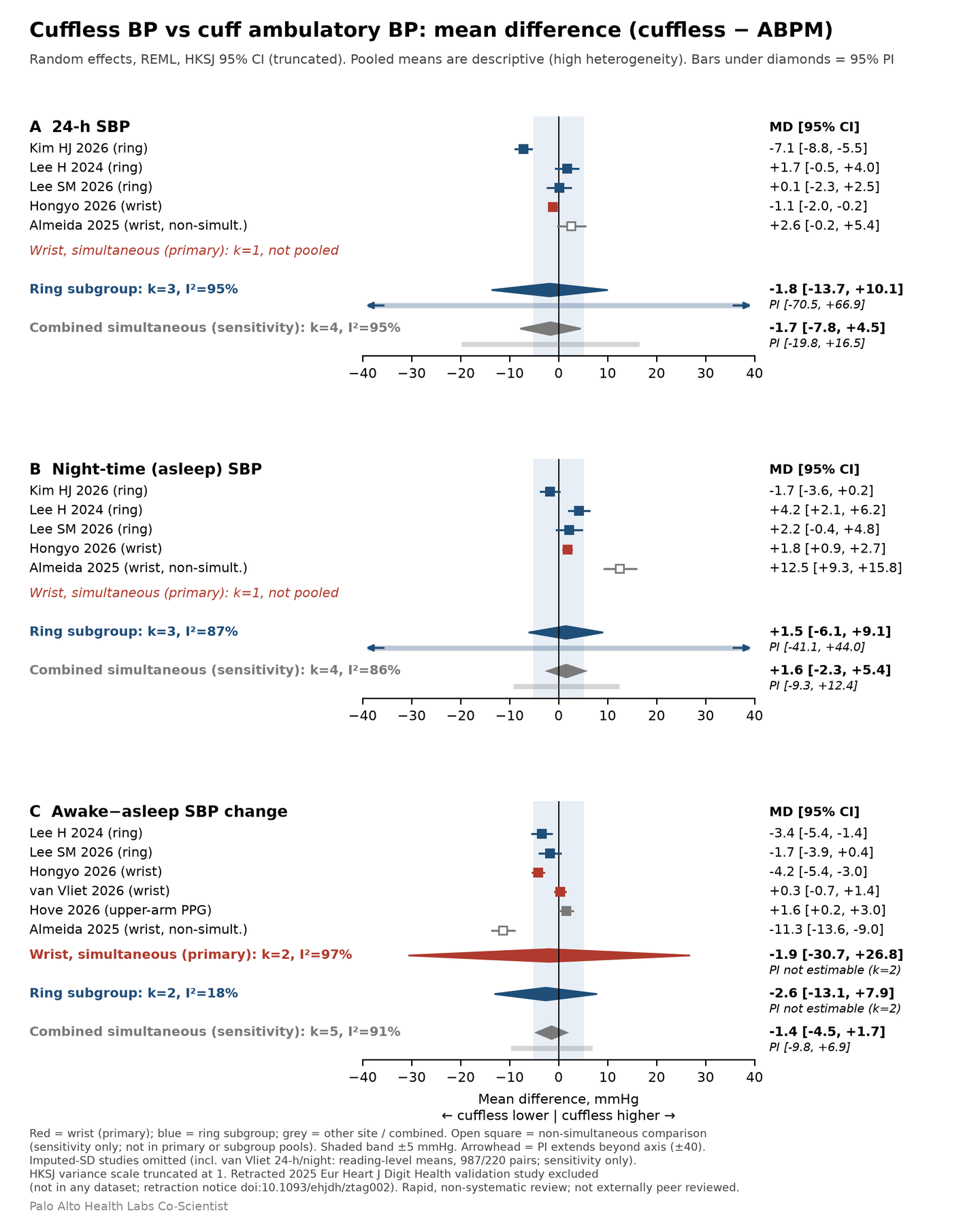
van Vliet 24-h and night-time values are reading-level means (987 and 220 paired readings) with SE based on n=40 and an imputed SD; they appear in sensitivity analyses only and are not plotted.
3.4 24-h systolic BP
- Primary (wrist, simultaneous): k=1. Hongyo 2026 MD −1.14 mmHg (95% CI −2.04 to −0.23); individual 95% LoA −9.1 to +6.9. Not pooled.
- Ring subgroup, k=3: −1.81 (HKSJ −13.68 to +10.06); PI −70.5 to +66.9; τ² 21.65; I² 95%.
- The PI is extremely wide because t(1) is used with k=3.
- Leave-one-out without Kim HJ: +0.97 (k=2, I² 0%).
- Sensitivity analyses.
- Combined simultaneous studies with person-level 24-h data, k=4: −1.65 (−7.82 to +4.51); PI −19.8 to +16.5; I² 95%; population LoA −18.1 to +14.8 (point estimate); Tipton–Shuster outer 95% limits −28.1 to +24.8.
- Plus Almeida (non-simultaneous), k=5: −0.85 (−5.66 to +3.96); PI −13.9 to +12.2.
- Wrist simultaneous plus van Vliet (imputed SD), k=2: −1.09 (−6.79 to +4.62).
- Combined simultaneous plus imputed-SD studies, k=6: −0.19 (−4.68 to +4.31); PI −12.6 to +12.3.
3.5 Night-time (asleep) systolic BP
- Primary (wrist, simultaneous): k=1. Hongyo 2026 +1.81 mmHg (+0.92 to +2.70): the device read higher than ABPM at night.
- Ring subgroup, k=3: +1.49 (−6.11 to +9.10); PI −41.1 to +44.0; I² 87%.
- Kim HJ was −1.72; Lee H +4.15; Lee SM +2.16.
- Combined simultaneous with person-level night-time data, k=4: +1.57 (−2.29 to +5.43); PI −9.3 to +12.4; I² 86%.
- Sensitivity analyses.
- Plus Almeida, k=5: +3.66 (−2.84 to +10.16). Almeida alone was +12.5.
- Plus imputed-SD studies, k=6: +2.82 (−1.70 to +7.34).
- van Vliet's reading-level means differed by −0.35.
- Direction. Most simultaneous estimates are positive: cuffless devices over-read night-time SBP relative to ABPM. Two estimates were negative (Kim HJ −1.72; van Vliet −0.35, imputed SD), and no pooled CI excludes zero. The data do not support describing the night-time error as under-reading.
3.6 Awake−asleep (dipping) change — ESH test
Sign convention: a negative MD means the cuffless device showed a smaller day–night fall than ABPM, i.e. it under-estimated dipping. For Lee H 2024 the source table is labelled "ABPM and CART-I Plus"; its daytime (+0.75) minus night-time (+4.15) device − ABPM differences give −3.40, matching the reported change of −3.39, so the value is device − ABPM on the same convention.
- Primary (wrist, simultaneous), k=2: −1.91 mmHg (HKSJ −30.66 to +26.84); PI not estimable; I² 97%.
- Hongyo −4.18 (−5.37 to −2.98): less dipping shown by the device.
- van Vliet +0.35 (−0.73 to +1.42): essentially no difference.
- The pooled value is descriptive only.
- Ring subgroup, k=2: −2.61 (HKSJ −13.08 to +7.85); PI not estimable; I² 18%.
- Lee H −3.39 (−5.39 to −1.39); Lee SM −1.74 (−3.88 to +0.40).
- Upper-arm, k=1: Hove +1.60 (+0.24 to +2.96).
- Combined simultaneous studies with awake−asleep data, k=5: −1.43 (−4.54 to +1.68); PI −9.8 to +6.9; I² 91%; population LoA −12.8 to +9.9 (point estimate); Tipton–Shuster outer 95% limits −17.3 to +14.4. Leave-one-out without Hongyo: −0.68; without Lee H: −0.98.
- Plus Almeida (non-simultaneous, −11.3), k=6: −3.05 (−7.82 to +1.71); PI −16.4 to +10.3.
- Hongyo detected non-dippers with sensitivity 0.93 and specificity 0.75.
3.7 Hypertension classification and smartwatch alerts (not pooled)
| Source | Index test | Reference | n | Sensitivity | Specificity |
|---|---|---|---|---|---|
| FDA 510(k) K250507 / manufacturer validation paper (2025) | Smartwatch notification, 30-day PPG; adults ≥22 without diagnosed hypertension | 30-day home cuff (not ABPM); Stage 1 130–<135 or 80–<85, Stage 2 ≥135 or ≥85 mmHg (home thresholds); PPV 70.9% (65.7–75.7) at 31.4% prevalence | 1,863 analysed of 2,229 (585 with HTN) | 41.2% (37.2–45.3); 241/585 | 92.3% (90.6–93.7); 1,179/1,278 |
| Same, by stage | Stage 1 29.6% (90/304); Stage 2 53.7% (47.7–59.7) | Normal 95.3% (924/970); Elevated 82.8% (255/308) | |||
| Kim HJ 2026 (derived 2×2) | Ring, 24-h ≥130/80 | 24-h ABPM | 154 | 79.8% (69.9–87.6); 71/89 | 75.4% (63.1–85.2); 49/65 |
A JAMA modelling study (Cohen 2026) examined population screening impact. It is context, not validation.
3.8 Risk of bias (QUADAS-2) and conflicts of interest
| Study | Patient selection | Index test | Reference | Flow & timing | Applicability |
|---|---|---|---|---|---|
| Hongyo 2026 | Unclear (treated HTN) | Unclear (two strategies reported; Strategy 1 chosen after the first pooling) | Low | Low | Unclear |
| van Vliet 2026 | Unclear (single centre, clinical referrals) | Low | Low | Low (simultaneous; 3 excluded from awake−asleep) | Low |
| Kim HJ 2026 | Low | Unclear (calibrated to 2 readings from the reference ABPM device at the start of the comparison recording) | Low | Low | Low |
| Lee H 2024 | Unclear (small) | Unclear (calibration readings selected from the comparison ABPM recording) | Low | Low | Low |
| Lee SM 2026 | High (selected to ESH distribution) | Low (calibrated ≥1 day before, in a separate session) | Low | Low | Low |
| Hove 2026 | Unclear (abstract only) | Unclear | Low | Unclear | Unclear (upper-arm site) |
| Almeida 2025 | Unclear | Unclear | Low | High (non-simultaneous) | High |
| Notification (K250507) | Low | Low | Unclear (home cuff) | Unclear (366 not analysed) | Low |
COI. Six of the seven adult BP-accuracy studies had device-maker funding, sponsorship, employment or fees; Kim HJ 2026 declared none. Lee H 2024 and Lee SM 2026 were sponsored by the ring's maker, which took part in study design and data collection. Derendinger 2024 had no external funding, though some authors have received device-maker funding for other studies. Huml 2026's COI statement could not be verified. The notification validation is manufacturer-sponsored. Verbatim statements: coi_sources_v3.md.
Calibration rule for the QUADAS-2 index-test domain (applied to all studies). Calibration that uses readings from the reference ABPM recording being compared (reference-derived calibration) shares information between index and reference, so the index test is rated Unclear (Kim HJ, Lee H). Calibration in a separate session at least one day before (Lee SM), calibration against a separate cuff, or no calibration is rated Low on this item. Hongyo, Hove and Almeida remain Unclear for other reasons (post hoc strategy choice; abstract-only reporting; initialisation timing relative to sessions).
3.9 Small-study effects
k≤6 for every outcome, so no funnel or Egger analysis was run.
4. Discussion
For wrist-worn devices tested against simultaneous ABPM, the evidence base for 2024–2026 is one study for 24-h and night-time SBP and two for dipping.
In the four simultaneous studies with person-level 24-h data, mean 24-h agreement was near zero but imprecise (95% CI −7.8 to +4.5); pooled MD −1.65 mmHg. A prediction interval of −19.8 to +16.5 mmHg and population LoA of −18.1 to +14.8 mmHg (point estimate; Tipton–Shuster outer 95% limits −28.1 to +24.8) mean an individual reading could differ from ABPM by a clinically decisive margin.
At night, devices more often read higher than ABPM (wrist primary +1.81; combined +1.57). Two studies went the other way, and no pooled CI excluded zero.
For dipping, the two wrist studies disagreed: one showed less dipping than ABPM, the other none. Both ring studies showed less dipping (−3.39 and −1.74). Across the five simultaneous studies with awake−asleep data, the pooled change was −1.43 mmHg, with a CI that included zero.
None of the studies is a full validation under ISO 81060-3, IEEE 1708 or the ESH recommendations, and none tested calibration stability beyond 30 days.
The notification feature does not estimate BP. Its specificity of 92.3% and sensitivity of 41.2% were measured against home cuff BP, not ABPM. A positive alert carries information. Absence of an alert does not rule hypertension out.
5. Limitations
- Rapid, non-systematic review.
- The planned second database (Europe PMC) was unavailable twice.
- Scopus and Google Scholar were unreachable.
- Crossref was used as a substitute. It indexes metadata and few abstracts, so its screening was title-based and less sensitive.
- The protocol was written after the search and after the first pooled analysis, and was not registered. No analysis choice is pre-specified.
- The screening re-check was a second pass by the same AI agent, not an independent human screener. Only 20% of title/abstract exclusions were re-checked. Title/abstract reasons for the remaining 127 were not logged.
- Very small k. The wrist primary has k=1–2, so PIs are not estimable or extremely wide, and I² is imprecise.
- Device heterogeneity: wrist, ring, upper-arm and PTT. The ring studies share a manufacturer.
- Most studies have device-maker involvement.
- SDs derived from CIs or LoA (Hongyo, Almeida, Hove, van Vliet). Imputed SDs (Derendinger; van Vliet 24-h and night-time) appear in sensitivity analyses only.
- van Vliet 24-h and night-time means are reading-level, not person-level.
- Calibration methods differ, and in two studies (Kim HJ, Lee H) calibration readings came from the reference ABPM recording (see §3.2).
- Alert accuracy rests on one sponsor-reported validation against home cuff BP.
- AI-agent checked only: no human validation, no external peer review.
6. Conclusions
On average, cuffless wearables' 24-h bias against ABPM is near zero but imprecise (95% CI −7.8 to +4.5). Evidence for wrist devices against simultaneous ABPM is sparse, and agreement for individuals, night-time BP and dipping is uncertain. Night-time error, where present, more often went towards over-reading, and most studies showed less dipping on the device than on ABPM. No included study is a complete validation under current cuffless standards. Smartwatch hypertension notifications are specific but insensitive against home cuff BP. Neither replaces cuff ABPM or home cuff BP for diagnosis.
References
- Kim HJ, et al. Real-world performance of a ring-type cuffless blood pressure device compared with ambulatory blood pressure monitoring. Clin Hypertens 2026. https://doi.org/10.5646/ch.2026.32.e41
- Lee H, et al. Feasibility and Effectiveness of a Ring-Type Blood Pressure Measurement Device Compared With 24-Hour Ambulatory Blood Pressure Monitoring Device. Korean Circ J 2024;54(2):93-104. https://doi.org/10.4070/kcj.2023.0303
- Lee SM, et al. Validation of ring-type cuffless blood pressure (BP) monitoring device for detecting awake-asleep BP variations compared to ambulatory BP monitoring device. Hypertens Res 2026. https://doi.org/10.1038/s41440-026-02759-6
- Almeida et al. Evaluation of Aktiia cuffless blood pressure monitor across 24-h, daytime, and night-time measurements versus ambulatory monitoring. J Hypertens 2025;43(4):690-697. https://doi.org/10.1097/HJH.0000000000003960
- Hongyo et al. Evaluation of Alysis-001 cuffless blood pressure estimation algorithm against the ESH awake/asleep test criteria in hypertensive patients. Hypertens Res 2026. https://doi.org/10.1038/s41440-026-02728-z
- Hove et al. Nocturnal blood pressure dipping in adults: a comparison between cuffless and ambulatory blood pressure monitoring. Am J Hypertens 2026. https://doi.org/10.1093/ajh/hpag115
- Derendinger et al. Ability of a 24-h ambulatory cuffless blood pressure monitoring device to track blood pressure changes in clinical practice. J Hypertens 2024;42(4):662-671. https://doi.org/10.1097/HJH.0000000000003667
- Huml et al. Continual cuffless blood pressure monitoring in children: agreement and feasibility compared with ambulatory blood pressure monitoring. J Hypertens 2026. https://doi.org/10.1097/HJH.0000000000004445
- US FDA. 510(k) summary K250507 (Hypertension Notification Feature), cleared 11 Sep 2025. https://www.accessdata.fda.gov/cdrh_docs/pdf25/K250507.pdf
- Apple. Hypertension Notifications validation paper, September 2025. https://www.apple.com/health/pdf/Hypertension_Notifications_Validation_Paper_September_2025.pdf
- Cohen JB, et al. Impact of a Smartwatch Hypertension Notification Feature for Population Screening. JAMA 2026. https://doi.org/10.1001/jama.2025.26925
- Cohen et al. Apple Watch for Hypertension Screening. Hypertension 2026. https://doi.org/10.1161/HYPERTENSIONAHA.125.26031
- Lee I, Chang MJ. Comparing the accuracy of continuous blood pressure monitoring using wearable cuffless devices with conventional 24-hour ABPM: a systematic review and meta-analysis. Am J Prev Cardiol 2025. https://doi.org/10.1016/j.ajpc.2025.101342
- Retraction of: Validation of a popular consumer-grade cuffless blood pressure device for continuous 24 h monitoring. Eur Heart J Digit Health 2026;7(2):ztag002. https://doi.org/10.1093/ehjdh/ztag002 (retracts https://doi.org/10.1093/ehjdh/ztaf044; Expression of Concern https://doi.org/10.1093/ehjdh/ztaf134)
- Excluded, cited for context: Liu Y, et al. J Clin Hypertens 2025. https://doi.org/10.1111/jch.70183 · Walzel S, et al. Digit Health 2026. https://doi.org/10.1177/20552076261415923 · Qiu Y, et al. JAHA 2026. https://doi.org/10.1161/JAHA.126.050501 · Traiwannakij et al. Sleep Breath 2026. https://doi.org/10.1007/s11325-026-03601-6
- van Vliet M, Aalberts JJJ, Hamelinck C, et al. Photoplethysmography based remote cardiac blood pressure monitoring compared with 24-h ambulatory blood pressure monitoring. Blood Press Monit 2026;31(4):185-192. https://doi.org/10.1097/MBP.0000000000000804
- ISO 81060-3:2022. Non-invasive sphygmomanometers — Part 3: Clinical investigation of continuous automated measurement type. Geneva: ISO; 2022. https://www.iso.org/standard/71161.html
- IEEE Std 1708-2014. IEEE Standard for Wearable Cuffless Blood Pressure Measuring Devices. 2014 (superseded by IEEE 1708-2025). https://doi.org/10.1109/IEEESTD.2014.6882122
- Stergiou GS, Avolio AP, Palatini P, et al. European Society of Hypertension recommendations for the validation of cuffless blood pressure measuring devices. J Hypertens 2023;41(12):2074–2087. https://doi.org/10.1097/HJH.0000000000003483
Supplementary material: protocol; analysis code and full results (all pooled, LOO and sensitivity outputs); 20% re-screen log; second-source search log; reference verification log; COI source notes; forest plot (high- and standard-resolution).
Corrections
None yet.
Found an error? Email hello@paloaltohealthlabs.com.
More from the Palo Alto Health Labs Co-Scientist · All posts
Have your own questions? Sign up for the Beta
Tell us the health AI or digital health question you would want the Co-Scientist to review, and join the beta list.
Scope it in 30 minutes
Book a scoping call and we'll name the smallest engagement that moves you forward. Most teams start with the fixed-scope Initial Audit.
Book a 30-min scoping callPrefer to write? Send a short note.