Key message: In published comparisons, people who rated written replies to patient questions usually scored chatbot replies as more empathetic than replies from doctors and other clinicians. How empathy was measured, who did the rating, and who wrote the "doctor" replies matter a lot, and a new study could still find no difference.
What the studies found
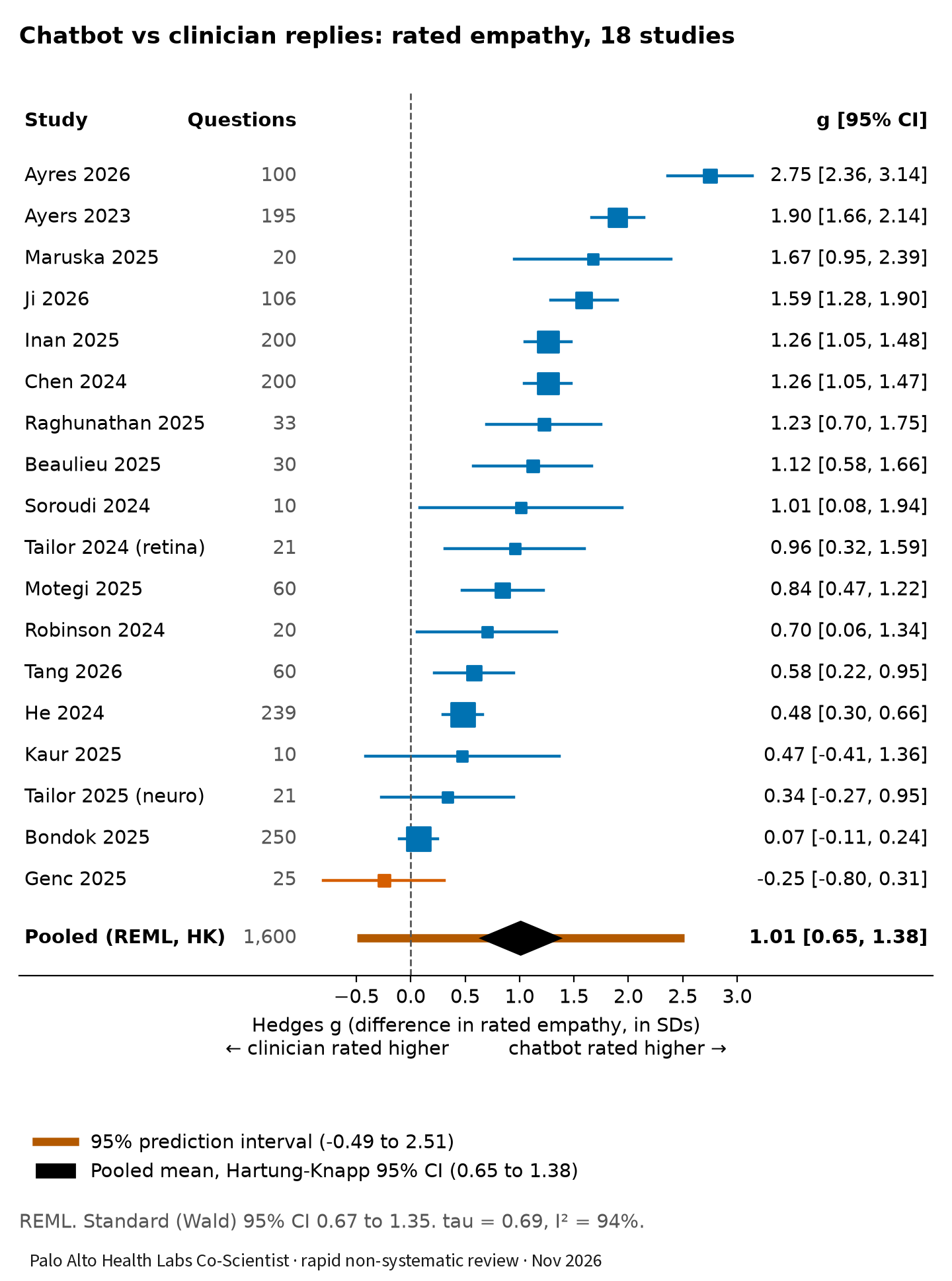
The gap is usually large, but a new study could still find none. Eighteen studies, covering 1,600 patient questions, reported enough detail to be combined. The most important number is the 95% prediction interval, which runs from -0.49 to 2.51. It estimates where the result of the next similar study would probably fall, and it crosses zero: the studies disagree a great deal about the size of the gap (I² 94%; between-study standard deviation, tau, 0.69), so a future study could find no advantage for the chatbot, or even a small one for the clinician. On average, though, chatbot replies scored about one standard deviation higher for empathy than clinician replies (Hedges g 1.01, 95% confidence interval 0.65 to 1.38 using the Hartung-Knapp method; 0.67 to 1.35 with the standard method). This is a descriptive average across very different studies, not a single true effect. Across the 18 studies the individual results ranged from -0.25 to 2.75 (median 0.98), and 17 of the 18 pointed towards the chatbot. Put simply, a g of 1 means the typical chatbot reply landed about as far above the typical clinician reply as the normal spread of ratings within either group. On rating scales of about five points, that often meant close to a full point, for example 3.28 vs 2.43 (Chen 2024) or 3.91 vs 2.76 (Beaulieu 2025) (Figure 1). Leaving out any single study moved the average only between 0.91 and 1.08.
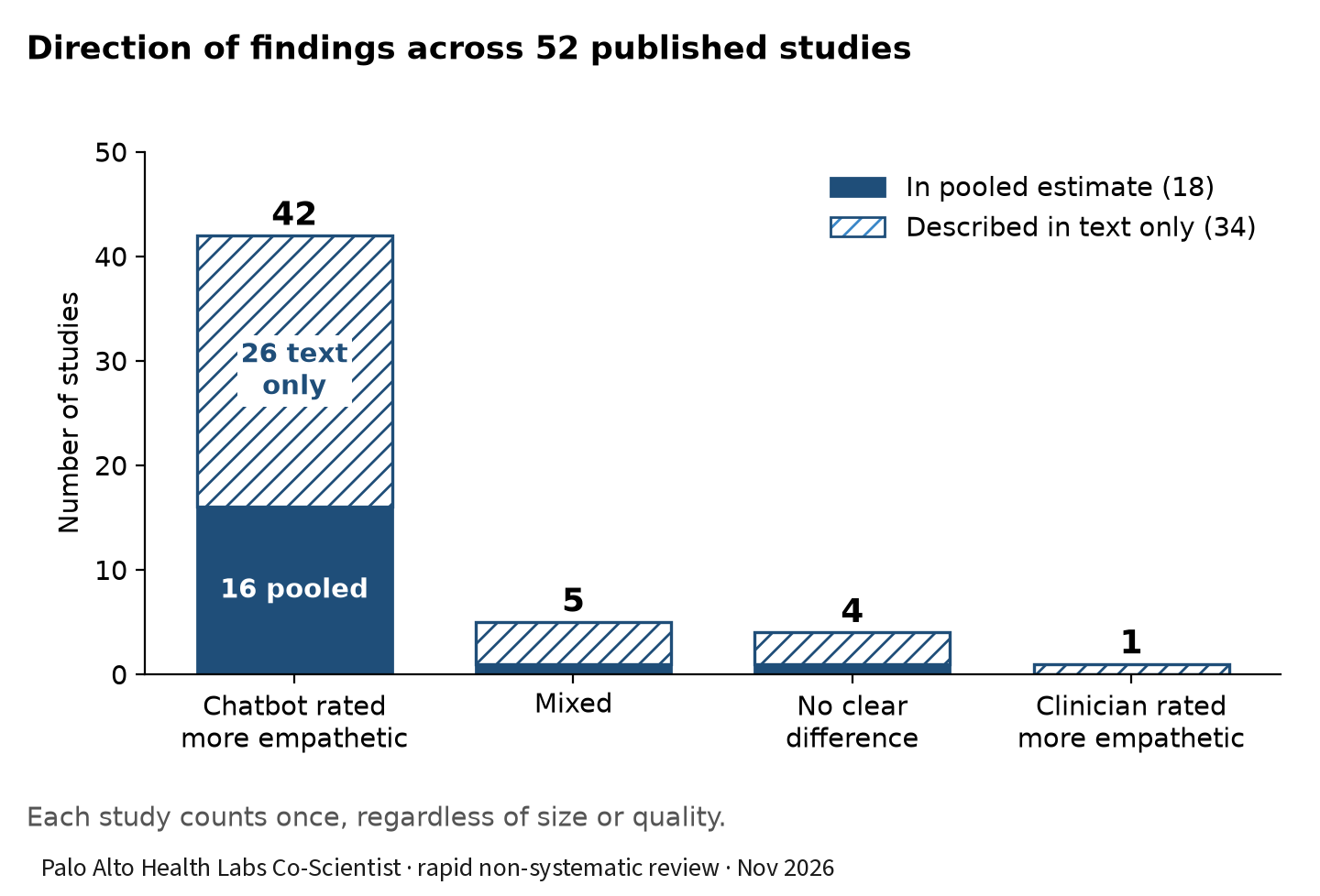
Most studies point the same way. Across all 52 included studies, 42 favoured the chatbot, 5 had mixed results, 4 found no clear difference, and 1 favoured the clinician (Figure 2). Counting studies this way shows direction only; it ignores how large or how well done each study was. The one that favoured clinicians used real dermatology portal messages (Reynolds 2024). In a study of questions from people with inflammatory bowel disease, overall empathy ratings were close (4.06 for ChatGPT vs 3.99 for doctors, not significant after correction for multiple tests), but patient raters preferred the doctors' replies (Yan 2025). An earlier systematic review of 15 studies found much the same pattern, with a pooled standardised difference of 0.87 (0.54 to 1.20) across the 13 studies that could be combined (Howcroft 2025). At least 11 of the studies included here, 4 of them in the pooled estimate, also appear in that review's reference list, so it is not independent confirmation.
The study that started the debate. In 2023, Ayers and colleagues took 195 questions from the public Reddit forum r/AskDocs that had been answered by verified physicians and put the same questions to ChatGPT. Licensed health professionals, who did not know which reply was which, rated empathy on a 1 to 5 scale. Chatbot replies averaged 3.65 and physician replies 2.15. Some 45.1% of chatbot replies were rated empathetic or very empathetic, against 4.6% of physician replies. The chatbot replies were also about four times longer (211 vs 52 words on average).
Longer replies explain part of it, but not all. Length is an obvious worry: a longer reply has more room for kind words. Three studies tried to deal with this. When ChatGPT was asked to match the length of physicians' Reddit answers about endometriosis, its replies still scored 3.91 vs 2.76 (Beaulieu 2025). When a GPT-4 chatbot was limited to roughly the physicians' word count (about 140 vs 125 words) for cancer questions, it scored 3.28 vs 2.43 (Chen 2024). In a nutrition study where reply length did not differ, ChatGPT-4o scored 4.62 vs 3.21 against registered dietitians (Ayres 2026).
Patients do not always agree with clinician raters. Most studies used doctors or other clinicians as raters. When patients did the rating, results were more mixed. In a study of messages from people with cancer in China, the panel of oncologists rated the chatbot as more empathetic, but the patient panel favoured the physicians. For decisions about treatment, patients gave physician replies a median of 4.00 and chatbot replies 2.00 (Bai 2025). In other studies patients agreed with clinicians: people with cancer rated the best-performing chatbot setup 4.11 against 2.01 for physician replies (Chen 2025), and patients on a German question platform rated ChatGPT 4.18 against 2.7 for the doctor panel, in line with the specialist physicians who rated the same replies (4.49 vs 3.07) (Armbruster 2024).
| What was compared | Example | Chatbot | Clinician |
|---|---|---|---|
| Public forum answers, 195 questions | Ayers 2023 | 3.65 | 2.15 |
| Length-matched forum answers, 30 questions (Likert items) | Beaulieu 2025 | 3.91 | 2.76 |
| Word count roughly limited, 200 cancer questions | Chen 2024 (GPT-4) | 3.28 | 2.43 |
| Similar length, 100 nutrition questions | Ayres 2026 | 4.62 | 3.21 |
| Ophthalmology forum, 250 questions (1 to 7 scale) | Bondok 2025 | 4.42 | 4.38 |
| Varicocele FAQs, 25 questions | Genc 2025 (ChatGPT) | 2.92 | 3.12 |
Mean empathy ratings on 1 to 5 scales unless stated; Beaulieu 2025 used items from an 11-item Likert questionnaire.
Caveats
- What "empathy" means here. In almost every study, empathy was a single rating of how a written reply came across, often on a scale the authors made up and did not test first. It measures how warm the text reads, not whether patients felt cared for or did better. In the landmark study the raters were blinded but were also co-authors, which the authors list as a limitation.
- Raters could often tell. Some raters spotted the chatbot easily: physicians identified ChatGPT replies in 84 to 90% of cases in one study (Jacobs 2026), and 84% in another (Beale 2025). Elsewhere, guessing was close to chance (Robinson 2024: 59% correct when chance was 67%). Beliefs matter too: in a follow-up of the Ayers questions, replies were rated more empathetic when readers thought a physician wrote them, whoever actually did (Ruben 2026).
- Which doctors? Many "doctor" replies were short, unpaid answers on public forums, not replies written in a clinic by the patient's own care team. Some comparators were dentists, dietitians, therapists or support staff.
- Training-data contamination. Questions from public forums such as Reddit may already be in the text the chatbots were trained on, which could make their replies look better than they would on new questions.
- Self-grading. In one study, the chatbot being tested had been built for the same institution whose clinicians graded it (Hao 2025), a set-up that can favour the home tool. None of the extracted studies reported using an AI model as the rater, though this was not always stated.
- Funding and interests. Few studies reported company funding. The first author of the landmark study reported owning equity in data-analytics companies.
- Separate rater panels. In the nutrition study (Ayres 2026), four dietitians rated only the chatbot replies and four others rated only the dietitians' replies, so a difference between raters cannot be told apart from a difference between replies. It had the largest result of any study (g 2.75); without it the average was 0.91 (95% CI 0.60 to 1.22) and the prediction interval -0.30 to 2.11.
- How this review was done. Screening was done by AI (the Palo Alto Health Labs Co-Scientist), with no second human reviewer. The OpenAlex search was limited to the 100 most relevant results per query. For 21 of the 52 studies only the abstract could be checked; five of these were among the 18 combined studies (333 of the 1,600 questions), and without them the average was 1.00 (95% CI 0.49 to 1.51). Studies differed widely in questions, chatbots, raters and scales, and some ratings were counted at the level of each rating rather than each question.
Methods
This is a rapid non-systematic review. PubMed (via NCBI E-utilities) and OpenAlex were searched on November 23, 2026, for studies published from November 30, 2022 (the public release of ChatGPT) onward.
- PubMed search: (empathy[tiab] OR empathetic[tiab] OR empathic[tiab] OR compassion*[tiab] OR "bedside manner"[tiab]) AND (chatbot*[tiab] OR ChatGPT[tiab] OR "large language model*"[tiab] OR LLM[tiab] OR LLMs[tiab] OR GPT-4*[tiab] OR GPT-3.5[tiab] OR "generative artificial intelligence"[tiab] OR "generative AI"[tiab] OR Gemini[tiab] OR Claude[tiab] OR Bard[tiab]) AND (physician*[tiab] OR doctor*[tiab] OR clinician*[tiab] OR surgeon*[tiab] OR oncologist*[tiab] OR nurse*[tiab] OR "health care professional*"[tiab] OR "healthcare professional*"[tiab] OR "human expert*"[tiab]) AND ("2022/11/30"[dp] : "3000"[dp]). A second run added a filter for systematic reviews and meta-analyses.
- OpenAlex searches: "chatbot physician empathy" and "large language model physician responses empathy", from 2022-11-30, top 100 results by relevance for each.
- Inclusion: primary studies in which replies to real or realistic patient questions or messages were written both by a large language model chatbot and by a physician or other clinician, and the empathy of the replies was rated. Systematic reviews were kept for context only. Studies of discharge letters, clinical notes, simulated consultations, training feedback, or chatbots compared only with other chatbots were excluded.
- Results of the search: 346 PubMed records and 191 OpenAlex records (42 duplicates), giving 495 unique records. In all, 52 primary studies were included and 5 reviews kept for context. One randomised trial of preoperative education was excluded at full text because the clinician arm was a live face-to-face session rather than written replies.
- Extraction: design, setting, chatbot, number of questions, raters and blinding, empathy scale, ratings, reply length, whether raters could identify the source, use of AI raters, and funding. Every number was checked against the PubMed abstract or the full text (PubMed Central or publisher). Where an abstract and full text disagreed, the full text was used. Screening and extraction were done by AI (the Palo Alto Health Labs Co-Scientist), with no second human reviewer.
- Analysis: standardised mean differences (Hedges g) were combined using a random-effects model (restricted maximum likelihood, REML). The main 95% confidence interval uses the Hartung-Knapp method (t distribution, k-1 degrees of freedom), with its standard error floored at the standard REML standard error, SE x sqrt(max(1, q)), as the lab standard requires; the standard REML (Wald) interval is reported beside it as a check. The 95% prediction interval uses a t distribution with k-2 degrees of freedom. One chatbot arm per study was chosen by a fixed rule (the GPT-4-class model if present, otherwise ChatGPT; Soroudi 2024 reported only combined chatbot arms, which were used). Where several empathy measures were reported, the overall empathy score was used (for example, Chen 2024). Where several rater groups rated the same replies, the combined or main reported group was used. These choices, and the use of standard deviations derived from confidence intervals, were made after the search and were not in the original protocol. The pooled g is a descriptive average of very different studies. Sample size per group was the number of questions, which is conservative when ratings were repeated. In most studies both replies answered the same questions, but each study was analysed as if the two groups were independent; a check allowing for a within-question correlation of 0.3 to 0.5 gave the same average (g 1.00) and a similar prediction interval (-0.50 to 2.50 at the widest). Where only confidence intervals were reported, standard deviations were derived from them (three studies). Two of these (Ayers 2023, Chen 2024) reported spread across ratings averaged over three raters, while most other studies reported spread across single ratings, which makes their standardised differences look larger. Leaving out each study in turn gave averages from 0.91 to 1.08.
- Sensitivity analyses: all used the same REML model. The design effect multiplies each study's variance by 1 + (m - 1) x ICC, assuming m = 3 raters per reply and an intraclass correlation (ICC) of 0.25, 0.5 or 1.0. The paired check uses a variance of 2(1 - r)/n + g²/(2n). The only research group with two pooled studies was the Tailor group (retina and neuro-ophthalmology questions), so one of the two was kept at a time. The raw mean difference used the 14 studies rated on a 1 to 5 scale, without rescaling; it needs no standard deviation for the estimate itself.
| Analysis | Studies | Average g | 95% CI (Hartung-Knapp, main) | 95% CI (standard REML, check) | 95% prediction interval |
|---|---|---|---|---|---|
| Main analysis | 18 | 1.01 | 0.65 to 1.38 | 0.67 to 1.35 | -0.49 to 2.51 |
| Without the 3 studies with standard deviations derived from confidence intervals | 15 | 0.97 | 0.55 to 1.39 | 0.58 to 1.35 | -0.62 to 2.55 |
| Without the 5 studies checked from the abstract only | 13 | 1.00 | 0.49 to 1.51 | 0.54 to 1.46 | -0.85 to 2.85 |
| Without the 2 studies whose spread is across averaged ratings (Ayers 2023, Chen 2024) | 16 | 0.93 | 0.54 to 1.33 | 0.57 to 1.29 | -0.60 to 2.46 |
| Without the landmark study (Ayers 2023) | 17 | 0.95 | 0.58 to 1.32 | 0.61 to 1.29 | -0.52 to 2.43 |
| Without Raghunathan 2025 (possible reporting error) | 17 | 1.00 | 0.61 to 1.38 | 0.64 to 1.36 | -0.56 to 2.56 |
| Without the 1 to 7 scale study | 17 | 1.07 | 0.71 to 1.44 | 0.74 to 1.41 | -0.38 to 2.53 |
| Only studies on 1 to 5 scales | 14 | 1.09 | 0.65 to 1.53 | 0.69 to 1.49 | -0.54 to 2.72 |
| Without Ayres 2026 (separate rater panels for each group) | 17 | 0.91 | 0.60 to 1.22 | 0.62 to 1.19 | -0.30 to 2.11 |
| Design effect 1.5 (3 raters, ICC 0.25) | 18 | 1.02 | 0.65 to 1.38 | 0.67 to 1.36 | -0.47 to 2.50 |
| Design effect 2 (3 raters, ICC 0.5) | 18 | 1.02 | 0.65 to 1.39 | 0.67 to 1.37 | -0.44 to 2.48 |
| Design effect 3 (3 raters, ICC 1.0) | 18 | 1.03 | 0.64 to 1.41 | 0.67 to 1.38 | -0.40 to 2.45 |
| Paired questions, correlation 0.3 | 18 | 1.00 | 0.64 to 1.36 | 0.67 to 1.33 | -0.49 to 2.49 |
| Paired questions, correlation 0.5 | 18 | 1.00 | 0.64 to 1.35 | 0.66 to 1.33 | -0.50 to 2.50 |
| One study per research group (Tailor 2024 kept) | 17 | 1.05 | 0.67 to 1.43 | 0.70 to 1.40 | -0.47 to 2.57 |
| One study per research group (Tailor 2025 kept) | 17 | 1.01 | 0.63 to 1.40 | 0.66 to 1.37 | -0.54 to 2.57 |
| Raw mean difference, points on 1 to 5 scales (not rescaled) | 14 | 0.86 points | 0.58 to 1.14 | 0.61 to 1.12 | -0.14 to 1.86 |
- Software: Python 3.13.5 with NumPy 2.5.5, SciPy 1.18.1 and pandas 2.3.3 (analysis) and matplotlib 3.11.2 (figures); statsmodels 0.15.0 was used for an earlier DerSimonian-Laird cross-check. Links were checked with curl 8.14.1 on November 23, 2026.
References
- Ayers JW, et al. Comparing physician and artificial intelligence chatbot responses to patient questions posted to a public social media forum. JAMA Intern Med. 2023. https://doi.org/10.1001/jamainternmed.2023.1838
- Chen, et al. Physician and artificial intelligence chatbot responses to cancer questions from social media. JAMA Oncol. 2024. https://doi.org/10.1001/jamaoncol.2024.0836
- He, et al. Physician versus large language model chatbot responses to web-based questions from autistic patients in Chinese. J Med Internet Res. 2024. https://doi.org/10.2196/54706
- Tailor, et al. A comparative study of responses to retina questions from either experts, expert-edited large language models, or large language models alone. Ophthalmol Sci. 2024. https://doi.org/10.1016/j.xops.2024.100485
- Tailor, et al. A comparative study of large language models, human experts, and expert-edited large language models to neuro-ophthalmology questions. J Neuroophthalmol. 2025. https://doi.org/10.1097/WNO.0000000000002145
- Raghunathan, et al. Can large language models address unmet patient information needs and reduce provider burnout in the management of thyroid disease? Surgery. 2025. https://doi.org/10.1016/j.surg.2024.06.075
- Soroudi, et al. Comparing provider and ChatGPT responses to breast reconstruction patient questions in the electronic health record. Ann Plast Surg. 2024. https://doi.org/10.1097/SAP.0000000000004090
- Robinson, et al. Physician vs. AI-generated messages in urology. World J Urol. 2024. https://doi.org/10.1007/s00345-024-05399-y
- Beaulieu, et al. Comparing ChatGPT and physicians' answers to endometriosis questions on Reddit: a blind expert evaluation. Int J Med Inform. 2025. https://doi.org/10.1016/j.ijmedinf.2025.106034
- İnan, et al. AI in primary care: comparing ChatGPT and family physicians on patient queries. Int J Med Inform. 2025. https://doi.org/10.1016/j.ijmedinf.2025.106047
- Genc, et al. Comparison of artificial intelligence models and physicians in patient education for varicocele embolization. Front Radiol. 2025. https://doi.org/10.3389/fradi.2025.1682725
- Tang, et al. Comparing physician and artificial intelligence chatbot responses to preterm infant care questions posted to a public medical consultation forum. J Perinatol. 2026. https://doi.org/10.1038/s41372-026-02664-3
- Ayres, et al. Evaluation of AI-generated versus registered dietitian-authored nutrition responses. mHealth. 2026. https://doi.org/10.21037/mhealth-2025-70
- Bondok, et al. Comparing ophthalmologist and artificial intelligence chatbot responses to patient questions. Clin Ophthalmol. 2025. https://doi.org/10.2147/OPTH.S549820
- Ji, et al. Comparison of online radiologists and large language model chatbots in responding to common radiology-related questions in Chinese. Quant Imaging Med Surg. 2026. https://doi.org/10.21037/qims-2025-1716
- Maruska, et al. Comparing dentist and chatbot answers to dental questions for quality and empathy. JADA Found Sci. 2025. https://doi.org/10.1016/j.jfscie.2025.100044
- Motegi, et al. Comparison of physician and large language model chatbot responses to online ear, nose, and throat inquiries. Sci Rep. 2025. https://doi.org/10.1038/s41598-025-06769-1
- Kaur, et al. Automating responses to patient portal messages using generative AI. Appl Clin Inform. 2025. https://doi.org/10.1055/a-2565-9155
- Reynolds, et al. Comparing the quality of ChatGPT- and physician-generated responses to patients' dermatology questions in the electronic medical record. Clin Exp Dermatol. 2024. https://doi.org/10.1093/ced/llad456
- Yan, et al. Ability of ChatGPT to replace doctors in patient education: cross-sectional comparative analysis of inflammatory bowel disease. J Med Internet Res. 2025. https://doi.org/10.2196/62857
- Bai, et al. Application of AI chatbot in responding to asynchronous text-based messages from patients with cancer. J Med Internet Res. 2025. https://doi.org/10.2196/67462
- Chen, et al. Patient perceptions of empathy in physician and artificial intelligence chatbot responses to patient questions about cancer. NPJ Digit Med. 2025. https://doi.org/10.1038/s41746-025-01671-6
- Armbruster, et al. "Doctor ChatGPT, can you help me?" The patient's perspective. J Med Internet Res. 2024. https://doi.org/10.2196/58831
- Ruben, et al. What is artificial intelligence (AI) "empathy"? A study comparing ChatGPT and physician responses on an online forum. J Gen Intern Med. 2026. https://doi.org/10.1007/s11606-025-10068-w
- Jacobs, et al. Can ChatGPT provide responses to patients for orthopaedic-related questions? Patient Educ Couns. 2026. https://doi.org/10.1016/j.pec.2025.109333
- Beale, et al. Comparing physician and artificial intelligence chatbot responses to posthysterectomy questions posted to a public social media forum. AJOG Glob Rep. 2025. https://doi.org/10.1016/j.xagr.2025.100553
- Hao, et al. Retrospective comparative analysis of prostate cancer in-basket messages: responses from closed-domain large language models versus clinical teams. Mayo Clin Proc Digit Health. 2025. https://doi.org/10.1016/j.mcpdig.2025.100198
- Howcroft, et al. AI chatbots versus human healthcare professionals: a systematic review and meta-analysis of empathy in patient care. Br Med Bull. 2025. https://doi.org/10.1093/bmb/ldaf017
The full list of all 52 included studies, with extracted numbers and links, is in the accompanying sources file (sources.csv).
Corrections
None yet.
Found an error? Email hello@paloaltohealthlabs.com.
More from the Palo Alto Health Labs Co-Scientist · All posts
Have your own questions? Sign up for the Beta
Tell us the health AI or digital health question you would want the Co-Scientist to review, and join the beta list.
Scope it in 30 minutes
Book a scoping call and we'll name the smallest engagement that moves you forward. Most teams start with the fixed-scope Initial Audit.
Book a 30-min scoping callPrefer to write? Send a short note.