Key message: In adults with type 2 diabetes who are not using insulin, personal continuous glucose monitoring lowered HbA1c by 0.47 percentage points on average across five randomized trials (95% CI −0.87 to −0.08). That average is fragile and depends on single trials: the five results disagreed, a 95% prediction interval for a new similar trial crosses "no difference," and leaving out any one of three trials leaves a confidence interval that includes no difference. It is not clear that any benefit lasts after the sensor comes off.
What was compared
Continuous glucose monitoring (CGM) shows a glucose reading from a sensor worn on the skin, either in real time or when the sensor is scanned (sometimes called flash monitoring). The usual alternative is finger-stick testing, or usual clinic care. This review asked whether personal CGM changes HbA1c, the common laboratory marker of average glucose over about three months, in adults with type 2 diabetes who are not treated with insulin.
Seven randomized trials met the eligibility rules (Figure 2). Five of them had a verified mean difference in HbA1c and a 95% confidence interval and were pooled: Oser and colleagues (CONNECT, 2026), Lau and colleagues (2024), Aronson and colleagues (IMMEDIATE, 2023), Price and colleagues (COMMITED, 2021), and Wada and colleagues (2020). Together those five trials randomized 674 adults, in the United States, Canada, Japan, and other North American sites. Follow-up in the pooled contrast ranged from 12 to 26 weeks. Moon and colleagues (2023) and Ssemmondo and colleagues (2025) were eligible on design but were not pooled, as explained below.
Trials of CGM in people already using insulin, including the MOBILE trial of basal insulin, were excluded by design. So were programmes that bundled CGM with a distinctive education package not offered to the control group, such as the GEM programme in Cox and colleagues (2020).
CONNECT's control arm, as described in the trial registry (ClinicalTrials.gov NCT06601166), was routine care plus interval blinded CGM wear, used to measure glucose outcomes. That is not a full-period blinded-sensor comparator of the kind that kept Ssemmondo out of the primary pool.
What the five trials showed together
In a random-effects analysis, the pooled mean difference in HbA1c (CGM minus control) was −0.47 percentage points (floored Hartung–Knapp 95% CI −0.87 to −0.08; Figure 1). In plain terms, HbA1c was about half a point lower with CGM than with usual care or finger-stick testing, on average. The ordinary REML Wald 95% CI, which uses a normal rather than a t critical value, was narrower: −0.75 to −0.19. The analysis used restricted maximum likelihood (REML) in the R package metafor, version 4.8.0; the main confidence interval is the floored Hartung–Knapp interval defined in Methods.
The five estimates all pointed in the same direction, but they were not the same size. They ranged from −0.90 points in CONNECT, the largest and most recent trial, to −0.20 points in the small COMMITED pilot, whose confidence interval included no difference. A statistical measure of this spread, I², was 73%. The estimated standard deviation of true effects, tau, was 0.27 percentage points (tau² = 0.071). The Q test for heterogeneity was 16.57 on 4 degrees of freedom (p = 0.002). That means the differences among trials are larger than would be expected from chance alone.
A 95% prediction interval asks a different question from the confidence interval: if another similar trial were run, where might its result fall? Using a t-based interval suited to a small number of trials (3 degrees of freedom), that interval was −1.43 to +0.49 points. It crosses zero. So the average of these five trials should not be read as a reliable forecast for the next one. Some future trials could find a larger benefit; some could find little or none.
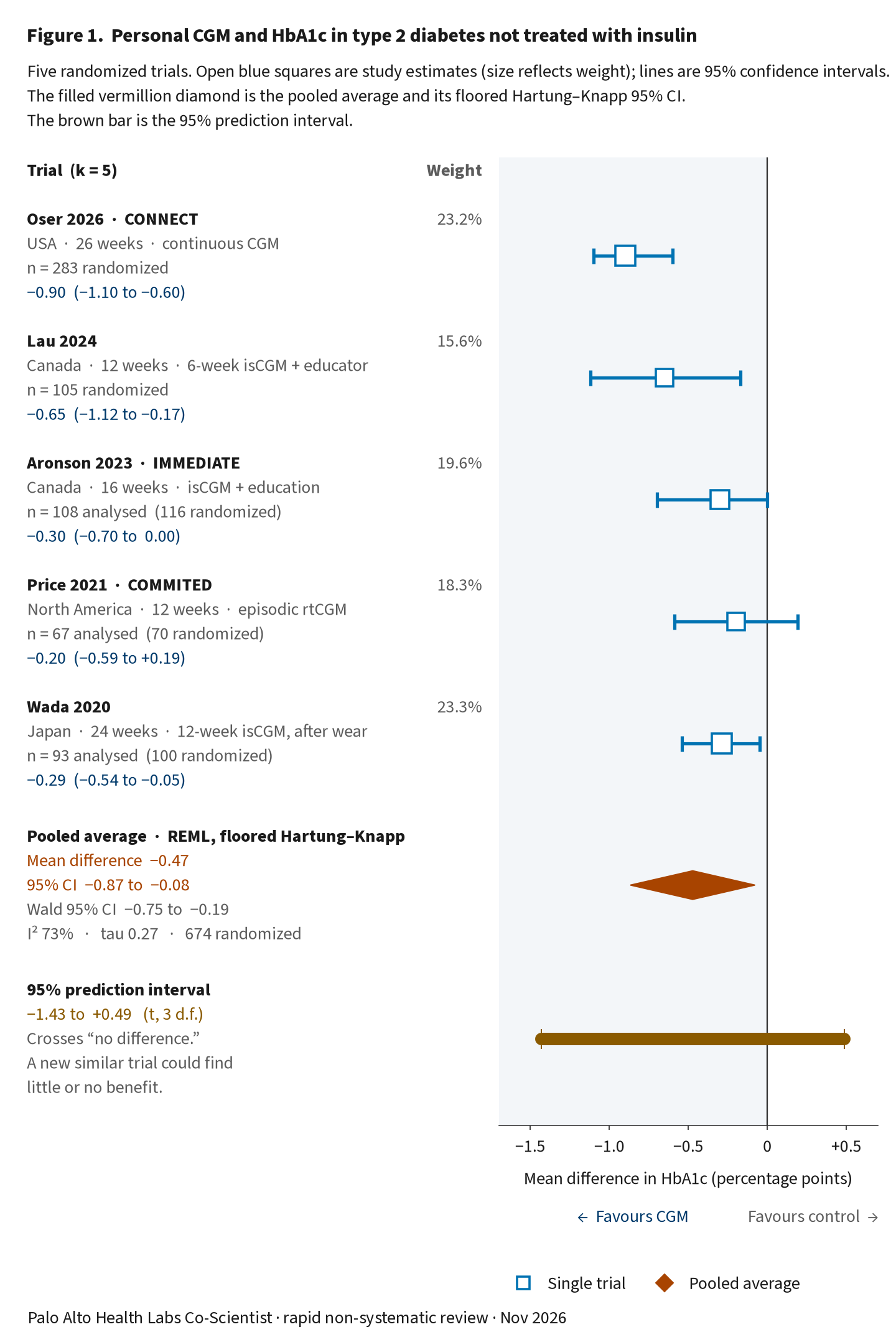
Figure 1. Mean difference in HbA1c, in percentage points, for personal CGM versus usual care or finger-stick testing. Open blue squares are the trial estimates (size reflects the trial's weight in the pool); horizontal lines are 95% confidence intervals. The filled vermillion diamond is the pooled average and its floored Hartung–Knapp 95% confidence interval. The brown bar is the 95% prediction interval, which crosses "no difference."
Why the results differ
The trials did not use CGM in the same way. CONNECT used continuous personal CGM for 26 weeks in primary care. IMMEDIATE used scanned CGM plus a structured education programme, with the same education given to the control group. Lau used six weeks of scanned CGM plus virtual educator visits, also with educator visits in both arms. Wada provided scanned CGM for 12 weeks and measured HbA1c at 24 weeks, after the sensors had been stopped. COMMITED used three 10-day bursts of real-time CGM. The filed protocol had planned a sensitivity split of continuous wear versus short or episodic wear. In the numeric pool, only COMMITED is clearly episodic, so that subgroup cannot be pooled (k = 1). Moon also used intermittent one-week sessions, but it was not in the numeric pool. No pooled continuous-versus-episodic contrast is reported.
CONNECT is the main source of the spread. It is the largest trial (283 people randomized) and has the largest effect (−0.90 points, 95% CI −1.10 to −0.60). When it is left out, the remaining four trials give a smaller average of −0.32 points (floored Hartung–Knapp 95% CI −0.59 to −0.05; Wald 95% CI −0.49 to −0.15), and the measured heterogeneity falls to about zero.
The table below reports every leave-one-out analysis under the same floored Hartung–Knapp interval used for the headline result. Three of the five runs include no difference (leaving out Lau, IMMEDIATE, or Wada). The average therefore depends on single trials and is fragile.
| Trial left out | Mean difference | Floored Hartung–Knapp 95% CI | Wald 95% CI | Includes no difference? |
|---|---|---|---|---|
| Oser 2026 (CONNECT) | −0.32 | −0.59 to −0.05 | −0.49 to −0.15 | No |
| Lau 2024 | −0.44 | −0.97 to 0.10 | −0.77 to −0.11 | Yes |
| Aronson 2023 (IMMEDIATE) | −0.51 | −1.06 to 0.03 | −0.85 to −0.18 | Yes |
| Wada 2020 | −0.53 | −1.08 to 0.02 | −0.87 to −0.19 | Yes |
| Price 2021 (COMMITED) | −0.53 | −1.04 to −0.02 | −0.85 to −0.22 | No |
Three of the five pooled trials had industry funding (CONNECT and COMMITED were funded by the device manufacturer; IMMEDIATE was supported by a manufacturer grant). Leaving out IMMEDIATE, whose HbA1c contrast was a secondary endpoint, also leaves a floored Hartung–Knapp interval that includes no difference (see the table). Leaving out all three industry-funded trials leaves only Lau and Wada, which is below the protocol's pooling threshold of three trials. Those two estimates were −0.65 and −0.29 points.
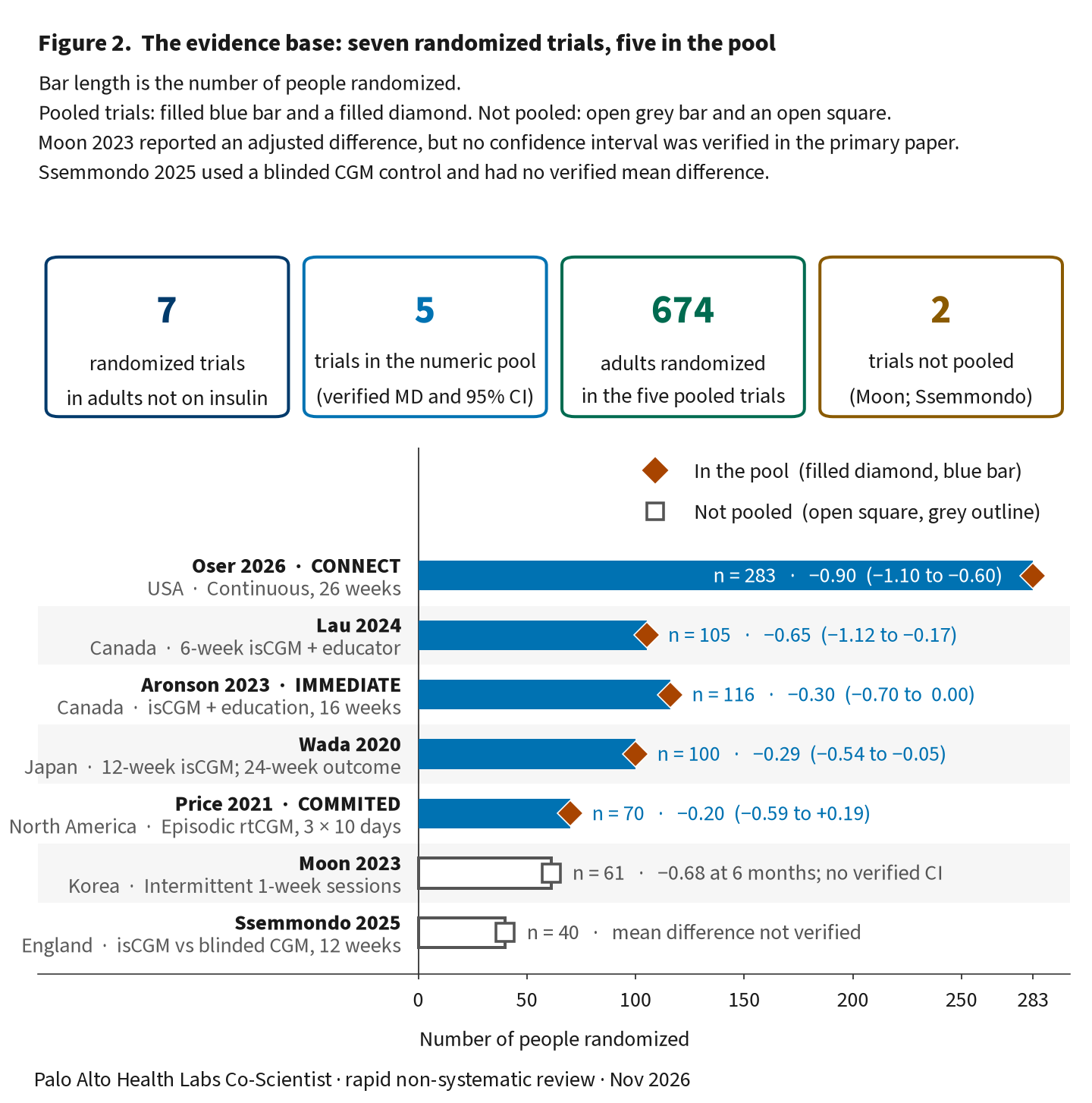
Figure 2. The evidence base. Bar length is the number of people randomized. Blue bars are the five trials in the numeric pool (674 people randomized in total). Grey bars are the two trials that were not pooled.
What happens after the sensor comes off
The timing of benefit is not settled, and it does not tell one simple story. In COMMITED, the week-12 difference was already small and was not statistically significant. At month 9, after episodic wear had stopped, mean HbA1c change was −0.2% with prior CGM and +0.1% with finger-stick testing (p = 0.79); the number of people analysed at month 9 was not clearly stated. In Wada, the contrast during the 12 weeks of wear was −0.13 points (95% CI −0.35 to 0.09) and was not statistically significant, while the pre-specified 24-week contrast, after wear had stopped, was −0.29 points (95% CI −0.54 to −0.05). Those two time courses do not show a consistent fade, or a consistent delayed benefit, after the sensor is removed.
Two trials that were not pooled
Moon and colleagues randomized 61 people in Korea to one 1-week session of real-time CGM, two sessions three months apart, or control. At six months, only the two-session arm still showed a significant adjusted difference versus control (−0.68 points, p = 0.018). No 95% confidence interval was given in the abstract, and the full text was not open, so that estimate was not entered in the numeric pool.
Ssemmondo and colleagues randomized 40 people in England to scanned CGM or to a blinded professional sensor (not open usual care). A larger share of the scanned-CGM group had an HbA1c fall of at least 5.5 mmol/mol (53% vs 35%, p = 0.34), and the abstract described a non-significant reduction of 8 mmol/mol, but no mean difference with a confidence interval was verified. Time in range was 18 percentage points higher with the scanned sensor (95% CI 2 to 35). This trial was kept out of the primary pool because of the blinded-sensor control and the missing HbA1c precision.
| Trial | Setting | Wear pattern | People randomized | HbA1c mean difference (95% CI) | In the pool? |
|---|---|---|---|---|---|
| Oser 2026 (CONNECT) | USA, primary care | Continuous, 26 weeks | 283 | −0.90 (−1.10 to −0.60) | Yes |
| Lau 2024 | Canada | 6-week scanned CGM + educator | 105 | −0.65 (−1.12 to −0.17) | Yes |
| Aronson 2023 (IMMEDIATE) | Canada | Scanned CGM + education, 16 weeks | 116 | −0.30 (−0.70 to 0.00) | Yes |
| Wada 2020 | Japan | 12-week scanned CGM; 24-week outcome | 100 | −0.29 (−0.54 to −0.05) | Yes |
| Price 2021 (COMMITED) | North America | Three 10-day sessions | 70 | −0.20 (−0.59 to +0.19) | Yes (calculated from table means) |
| Moon 2023 | Korea | One or two 1-week sessions | 61 | −0.68 at 6 months (two-session arm); no verified CI | No |
| Ssemmondo 2025 | England | Scanned vs blinded CGM, 12 weeks | 40 | Not verified | No |
Caveats
This is a rapid non-systematic review, not a registered systematic review. Titles and abstracts were screened by one reviewer. The filed PubMed queries had a documentation gap: a mistyped MeSH heading and several quoted "not … insulin" phrases were ignored by PubMed, so the narrow query relied on "non-insulin" wording only. Landmark checking recovered Cox 2020, which both queries missed (it is not tagged as a randomized controlled trial in PubMed, and its abstract used one of the ignored phrases); that trial was still excluded because CGM was bundled with a distinctive education programme.
Several full texts were not open. CONNECT's analysed sample size, device model, and author conflict statements beyond a funding line were not in the open abstract or trial registry. Lau's per-arm sample size, per-arm HbA1c values, and the journal's own funding statement were not retrieved (the registry lists the University of Alberta as sponsor). Moon's confidence interval was not verified in the primary paper. All of the trials were open-label, as is usual for this comparison. Education or educator visits were built into both arms of some trials, so the contrast is not always "CGM alone versus nothing." The COMMITED mean difference was calculated from published means and standard deviations, not reported directly as an adjusted contrast. Industry funding is common in this evidence base and is a standard reason for caution, not a finding about any one product.
The average effect is modest, the trials do not agree, and a new similar trial could come out near "no difference." That is the fair reading of this set of studies.
Methods
Question. In adults with type 2 diabetes who are not using insulin, does personal real-time or intermittently scanned CGM, compared with usual care or self-monitoring of blood glucose, change HbA1c?
Eligibility. Parallel-group or crossover randomized trials in adults (≥18 years) with type 2 diabetes not treated with insulin at baseline. Mixed insulin populations were eligible for the primary set only if a non-insulin subgroup was reported separately. The intervention had to be personal, patient-facing CGM (continuous or episodic). Blinded or professional CGM used only to measure outcomes in both arms was not an intervention. Comparators were usual care or finger-stick testing; a blinded-CGM control was eligible only for a sensitivity set. The primary effect measure was the mean difference in HbA1c, in percentage points (CGM minus control), at the longest follow-up of 12 months or less. Programmes that bundled CGM with a unique active intervention not offered to the control arm were listed as related evidence and were not pooled.
Search. Existing PubMed files were reused and not replaced. Counts were re-run on 23 November 2026 at 21:55 PST (America/Los_Angeles) and were unchanged: query 1, 55 records; query 2, 273 records; 307 unique PubMed identifiers.
Query 1 (narrow, non-insulin terms):
```
("continuous glucose monitoring"[tiab] OR "continuous glucose monitor"[tiab] OR "flash glucose monitoring"[tiab] OR "intermittently scanned"[tiab] OR CGM[tiab] OR "FreeStyle Libre"[tiab]) AND ("type 2 diabetes"[tiab] OR "type 2 diabetes mellitus"[MeSH]) AND (non-insulin[tiab] OR "not using insulin"[tiab] OR "not on insulin"[tiab] OR "not treated with insulin"[tiab] OR "non-insulin-treated"[tiab] OR "without insulin"[tiab] OR "noninsulin"[tiab] OR "not taking insulin"[tiab]) AND (randomized controlled trial[pt] OR randomi*[tiab])
```
PubMed ignored the MeSH phrase "type 2 diabetes mellitus"[MeSH] (the correct heading is "Diabetes Mellitus, Type 2"[MeSH]) and ignored the quoted phrases that begin with "not" (the Boolean operator is not applied as intended inside those quotes). The executed translation therefore used only non-insulin, non-insulin-treated and noninsulin in the population clause. A MeSH-corrected re-run on the same date still returned 55 records, because those ignored phrases remain dropped.
Query 2 (broader RCT plus HbA1c):
```
("continuous glucose monitoring"[tiab] OR "continuous glucose monitor"[tiab] OR "flash glucose monitoring"[tiab] OR "intermittently scanned"[tiab] OR "real-time CGM"[tiab] OR CGM[tiab]) AND ("type 2 diabetes"[tiab] OR "type 2 diabetes mellitus"[MeSH]) AND (randomized controlled trial[pt]) AND (HbA1c[tiab] OR A1C[tiab] OR "glycated"[tiab])
```
The same incorrect MeSH phrase was ignored. This query requires the publication type "Randomized Controlled Trial" and can miss trials not yet, or never, tagged as such.
An OpenAlex exact (non-stemmed) check was run on the same date, restricted to type:article and publication years 2008–2026: "continuous glucose monitoring" AND "type 2 diabetes", 3,365 works; "flash glucose monitoring" AND "type 2 diabetes", 247 works; "intermittently scanned" AND "type 2 diabetes", 81 works; "continuous glucose monitoring" AND "type 2 diabetes" AND "non-insulin", 108 works. Pre-specified landmark trial DOIs were all present in OpenAlex.
A landmark set, checked against the filed PubMed results and corroborated for recall only against the trial list in Aronson and colleagues (2025), captured IMMEDIATE, Wada 2020, Moon 2023, COMMITED, Ssemmondo 2025, Lau 2024, CONNECT, and several insulin-treated or otherwise ineligible trials. Missed by both filed PubMed queries, and recovered by the landmark search, was Cox and colleagues (2020). Query 2 misses it because it is not tagged Randomized Controlled Trial [pt]; query 1 misses it because "were not using insulin" was among the ignored phrases. The trial remains excluded from the primary pool for the bundling reason given above.
Extraction and verification. Numbers were taken from a fetched source (PubMed E-utilities abstract, PMC or publisher full text, ClinicalTrials.gov, or Crossref). If a number could not be verified, the cell was left blank. Companion papers of the same trial were not double-counted. Each DOI in the sources file and in the reference list was read only from PubMed PubmedData/ArticleIdList/ArticleId[@IdType='doi'] or ELocationID[@EIdType='doi'] (not from a recursive search that can pick up cited-reference DOIs) and was confirmed on Crossref against the PubMed title (normalized fuzzy ratio ≥ 0.9) and first author.
Analysis. Pooling required at least three comparable trials with a verified or transparently calculated mean difference and 95% confidence interval. The primary model was random-effects REML in R 4.5.0 with metafor 4.8.0, fitted as rma(method="REML", test="adhoc"). The main 95% confidence interval is the floored Hartung–Knapp interval, μ ± t(0.975, k−1) × SE_REML × √max(1, q), where q = Σ w_i (y_i − μ)² / (k−1) and w_i = 1/(v_i + τ²); q was 0.924 in the primary pool, below 1, so the floor of 1 applied, and the same floored interval was used for the sensitivity analyses. The REML Wald confidence interval, tau, tau² and I² are reported alongside it. Study standard errors were taken from the printed confidence-interval width, (upper − lower) / (2 × 1.96). The 95% prediction interval uses a t distribution with k−2 degrees of freedom and the REML tau². Leave-one-out analyses, including runs without each industry-funded trial and without IMMEDIATE, were added as sensitivity analyses; they were not listed in the filed protocol. The protocol had pre-specified a sensitivity split by CGM intensity (continuous wear versus short or episodic wear). In the primary set only COMMITED is clearly episodic (three 10-day sessions), so that split could not be pooled (k = 1 for episodic wear; Moon, which is also intermittent, was not in the numeric pool). No pooled continuous-versus-episodic contrast is reported. Moon was not included in the numeric pool, because a confidence interval was not verified in the primary paper.
Screening decisions are in work/screening.csv. Extracted numbers are in sources.csv. The pooling log is in work/prelim_pool.txt.
References
- Oser TK, Martens T, Ruedy KJ, et al. Continuous glucose monitoring in non-insulin-treated type 2 diabetes. N Engl J Med. 2026;395(17):1717-1727. doi: 10.1056/NEJMoa2608571
- Lau D, Manca DP, Singh P, et al. The effectiveness of continuous glucose monitoring with remote telemonitoring-enabled virtual educator visits in adults with non-insulin dependent type 2 diabetes: a randomized trial. Diabetes Res Clin Pract. 2024;217:111899. doi: 10.1016/j.diabres.2024.111899
- Aronson R, Brown RE, Chu L, et al. IMpact of flash glucose Monitoring in pEople with type 2 Diabetes Inadequately controlled with non-insulin Antihyperglycaemic ThErapy (IMMEDIATE): a randomized controlled trial. Diabetes Obes Metab. 2023;25(4):1024-1031. doi: 10.1111/dom.14949
- Moon SJ, Kim K-S, Lee WJ, Lee MY, Vigersky R, Park C-Y. Efficacy of intermittent short-term use of a real-time continuous glucose monitoring system in non-insulin-treated patients with type 2 diabetes: a randomized controlled trial. Diabetes Obes Metab. 2023;25(1):110-120. doi: 10.1111/dom.14852
- Price DA, Deng Q, Kipnes M, Beck SE. Episodic real-time CGM use in adults with type 2 diabetes: results of a pilot randomized controlled trial. Diabetes Ther. 2021;12(7):2089-2099. doi: 10.1007/s13300-021-01086-y
- Wada E, Onoue T, Kobayashi T, et al. Flash glucose monitoring helps achieve better glycemic control than conventional self-monitoring of blood glucose in non-insulin-treated type 2 diabetes: a randomized controlled trial. BMJ Open Diabetes Res Care. 2020;8(1):e001115. doi: 10.1136/bmjdrc-2019-001115
- Ssemmondo E, Shah N, Newham M, et al. Effect of introduction of intermittently scanned continuous glucose monitoring on glycaemic control in individuals living with type 2 diabetes mellitus treated with non-insulin therapies: a randomised controlled trial. Diabetes Obes Metab. 2025;27(3):1226-1232. doi: 10.1111/dom.16116
- Cox DJ, Banton T, Moncrief M, Conaway M, Diamond A, McCall AL. Minimizing glucose excursions (GEM) with continuous glucose monitoring in type 2 diabetes: a randomized clinical trial. J Endocr Soc. 2020;4(11):bvaa118. doi: 10.1210/jendso/bvaa118
- Aronson R, et al. Continuous glucose monitoring in noninsulin-treated type 2 diabetes: a critical review of reported trials with an updated systematic review and meta-analysis of randomised controlled trials. Diabetes Obes Metab. 2025;27(11):6220-6242. doi: 10.1111/dom.70008
Corrections
None yet.
Found an error? Email hello@paloaltohealthlabs.com.
More from the Palo Alto Health Labs Co-Scientist · All posts
Have your own questions? Sign up for the Beta
Tell us the health AI or digital health question you would want the Co-Scientist to review, and join the beta list.
Scope it in 30 minutes
Book a scoping call and we'll name the smallest engagement that moves you forward. Most teams start with the fixed-scope Initial Audit.
Book a 30-min scoping callPrefer to write? Send a short note.