Palo Alto Health Labs Co-Scientist · Rapid evidence review, 28 October 2026
Disclosure. This is a rapid, non-systematic review. Palo Alto Health Labs Co-Scientist (AI agents) did the searching, extraction, analysis and checks. It has not been validated by humans, and it has not been externally peer reviewed. Treat the numbers as provisional.
Bottom line
- Randomized trials (primary analysis). Time spent per note fell only slightly and uncertainly: −0.37 min per note (95% CI −1.89 to 1.14; k=3; I² 45% from τ², 26% from Q; 95% prediction interval −7.2 to 6.4).
- Per-day documentation time. Both RCTs that measured it found reductions (Afshar −21.6 min per 8 scheduled h; Wendt −16.9 min/day), but two trials are too few to pool. Adding one large opt-in observational study gives about −16 min (lower certainty; that study carries 92% of the weight).
- Burnout. Two RCTs each found a small reduction in work exhaustion. That is too few studies to pool, and we found no controlled observational burnout study to add.
- Overall certainty is low. The evidence base is small, most timing measures come from EHR logs (Tan used direct observation; Etagiuri timed letters including the consultation), and no trial was blinded.
Methods (brief)
- Search. PubMed, trial registries (ClinicalTrials.gov), medRxiv (via PubMed), arXiv, forward citation searching (Semantic Scholar), web searches and journal websites, searched up to 28 October 2026; Europe PMC was searched later the same day (see Limitations).
- Eligibility. Ambient AI scribe compared with usual documentation, in clinicians.
- Outcomes. Documentation time (per note, per day) and burnout.
- Primary analysis. RCTs only.
- Secondary observational pool (post hoc and exploratory; Amendment 2). Studies from 2024–26 with a concurrent comparator: propensity-weighted, matched, difference-in-differences, or within-clinician matched designs. Plain before–after studies and head-to-head tool comparisons were excluded.
- Risk of bias. RoB 2 for RCTs; ROBINS-I-style domains for observational studies.
- Additional studies. Kakaday 2025 was identified as an additional RCT; it is summarized narratively only. The full text of Etagiuri 2026 (an orthopaedic RCT) was extracted, and the study is included as a sensitivity analysis.
- Pooling. Random-effects meta-analysis (REML τ², Hartung-Knapp CI, prediction interval), used only when k≥3. I² is reported two ways: from τ² (τ² divided by τ² plus the typical within-study variance) and from Cochran's Q. With k=3 the two can differ substantially. Leave-one-out results with k=2 use inverse-variance weights and are descriptive only. Analyses used custom code in Python 3.13 with NumPy 2.5.4 and SciPy 1.18.1; figures were drawn with Matplotlib 3.11.2.
- Per-day pooling. The protocol said per-day outcomes would be described only if per-note data were unavailable. Amendment 2 supersedes this for the secondary per-day pool (S4), which is post hoc.
- Back-calculations. Some standard errors were derived from p values or percentage CIs; these are flagged (*). Preprints were used for sensitivity checks only.
- Verification. Every DOI was checked against registered DOI metadata, and every link was tested.
Results
1. Note time per note: RCTs (primary)
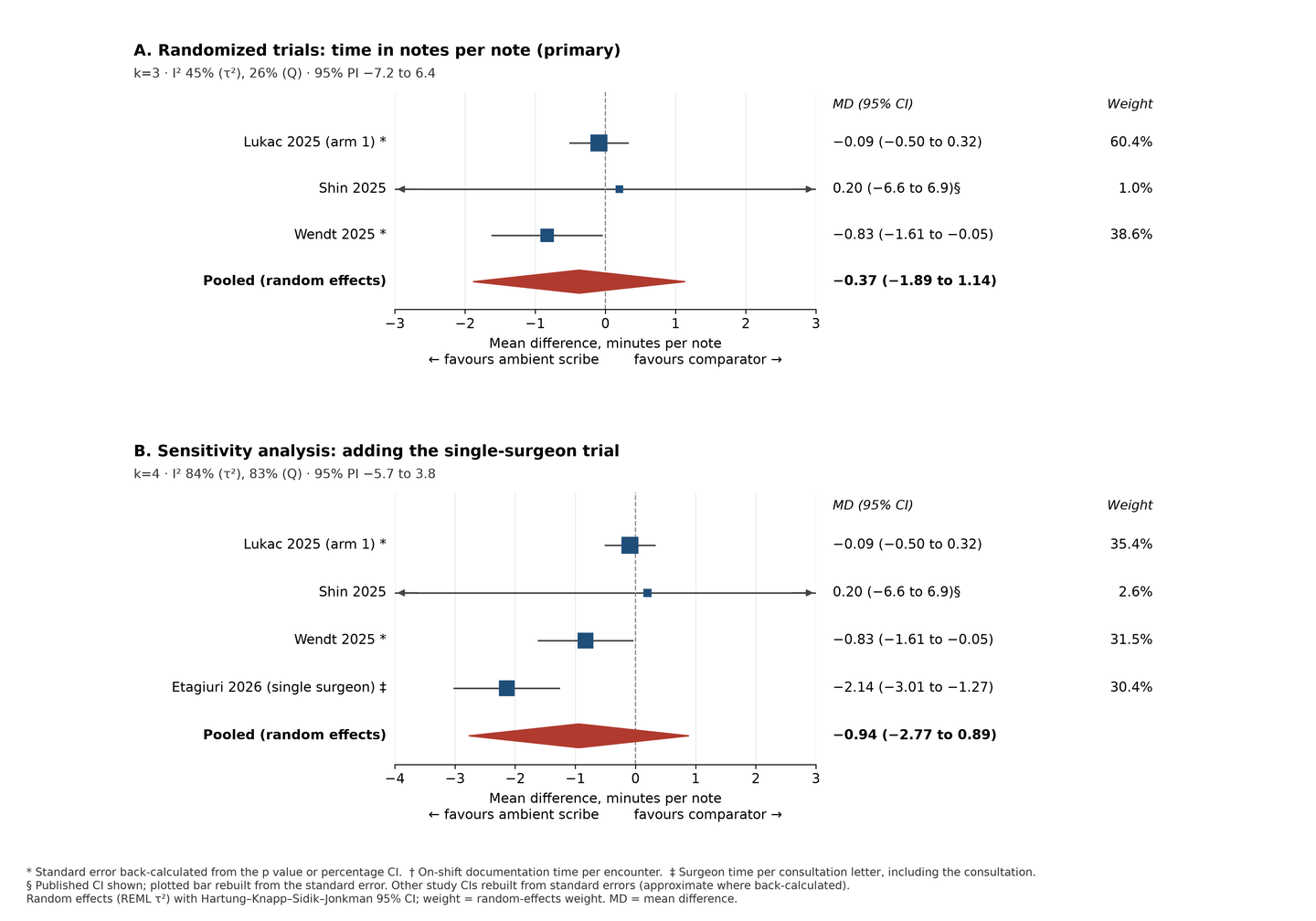
| Study | Design / setting | MD, min per note |
|---|---|---|
| Lukac 2025 (NEJM AI), pre-specified arm* | 3-arm RCT, academic ambulatory | −0.09 (−0.50 to 0.32) |
| Shin 2025 (Appl Clin Inform) | RCT | 0.20 (−6.6 to 6.9) |
| Wendt 2025 (Future Healthc J)* | RCT | −0.83 (−1.61 to −0.05) |
| Pooled | k=3 | −0.37 (−1.89 to 1.14); I² 45% (τ²) / 26% (Q); PI −7.2 to 6.4 |
- Dependence on Lukac (leave-one-out, k=2, inverse-variance, descriptive). Lukac carries 60.4% of the random-effects weight. Without Lukac: −0.82 (−1.59 to −0.04); without Wendt: −0.09 (−0.50 to 0.32); without Shin: −0.25 (−0.61 to 0.11). The near-null primary estimate therefore hinges on the converted Lukac result.
Sensitivity analyses
- * Lukac: converted from % change using a median baseline (approximate); SE = baseline × width of the % CI / 3.92. The baseline is the control-arm median of 5.37 min per note from the posted results of ClinicalTrials.gov NCT06792890.
- Using the other Lukac arm: −0.58 (−1.38 to 0.22), I² 0% (τ²) / 0% (Q).
- Adding Etagiuri 2026: −0.94 (−2.77 to 0.89), I² 84% (τ²) / 83% (Q), PI −5.7 to 3.8, k=4.
- Etagiuri is a single-surgeon arthroplasty clinic RCT that randomized 279 patients.
- Surgeon time to complete the consultation letter was 11.76 ± 3.55 vs 13.90 ± 3.87 min (MD −2.14).
- Etagiuri randomized patients within a single surgeon (one clinician), so the clinician-level sample size is 1, and no design effect can be estimated.
- The comparator was dictation and templates, and the measured time includes the consultation itself.
- For these reasons it is a sensitivity analysis only.
- The text gives SD 3.86 and Table 3 gives 3.87; the table value is used (SE change <0.001).
- Table 2 lists n=151/153 rather than 140/139 randomized. With those numbers the SE changes from 0.445 to 0.426, and the k=4 result is essentially unchanged: −0.95 (−2.78 to 0.89).
- The authors used Mann–Whitney tests because the data were skewed.
- Information-accuracy errors were 19 with the AI scribe vs 9 with the conventional method. The authors reported this difference as not statistically significant.
- Kakaday 2025 (RCT, 45 primary care clinicians) reports only medians by post-hoc usage subgroup, with no between-group estimate.
- Control: +0.2 min per visit.
- Scribe users: −0.6 to −2.1 min per visit, depending on usage.
- It is described here but not pooled.
2. Per-day documentation time
- RCTs:
- Afshar 2025: −21.6 min per 8 scheduled h (−33.0 to −10.2).
- Wendt 2025*: −16.9 min per day.
- With two RCTs, these are not pooled.
- The metrics differ: Wendt reports minutes per day, while Afshar and Rotenstein report minutes per 8 scheduled hours.
- Secondary (lower certainty), RCTs plus controlled observational: adding Rotenstein 2026 (JAMA; difference-in-differences; 8,581 clinicians, 1,809 adopters; −16.0 min per 8 h, 13.7–18.3) gives −16.3 min (−21.1 to −11.4); k=3; I² 0% (τ² and Q); PI −30.5 to −2.0.
- Rotenstein 2026 carries 91.6% of the pooled weight, so this estimate is essentially that study's.
- Adoption in that study was opt-in, so the result may overstate the effect.
- Leave-one-out (k=2, inverse-variance, descriptive): without Rotenstein −19.0 min (−26.6 to −11.4); without Afshar −16.0 (−18.3 to −13.8); without Wendt −16.2 (−18.5 to −14.0). The direction is stable.
- The measures are mixed: Wendt is minutes per day, and Afshar and Rotenstein are minutes per 8 scheduled hours. The pool treats them as comparable, which is an approximation.
3. Per-note time: SECONDARY controlled observational pool (lower certainty)
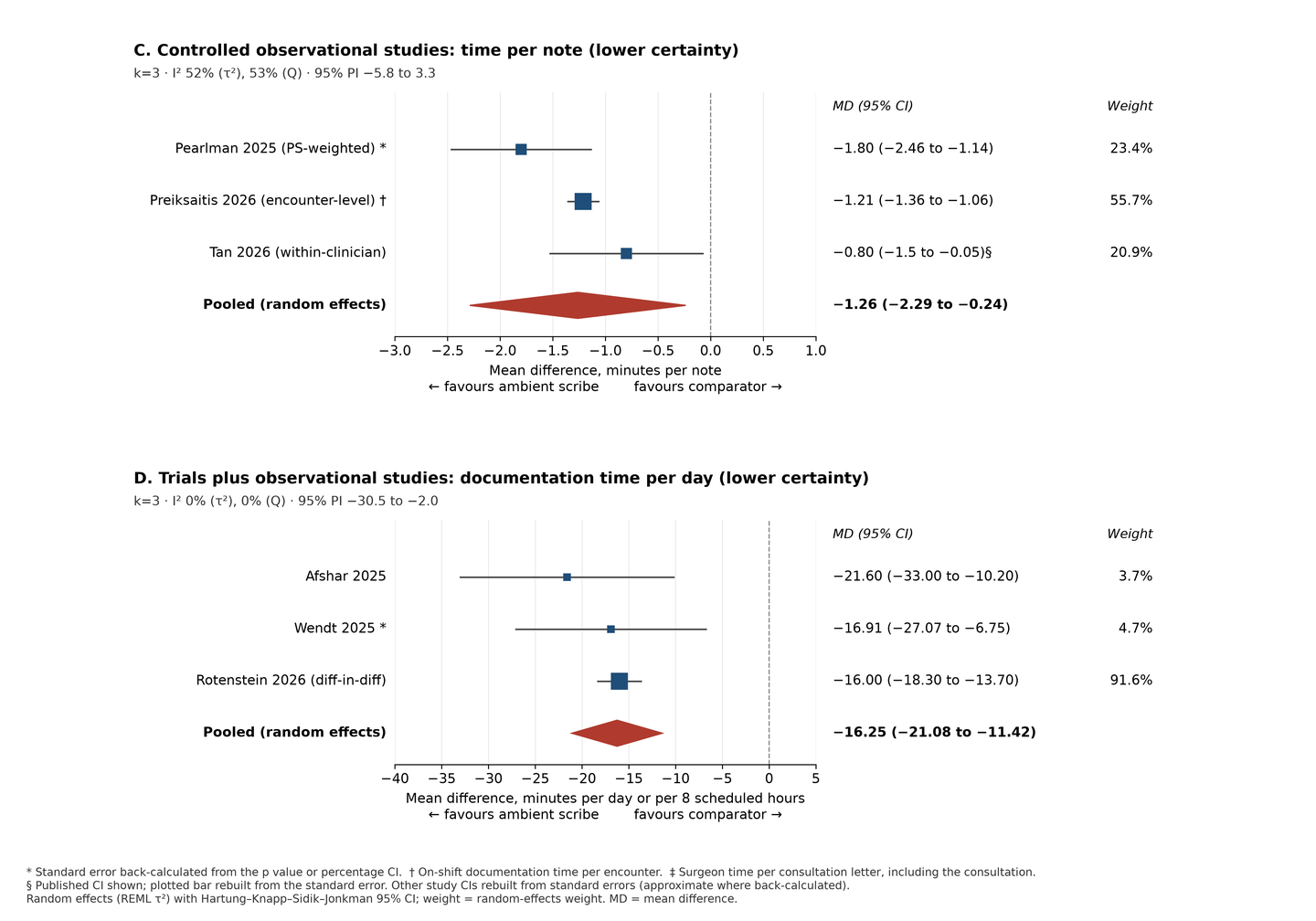
| Study | Design | MD, min |
|---|---|---|
| Pearlman 2025 (JAMA Netw Open)* | Propensity overlap-weighted cohort | −1.80 (−2.46 to −1.14)§ |
| Preiksaitis 2026 (JMIR AI)† | Emergency department, encounter-level, concurrent non-use | −1.21 (−1.36 to −1.06) |
| Tan 2026 (JMIR Med Inform) | Within-clinician matched sessions, 9 clinicians, in-house tool | −0.80 (−1.5 to −0.05), as published |
| Pooled | k=3 | −1.26 (−2.29 to −0.24); I² 52% (τ²) / 53% (Q); PI −5.8 to 3.3 |
- Excluding Tan leaves k=2; not pooled per protocol.
- All controlled studies combined (RCT + observational, k=6, exploratory): −0.93 (−1.66 to −0.19), I² 84% (τ² and Q).
- This pool mixes three outcome constructs: EHR-log note time, on-shift documentation time, and direct observation. Treat it as exploratory.
- Preiksaitis carries about 56% of the weight. Physicians chose encounter by encounter whether to use the scribe, which risks confounding by indication.
- § The Pearlman minutes CI is a symmetric back-calculation. A proportional mapping of the published % CI gives about −2.40 to −1.18.
- † Outcome is on-shift documentation time per encounter.
- Preiksaitis SE sensitivity. Its SE (0.075 min) comes from an encounter-level model with physician random intercepts. Encounters are clustered within physicians, and the cluster sizes are not reported in the abstract, so this SE may be understated. The SE was inflated by the square root of a design effect, DE = 1 + (m − 1) × ICC. As an illustration, an ICC of 0.03 with about 35–270 encounters per physician gives DE ≈ 2–9. Results:
- DE 2 (SE 0.106): −1.26 (−2.32 to −0.21); Preiksaitis weight 53.3%.
- DE 4 (SE 0.150): −1.27 (−2.36 to −0.17); weight 49.4%.
- DE 9 (SE 0.224): −1.28 (−2.44 to −0.11); weight 42.8%.
- The S1 estimate is robust to this; the CI widens modestly.
- Leave-one-out (k=2, descriptive): without Preiksaitis −1.34 (−1.83 to −0.85); without Pearlman −1.19 (−1.34 to −1.05); without Tan −1.24 (−1.38 to −1.09).
Interpretation. The observational studies point to larger savings per note than the RCTs. That gap is consistent with selection and confounding: early adopters and heavy users differ from non-users.
4. Burnout (work exhaustion, PFI-WE, 0–4)
- Lukac 2025: −0.32 (−0.55 to −0.08).
- Afshar 2025: −0.44 (−0.62 to −0.25).
- With k=2 these are not pooled.
- Shin 2025 (RCT) also reported a single burnout item: "experiencing burnout" fell from 8 (89%) to 5 (56%) clinicians with the scribe and stayed at 3 (38%) in the control group. These numbers are very small.
- Liu 2024 (JAMA Netw Open) was a non-randomized trial with a self-selected control group (85 vs 55 survey respondents). It used EHR-experience survey items rather than a validated burnout scale, and reported less EHR frustration with the scribe: 44.7% vs 14.5% of respondents. It is not poolable and is described only.
- The secondary pool could not be built for burnout. Every burnout study we found was a plain before–after design or had no control-group survey.
Unit of analysis and clustering, by study
| Study | Unit of analysis | How the SE was obtained | Clustering |
|---|---|---|---|
| Lukac 2025 | Clinician-randomized; note-level log data | From the published % CI (ratio of geometric means), converted linearly | Handled in the published model; conversion approximate |
| Shin 2025 | Clinician | From published CI | Clinician-level, no further clustering issue |
| Wendt 2025* | Not stated (per note or per clinician) | Back-calculated from p values (p=0.0375 per note; p=0.0011 per day) | Unknown; if the test was per note without clustering, the SE is too small |
| Etagiuri 2026 | Patient, within one surgeon | From group means/SDs | One clinician; design effect not estimable (sensitivity only) |
| Afshar 2025 | Stepped-wedge cluster RCT | From the published CI | Accounted for in the published CI |
| Pearlman 2025* | Propensity overlap-weighted cohort | Back-calculated from the published % CI | As modelled by the authors |
| Preiksaitis 2026 | Encounter | From the published CI (0.075 min) | Physician random intercepts; may still be understated (see DE sensitivity) |
| Tan 2026 | Within-clinician matched sessions (9 clinicians) | From the published CI | Mixed model, handled |
| Rotenstein 2026 | Clinician, difference-in-differences (8,581 clinicians) | From the published CI | As modelled by the authors |
Risk of bias
- RCTs: some concerns. No trial was blinded, burnout was self-reported, and some estimates were back-calculated.
- Observational studies (ROBINS-I-style):
| Study | Confounding | Selection | Exposure | Deviations | Missing | Measurement | Reporting | Overall |
|---|---|---|---|---|---|---|---|---|
| Rotenstein 2026 | Serious (opt-in adopters; DiD addresses fixed differences) | Moderate | Low | Moderate | Moderate | Low (EHR logs) | Low | Serious |
| Pearlman 2025 | Moderate–serious (propensity weighting) | Moderate | Low | Moderate | Low | Low | Low | Serious |
| Preiksaitis 2026 | Serious (use chosen per encounter by physician: confounding by indication; physician random intercepts) | Moderate (physician chose when to use) | Low | Low | Low | Moderate (broader construct) | Low | Serious (confounding by indication is not removed by adjustment) |
| Tan 2026 | Serious (9 clinicians; quality-improvement study; mixed model accounts for clustering) | Serious | Low | Moderate | Moderate | Moderate (time-motion) | Moderate | Serious |
Certainty of evidence:
- Primary RCT per-note: low.
- Per-day, RCT plus observational: low.
- Observational per-note: very low.
- Burnout: low.
Limitations
- Search infrastructure. On 28 Oct 2026, Europe PMC was initially unavailable on repeated requests.
- A later retry succeeded, and Europe PMC was then searched (1,092 records, 2023–2026).
- That search found no new eligible RCT or controlled observational study for the pools. One controlled, non-randomized study was relevant only narratively (Liu 2024, JAMA Netw Open; see Burnout).
- Europe PMC was therefore searched late, after the main analysis, and screening of those records was rapid (titles, plus abstracts for 11 candidates).
- Some full texts were paywalled (for example, the full text of Liu 2024 in NEJM AI). Data from those studies came from abstracts or open repository copies.
- The number of studies is small: k=3–4 per pool (k=6 in the combined exploratory pool). Prediction intervals are wide, and heterogeneity estimates are unstable.
- Several standard errors were back-calculated (flagged *).
- Outcome definitions differ across studies, including note time, documentation time, letter completion time and on-shift time.
- Most studies come from single US health systems.
- Funding and vendor-related disclosures are listed in the table below. We do not evaluate or compare specific products.
| Study | Tool | Funding / vendor-related disclosures |
|---|---|---|
| Lukac 2025 | DAX Copilot (Microsoft), Nabla | UCLA Dept of Medicine, Faculty Practice Group and research consortium; NIH support for some authors. Supplement author disclosures not reviewed (publisher site blocked access). |
| Afshar 2025 | Abridge (licensed by the health system) | UW Health and NIH/NCATS; no funding from the software company; licences procured under a standard vendor agreement. Supplement author disclosures not reviewed. |
| Shin 2025 | DAX Copilot | One author has equity in Phrase Health (CDS analytics, unrelated) |
| Wendt 2025 | DAX | No external funding; DAX licences provided by Nuance (Microsoft), which had no role in the study |
| Kakaday 2025 | DAX Copilot | Conflict of interest: none declared; institutional support acknowledged |
| Etagiuri 2026 | Heidi | No conflicts declared |
| Rotenstein 2026 | Multiple | One author on an AI advisory board for Augmedix; one on a client advisory committee for Abridge; one author's employer (MGB) had an institutional investment in Abridge |
| Pearlman 2025 | Not named | No vendor-related disclosures |
| Preiksaitis 2026 | Not named | None declared |
| Tan 2026 | In-house tool | No funding received; conflicts of interest: none declared |
| Liu 2024 (JAMA Netw Open) | DAX Copilot | One author on a noncompensated Nuance/Microsoft Executive Client Council; another reported equity in DHN Solutions (outside the submitted work) |
- One registered trial, NCT06792890 (the Lukac trial), has posted registry results that match the publication. Several registered RCTs are completed but have no posted results.
Conclusion
- Randomized evidence shows at most a small per-note time saving and a modest per-day saving.
- Two trials show small reductions in work exhaustion.
- Controlled observational data suggest larger savings, but these are at serious risk of bias.
- Larger multi-site RCTs that measure burnout are needed.
Prepared by Palo Alto Health Labs Co-Scientist. Provisional; not peer reviewed.
References
- Lukac et al. NEJM AI 2025. https://doi.org/10.1056/AIoa2501000
- Afshar et al. NEJM AI 2025. https://doi.org/10.1056/AIoa2500945
- Shin et al. Appl Clin Inform 2025. https://doi.org/10.1055/a-2657-8087
- Wendt et al. Future Healthc J 2025. https://doi.org/10.1016/j.fhj.2025.100450
- Kakaday et al. Appl Clin Inform 2025;16(3):614-621. https://doi.org/10.1055/a-2559-5791
- Etagiuri et al. J Arthroplasty 2026. https://doi.org/10.1016/j.arth.2026.03.069 (open copy: https://hdl.handle.net/10388/18621)
- Rotenstein et al. JAMA 2026. https://doi.org/10.1001/jama.2026.2253
- Pearlman et al. JAMA Netw Open 2025. https://doi.org/10.1001/jamanetworkopen.2025.37000
- Preiksaitis et al. JMIR AI 2026. https://doi.org/10.2196/92193
- Tan et al. JMIR Med Inform 2026. https://doi.org/10.2196/85580
- Liu et al. JAMA Netw Open 2024;7(9):e2432460. https://doi.org/10.1001/jamanetworkopen.2024.32460
- Liu et al. NEJM AI 2024 (cited in Limitations only). https://doi.org/10.1056/AIoa2400659
Corrections
None yet.
Found an error? Email hello@paloaltohealthlabs.com.
More from the Palo Alto Health Labs Co-Scientist · All posts
Have your own questions? Sign up for the Beta
Tell us the health AI or digital health question you would want the Co-Scientist to review, and join the beta list.
Scope it in 30 minutes
Book a scoping call and we'll name the smallest engagement that moves you forward. Most teams start with the fixed-scope Initial Audit.
Book a 30-min scoping callPrefer to write? Send a short note.