Palo Alto Health Labs · Analysis: Palo Alto Health Labs Co-Scientist · October 2026
Structured abstract
Background. Large language models (LLMs) are now routinely tested on diagnostic case vignettes. Two different questions are often merged in public discussion: how an AI system performs compared with physicians on the same cases, and how often an AI system names the correct diagnosis on its own. This review keeps them separate.
Methods. Rapid review with two pools defined before final pooling. Part A pooled studies in which an AI-alone arm and an unassisted-physician arm diagnosed the same case set (top diagnosis correct), using log odds ratios, restricted maximum likelihood (REML) τ², and Hartung–Knapp–Sidik–Jonkman (HKSJ) confidence intervals with the variance factor floored at 1. Part B pooled peer-reviewed studies (journal issue year 2024–2026) reporting one-shot, open-ended top-1 accuracy of a GPT-4-class or newer model under a static prompt, with no LLM judge as the documented sole grader, using logit-transformed proportions with REML. Prediction intervals, subgroup analysis by model generation, meta-regression adjusted for case source, leave-one-out and sensitivity analyses defined before final pooling were performed. Self-grading, training-data contamination and conflicts of interest were tallied across all pooled studies.
Results. Part A (k = 6): pooled OR 2.53 (95% CI 1.80–3.57; 95% prediction interval 1.29–4.99; I² 42%), favouring AI alone, an absolute difference of roughly 10 to 31 percentage points. Every leave-one-out estimate excluded 1 (range 2.21–2.76). The only patient-outcome trial identified (Kenya; 9,347 patients analysed, 9,691 enrolled) found no significant difference in its primary outcome, 14-day treatment failure (2.2% in the intervention arm vs 2.0% in the control arm; adjusted odds ratio 0.77, 95% CI 0.55–1.08). Part B (k = 8): pooled accuracy 60.2% (46.3–72.6; prediction interval 17.9–91.3%; I² 93%). Earlier models: 53.9% (49.3–58.5); reasoning models: 67.8% (43.8–85.0); subgroup p = 0.26; case-source-adjusted OR 1.72 (0.76–3.90); this comparison is inconclusive: the OR was 0.97 with Hasan reclassified as an earlier model and 1.44 with Hasan omitted. Five of six Part A studies were run by the system's developers; two of 14 pooled studies graded with an LLM judge and three were evaluated on case sets built by the model developer; 9 of 14 used public or credentialed-access case sets; one used prospective real patients.
Conclusions. On curated cases, AI alone often matched or exceeded unassisted physicians, but absolute one-shot accuracy varied widely, and whether reasoning models are more accurate is inconclusive in these data. Patient-level benefit requires independent, prospective, pre-registered trials.
1. Introduction
Diagnostic error is a persistent source of preventable harm, and LLMs have been proposed as a way to widen differential diagnoses and catch missed conditions. Between 2024 and 2026 the literature moved from early GPT-4 case-vignette studies to head-to-head comparisons with physicians and to "reasoning" models that generate extended intermediate reasoning before answering.
Headline figures from this literature are frequently juxtaposed even though they answer different questions. A study reporting that an AI system was correct in 80% of cases where physicians were correct in 50% answers a comparative question on a specific case set. A study reporting that a model named the right diagnosis in 60% of published case reports answers an absolute-accuracy question with no human benchmark. Neither measures what happens to patients.
This review therefore asks two separate questions: (A) on the same cases, how does AI alone compare with physicians working without AI? and (B) how often does a contemporary LLM name the correct diagnosis first, on its own, in a single pass? It also tallies three recurring sources of bias: self-grading, training-data contamination, and developer involvement. The work was carried out as a rapid review by the Palo Alto Health Labs Co-Scientist.
2. Methods
2.1 Design and reporting
This is a rapid review with two random-effects meta-analyses. It follows the structure of PRISMA 2020 reporting where applicable, but it is not a full systematic review: there was a single extractor, no registered protocol, and no formal risk-of-bias instrument (Section 5).
2.2 Information sources and search
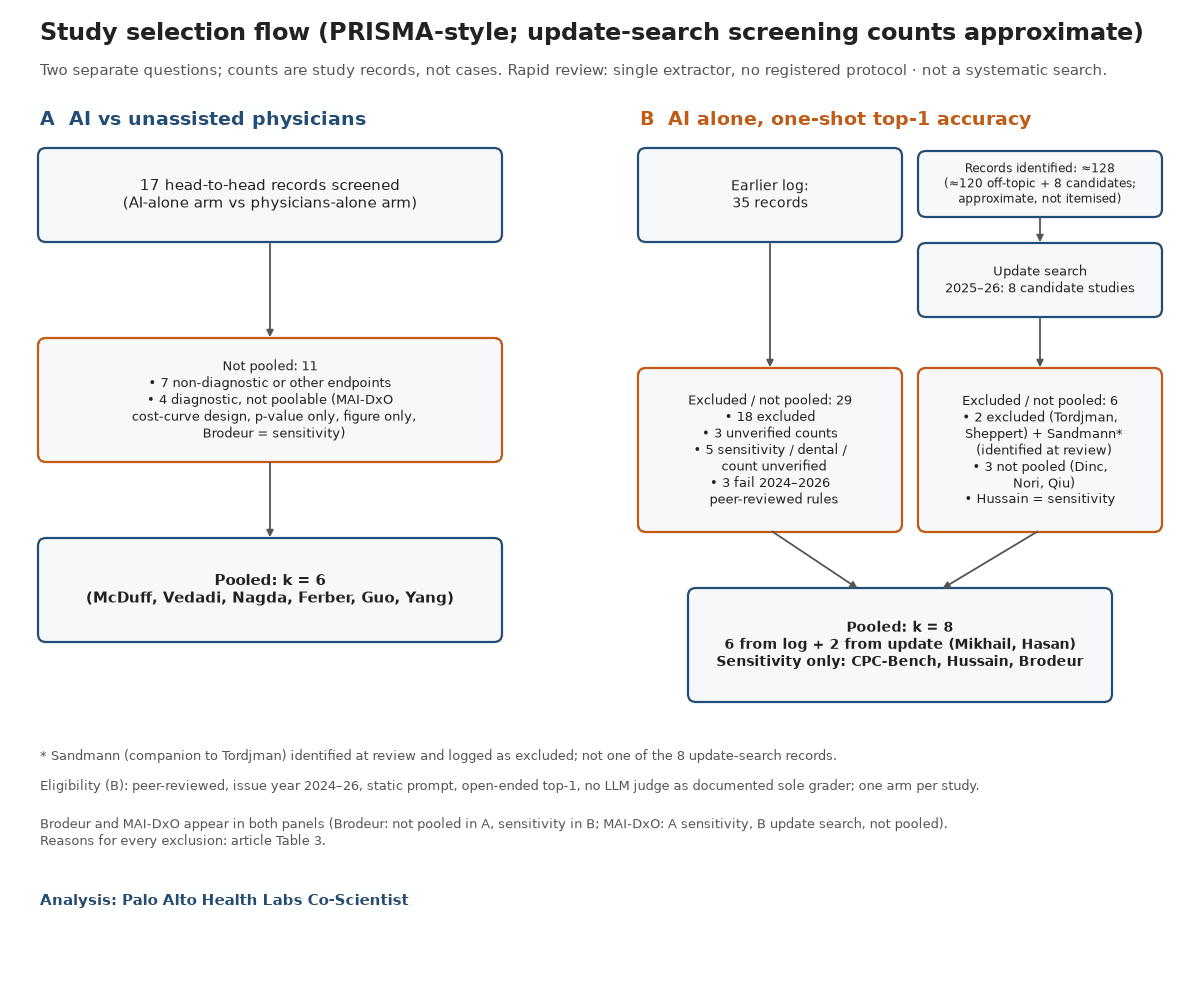
Part A drew on a structured review of 17 head-to-head records comparing AI-alone and physician-alone arms, assembled from PubMed, journal tables of contents (Nature, Nature Medicine, Science, npj Digital Medicine, JAMA Network) and arXiv/medRxiv, with citation chasing. Part B drew on an earlier extraction log of 35 records and an update search for 2025–2026 publications (PubMed and journal sites), which yielded 8 candidate studies after removal of roughly 120 off-topic hits (an approximate count; screening of these hits was not itemised). One further study (Sandmann 2025) was identified at internal review as a companion paper to an excluded study and was logged and excluded. Searches were not run from a pre-registered strategy; search strings, dates and the number of records identified before screening were not itemised, so the flow in Figure 1 documents screening and eligibility decisions, not a reproducible systematic search.
2.3 Eligibility
Part A. Studies with an AI-alone arm and an unassisted-physician arm assessed on the same cases, reporting (or permitting calculation of) the number of cases with the correct top diagnosis in each arm. Arms in which physicians used AI were not pooled. Preprints were eligible for Part A because several head-to-head comparisons exist only as preprints; this is noted as a limitation.
Part B. Peer-reviewed journal articles with journal issue year 2024–2026, testing a GPT-4-class or newer model with a static prompt (no interactive questioning or tool use), scoring open-ended top-1 diagnosis, with no LLM judge as the documented sole grader. This grading rule applies to Part B only; Part A has no grading restriction. Human grading was confirmed for 3 of the 8 Part B studies (Hirosawa, Buckley, Chan); for the other five the grader was not stated (Koga, Fabre) or not checked (Wu, Mikhail, Hasan), so the rule could only be applied to what the sources documented.
- Issue-year rule. Eligibility was decided by the journal issue year rather than the online-first date. Under this rule Koga 2024 (Brain Pathology) was retained.
- Preprint handling. Preprints were excluded from the primary Part B pool and entered only in sensitivity analyses (CPC-Bench, Hussain). Brodeur 2026 was also sensitivity-only because its NEJM cases overlap with other pooled sets.
- One arm per study. Where a study tested several eligible models, the rule defined before final pooling took the highest-accuracy eligible arm. A sensitivity analysis replaced it with the lower eligible arm in every multi-arm study.
2.4 Data extraction
For each study, the extractor recorded model, case source, number of cases and number correct, grading method, specialty, developer role, funding and employment disclosures, pre-registration, and whether cases were public. Where only percentages were reported, counts were back-calculated and flagged. Hasan 2026 was extracted from the abstract (86.1% of 101 cases for Claude Opus 4.6, giving 87/101). Whether each evaluation used a benchmark or case set built by the model developer was also coded (Section 4). Several studies were checked against full text a second time at internal review. Items that could not be confirmed were coded "not stated in source" (the paper was read and the item was absent) or "not checked" (no full-text access).
2.5 Outcomes
Part A: odds ratio for correct top diagnosis, AI alone vs unassisted physicians. Part B: proportion of cases with the correct diagnosis ranked first.
2.6 Statistical analysis
Part A. Log odds ratios with standard errors from 2×2 counts were pooled using REML estimation of τ². Confidence intervals used the HKSJ adjustment with the variance factor floored at 1 (so the interval is never narrower than the conventional one) and a t distribution on k − 1 degrees of freedom. The 95% prediction interval used t on k − 2 degrees of freedom. I² is reported from τ² (I² = τ²/(τ² + typical within-study variance)), alongside the Q-based I².
Part B. Proportions were logit-transformed and pooled with REML. Wald confidence intervals were used, and the prediction interval used t on k − 2 degrees of freedom. Subgroups by model generation (earlier: GPT-4-class and Llama 3.1; reasoning: o3, DeepSeek-R1, Claude Opus 4.6) were compared with a between-subgroup Q test. A meta-regression on the logit scale estimated the reasoning-vs-earlier odds ratio, adjusted for whether cases came from NEJM case series.
Leave-one-out. Each pool was re-estimated with each study omitted in turn.
2.7 Sensitivity analyses
Defined before final pooling: (i) Part A without Yang (best-of-7 selection), with McDuff counted per read (96/604) rather than per case, without McDuff, and with the MAI-DxO comparison added (n = 56 per arm assumed); (ii) Part B adding each preprint, both preprints, and Brodeur; the lower-arm swap; and general-medicine studies only. Every estimate was produced from the analysis scripts and an independent recomputation; no figures were estimated by hand.
3. Results
3.1 Study selection
Figure 1 shows the flow. In Part A, 17 head-to-head records were screened. Seven reported non-diagnostic or other endpoints, and four were diagnostic but not poolable: MAI-DxO (a cost-curve design with an LLM judge and no reported AI case count; sensitivity only), one reporting a p-value only, one reporting results in a figure only, and Brodeur (sensitivity only). Six studies were pooled. In Part B, the earlier log of 35 records yielded six eligible studies after applying the 2024–2026 peer-reviewed rules (three otherwise-included records failed them: Kanjee 2023; a 2023 preprint, Reese (medRxiv, https://doi.org/10.1101/2023.07.13.23292613); and Tenner 2024, a GPT-3.5 study). The update search added two (Mikhail 2025, Hasan 2026). Hussain went to sensitivity; Tordjman and Sheppert were excluded on full-text or abstract review; Dinc, Nori and Qiu were not pooled. Sandmann was logged and excluded. Reasons for every exclusion are in Table 3.
3.2 Study characteristics
Table 1 summarises the 14 pooled studies. Part A cases came mainly from NEJM case records, simulated scenario packs and MIMIC-IV-based emergency department encounters. Guo 2026 was the only prospective real-patient comparison (shadow mode; NCT06779292). Part B cases were published case reports or case challenges, three of them NEJM-derived (Fabre, Buckley, Chan), one from general journal case reports (Hirosawa) and four in specialties (neuropathology, intensive care, ophthalmology, nephrology).
Table 1. Characteristics of pooled studies
| Study | Part | System / model | Cases | AI correct / n | Physicians correct / n | Grader | Case source | Developer-built benchmark / case set | Developer role |
|---|---|---|---|---|---|---|---|---|---|
| McDuff 2025, Nature | A | AMIE | NEJM CPCs | 89/302 | 48/302 | Human (specialists) | Public | No (published NEJM CPCs; subset selected by the developers) | Developer (commercial) |
| Vedadi 2025, arXiv | A | g-AMIE (guardrailed AMIE) | Simulated scenarios | 49/60 | 32/60 | LLM auto-rater | Non-public | Yes (purpose-built scenario packs, generated by an OSCE laboratory at the team's request) | Developer (commercial) |
| Nagda 2026, arXiv | A | AMIE (Video) | Simulated scenarios | 91/100 | 77/100 | Human (expert PCPs) | Non-public | Yes (scenario packs designed by the team, prepared by an OSCE laboratory; 120 designed, 100 used) | Developer (commercial) |
| Ferber 2026, Nature | A | MIRA (academic LLM agent) | MIMIC-IV ED | 273/311 | 243/311 | LLM judge (evaluator LLM) | Credentialed access | Yes (case set and simulated patient agent built by the study team from MIMIC-IV records) | Developer (academic) |
| Guo 2026, npj Digit Med | A | Xuanwu-NeuroAid (academic LLM system) | Prospective patients | 344/433 | 283/433 | Not stated (expert-panel reference) | Non-public | No (prospective patients; consecutive patients at the developers' own hospital, Xuanwu Hospital, single centre) | Developer (academic) |
| Yang 2025, npj Digit Med | A | Best of 7 LLMs | Gastroenterology | 33/67 | 147/786 | Human (3 gastroenterologists) | Non-public | No (third-party authors) | Third party |
| Koga 2024, Brain Pathol | B | GPT-4 | Brain-bank CPCs | 13/25 | — | Not stated in source | Non-public | No (third-party authors) | Third party |
| Fabre 2024, ESMO RWD&DO | B | GPT-4 | NEJM cases | 5/10 | — | Not stated in source | Public | No (third-party authors) | Third party |
| Hirosawa 2024, Digit Health | B | GPT-4 | Journal case reports | 214/392 | — | Human | Public | No (third-party authors) | Third party |
| Buckley 2025, JAMA Health Forum | B | Llama 3.1 405B | NEJM CPCs | 10/22 | — | Human | Public | No (third-party authors) | Third party |
| Chan 2025, Int J Surg | B | DeepSeek-R1 | NEJM CPCs | 35/100 | — | Human (2 + adjudicator) | Public | No (third-party authors) | Third party |
| Wu 2025, Int J Med Inform | B | o3 | ICU cases | 36/50 | — | Not checked | Public | No (third-party authors) | Third party |
| Mikhail 2025, JAMA Ophthalmol | B | DeepSeek-R1 | Clinical challenges (text) | 297/422 | — | Not checked | Public | No (third-party authors) | Third party |
| Hasan 2026, Dtsch Arztebl Int | B | Claude Opus 4.6 | Nephrology case reports | 87/101 | — | Not checked | Public | No (third-party authors) | Third party |
Developer-built benchmark / case set: a dataset, scenario pack, rubric or benchmark built by the team or company that built the model. Yang: physician denominator is reads across cases. "Developer" means the study team built the system, whether academic or commercial. Koga's conference cases were coded non-public on review.
3.3 Part A: AI alone vs unassisted physicians
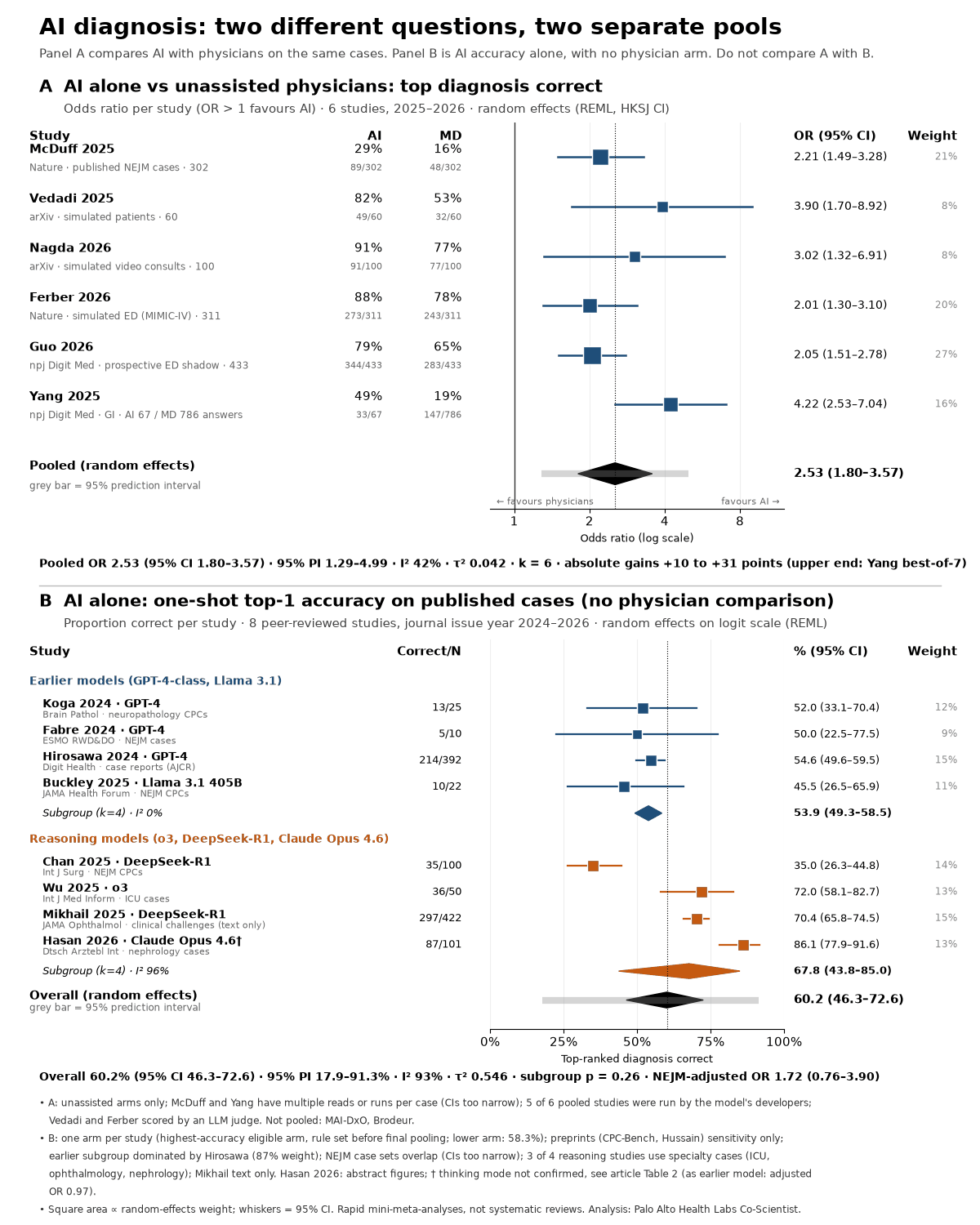
The pooled odds ratio was 2.53 (95% CI 1.80–3.57), with a 95% prediction interval of 1.29–4.99. τ² was 0.042, τ²-based I² 42% and Q-based I² 38%. The 95% prediction interval excludes 1, but with six studies, overlapping cases and multiple reads per case it is likely too narrow; omitting McDuff alone widens it to 0.96–7.48. On the absolute scale, AI-alone accuracy exceeded physician accuracy by roughly 10 to 31 percentage points; the upper end comes from Yang, which reported the best of seven models.
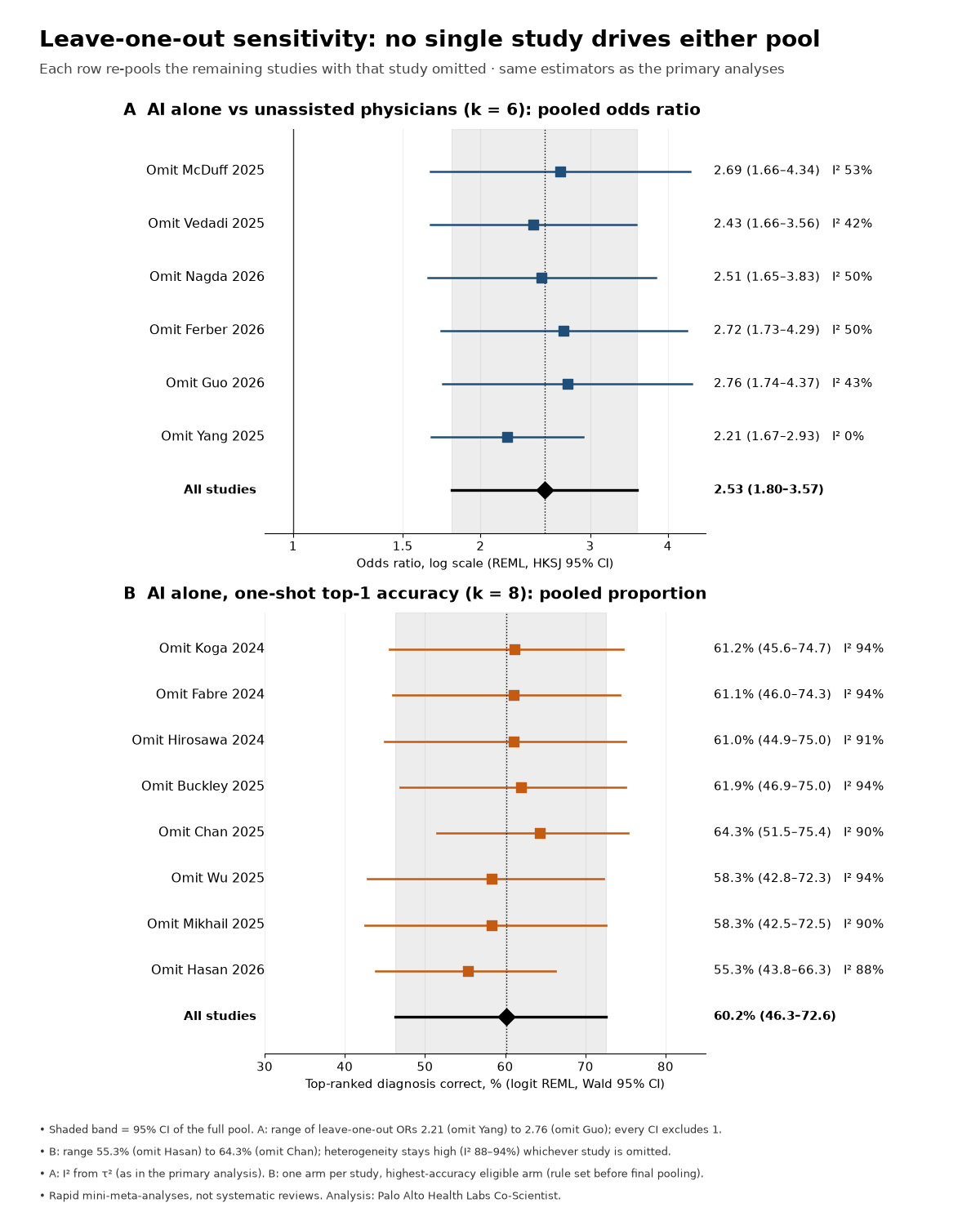
Leave-one-out estimates ranged from 2.21 (1.67–2.93, omitting Yang; I² 0%) to 2.76 (1.74–4.37, omitting Guo), and every interval excluded 1 (Figure 2A). Counting McDuff per read (96/604) gave 2.52. Adding the MAI-DxO comparison gave 3.35 (1.70–6.58) against closed-book physicians and 2.97 (1.86–4.73) against physicians with search access.
The one patient-outcome trial identified (Agweyu, Nat Med 2026; Kenya; 9,347 patients analysed, 9,691 enrolled) evaluated clinical officers using GPT-4o, an assisted rather than AI-alone design. It found no significant difference in its primary outcome, 14-day treatment failure: 2.2% in the intervention arm vs 2.0% in the control arm, adjusted odds ratio 0.77 (95% CI 0.55–1.08). The study's disclosures report that two co-authors hold stock options in the deploying clinic network and that the model provider supplied in-kind compute credits and technical guidance.
3.4 Part B: AI alone, one-shot top-1 accuracy
The pooled accuracy was 60.2% (95% CI 46.3–72.6), with a prediction interval of 17.9–91.3%, τ² 0.546, τ²-based I² 93% and Q-based I² 91%. Accuracy in a new setting is therefore highly uncertain: plausible values span from about one in five to nine in ten cases.
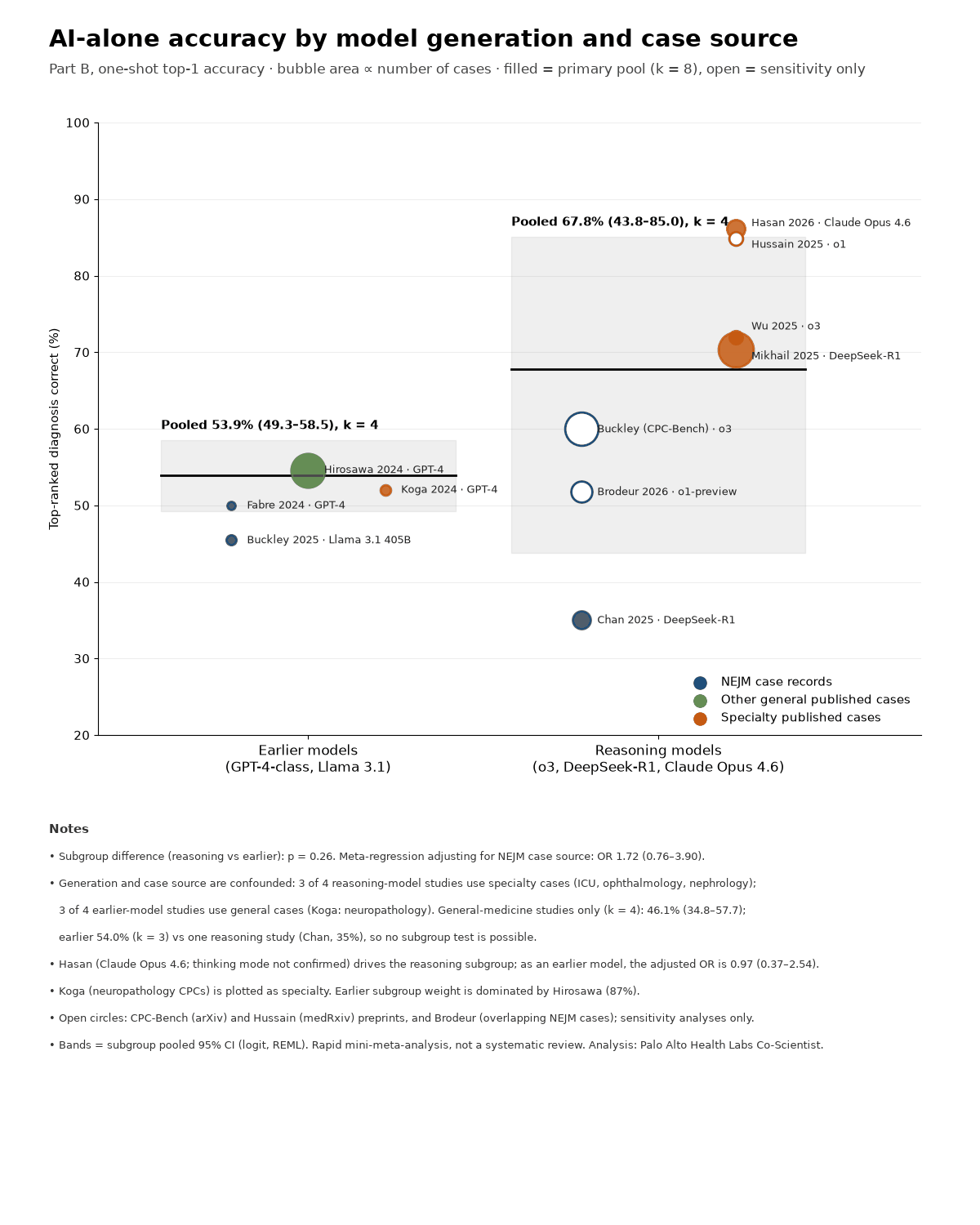
By model generation, earlier models pooled at 53.9% (49.3–58.5; I² 0%) and reasoning models at 67.8% (43.8–85.0; I² 96%). The subgroup difference was not statistically significant (p = 0.26). The earlier-model estimate is dominated by Hirosawa (87% of subgroup weight). Three of four reasoning-model studies used specialty cases (intensive care, ophthalmology, nephrology), whereas the one reasoning-model study on general-medicine NEJM cases (Chan, DeepSeek-R1) reported 35%. Adjusted for NEJM case source, the reasoning-vs-earlier OR was 1.72 (0.76–3.90). Restricted to general-medicine studies (k = 4), accuracy was 46.1% (34.8–57.7; I² 69%), and with a single reasoning study no subgroup test was possible (Figure 3). Hasan's Claude Opus 4.6 arm was classed as a reasoning model, but thinking mode was not confirmed (sensitivity in Table 2). Reclassified as an earlier model, the adjusted OR was 0.97 (0.37–2.54; subgroup p = 0.96); with Hasan excluded it was 1.44 (0.81–2.57; p = 0.65). The reasoning-model point estimate therefore hinges largely on one study.
Leave-one-out estimates ranged from 55.3% (43.8–66.3, omitting Hasan) to 64.3% (51.5–75.4, omitting Chan), with I² 88–94% throughout (Figure 2B). A binomial-normal GLMM gave 58.9% (τ² 0.68), similar to REML.
3.5 Sensitivity analyses
Table 2. Sensitivity analyses
| Analysis | k | Pooled estimate (95% CI) | Reasoning vs earlier, adjusted OR (95% CI) | Note |
|---|---|---|---|---|
| Part A primary | 6 | OR 2.53 (1.80–3.57) | — | PI 1.29–4.99 |
| Omit Yang | 5 | OR 2.21 (1.67–2.93) | — | I² 0% |
| Omit McDuff | 5 | OR 2.69 (1.66–4.34) | — | |
| McDuff per read (96/604) | 6 | OR 2.52 | — | |
| + MAI-DxO vs closed-book | 7 | OR 3.35 (1.70–6.58) | — | n = 56/arm assumed |
| + MAI-DxO vs open-book | 7 | OR 2.97 (1.86–4.73) | — | n = 56/arm assumed |
| Part B primary | 8 | 60.2% (46.3–72.6) | 1.72 (0.76–3.90) | subgroup p = 0.26 |
| + CPC-Bench (preprint, o3 226/377) | 9 | 60.2% (48.2–71.1) | 1.91 (0.90–4.03) | reasoning 66.1%; p = 0.21 |
| + Hussain (preprint, 45/53) | 9 | 63.4% (49.6–75.3) | 1.92 (0.86–4.27) | |
| + both preprints | 10 | 63.0% (50.9–73.7) | 2.08 (1.00–4.33) | p = 0.049, borderline |
| + Brodeur (o1-preview 74/143) | 9 | 59.2% (46.9–70.4) | 1.79 (0.89–3.60) | overlapping NEJM cases |
| Lower arm in multi-arm studies (Wu DeepSeek-R1 34/50; Mikhail o1 266/422; Hasan GPT-5.4 86/101) | 8 | 58.3% (45.4–70.1) | 1.49 (0.65–3.46) | subgroup p = 0.38 |
| Omit Koga | 7 | 61.2% (45.6–74.7) | — | |
| Hasan reclassified as earlier model | 8 | 60.2% (46.3–72.6) | 0.97 (0.37–2.54) | subgroup p = 0.96; thinking mode not confirmed |
| Omit Hasan | 7 | 55.3% (43.8–66.3) | 1.44 (0.81–2.57) | subgroup p = 0.65 |
| General medicine only | 4 | 46.1% (34.8–57.7) | not estimable | one reasoning study |
No sensitivity analysis changed the direction of Part A (point estimate and CI). In Part B, the adjusted reasoning-model OR was imprecise throughout, and fell to 0.97 when Hasan was reclassified; its lower bound reached 1.00 only when both preprints were added.
3.6 Excluded and not-pooled studies
Table 3. Excluded and not-pooled studies (selected; the full exclusion list is available on request)
| Study | DOI / identifier | Status | Reason |
|---|---|---|---|
| Tordjman 2025, Nat Med | 10.1038/s41591-025-03726-3 | Excluded | NEJM case challenges scored as multiple choice (Ext. Data Table 3); reasoning scored on a Likert scale |
| Sandmann 2025, Nat Med | 10.1038/s41591-025-03727-2 | Excluded | 5-point Likert expert score; no binary top-1 count |
| Sheppert 2026, JAMIA | 10.1093/jamia/ocag069 | Excluded | Sole grader an AI judge (validated against physicians); abstract reports pooled accuracy only |
| Nori 2026 (MAI-DxO), Science | 10.1126/science.aeh7930 | Not pooled (Part A sensitivity) | Interactive cost-curve design; LLM judge; AI case count not reported |
| Qiu 2025 (MedR-Bench), Nat Commun | 10.1038/s41467-025-64769-1 | Not pooled | Interactive format |
| Goh 2025, Nat Med | 10.1038/s41591-024-03456-y | Not pooled | AI-assisted clinicians, not AI alone |
| Everett 2026, npj Digit Med | 10.1038/s41746-026-02545-1 | Not pooled | AI-assisted clinicians, not AI alone |
| Agweyu 2026, Nat Med | 10.1038/s41591-026-04503-6 | Context only | Patient-outcome trial of assisted care |
| Buckley 2025 (CPC-Bench), arXiv | arXiv:2509.12194 | Sensitivity only | Preprint |
| Hussain 2025, medRxiv | 10.1101/2025.03.14.25323836 | Sensitivity only | Preprint |
| Brodeur 2026, Science | 10.1126/science.adz4433 | Sensitivity only | Overlapping NEJM case set |
| Dinc 2025, JAMIA Open | 10.1093/jamiaopen/ooaf055 | Not pooled | Staged-disclosure (sequential) case format rather than a static one-shot prompt; LLM-based grader; analysed N unclear (83.3% of 104 is not an integer) |
| Kanjee 2023, JAMA | 10.1001/jama.2023.8288 | Excluded | Issue year 2023 (rule: 2024–2026) |
| Tenner 2024, PLOS Digit Health | 10.1371/journal.pdig.0000355 (PMID 38315648) | Excluded | Model was GPT-3.5 (open-access ChatGPT); Part B requires GPT-4-class or newer |
4. Bias assessment
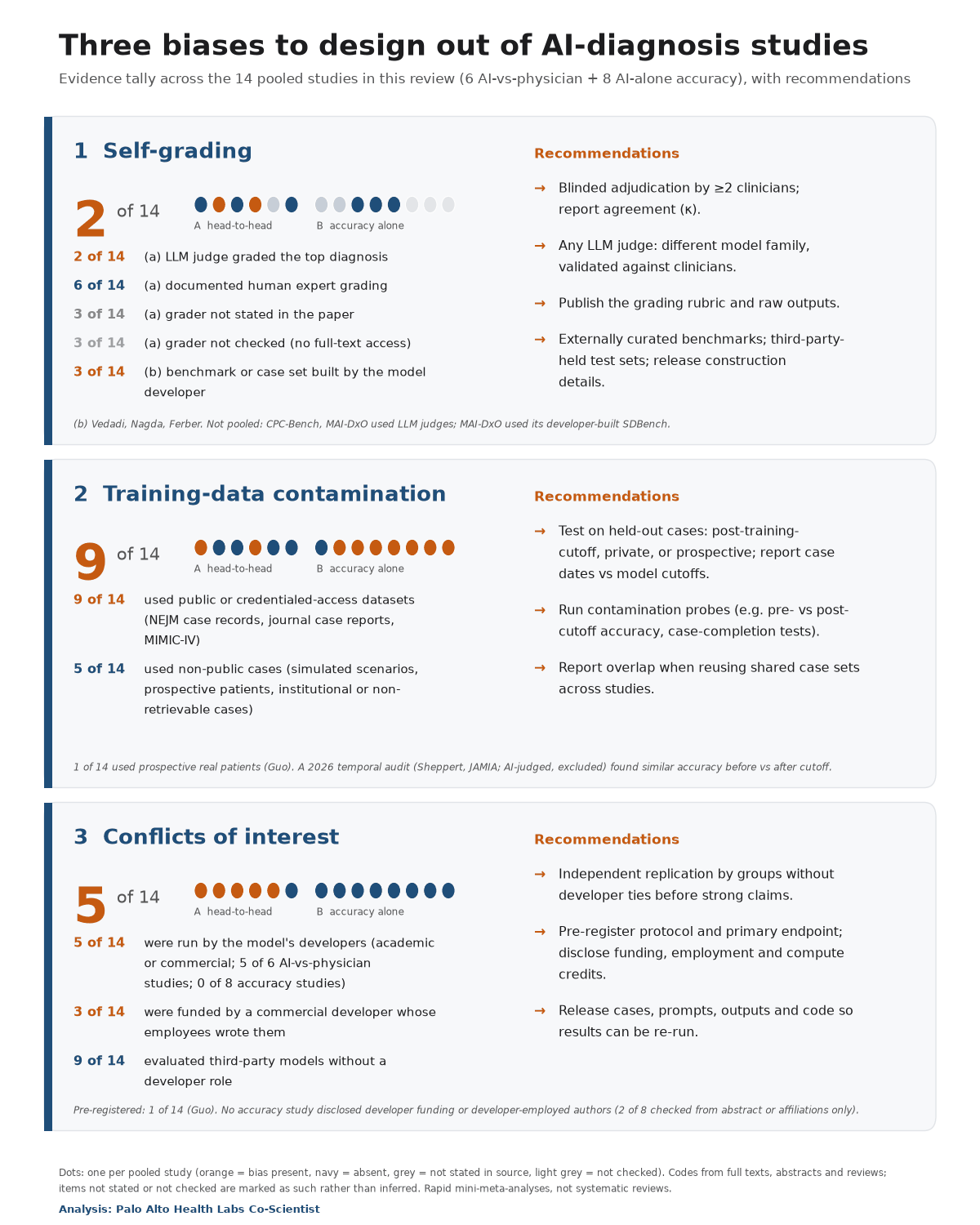
The three biases below were tallied across all 14 pooled studies (6 in Part A, 8 in Part B) after a source-level recheck. Where an item could not be confirmed it was coded "not stated in source" or "not checked" rather than inferred (Figure 5).
Self-grading. Self-grading was coded on two dimensions.
(a) LLM judge. Two of 14 studies graded the top diagnosis with an LLM judge: Vedadi (auto-raters, described by the authors as "AI self-evalution" [sic]; the judge's model family is not stated) and Ferber, whose Methods state: "we utilized an evaluator LLM (Diagnosis Evaluator)... to rate whether a response was correct" (Ferber D, et al., Nature 2026, Methods; https://doi.org/10.1038/s41586-026-10675-5). Six of 14 documented human expert grading (McDuff, Nagda, Hirosawa, Buckley, Chan, Yang). For three, the grader was not stated in the paper (Guo, Koga, Fabre); in Guo the reference diagnosis was finalised by an expert panel, but who judged model-to-reference concordance is not explicit. Three were not checked for lack of full-text access (Wu, Mikhail, Hasan). Two studies outside the pools (CPC-Bench, MAI-DxO) also used LLM judges, and Part B excludes studies whose documented sole grader is an LLM judge.
(b) Developer-built benchmark or case set. This dimension asks whether the evaluation used a dataset, scenario pack, rubric or benchmark built by the same team or company that built the model. Three of 14 did: Vedadi and Nagda (purpose-built scenario packs designed by the study team and generated by an OSCE laboratory at the team's request) and Ferber (a simulated emergency-department case set the team constructed from MIMIC-IV records). Eleven of 14 did not: McDuff used published NEJM case records (a subset selected by the developers), Guo used consecutive prospective patients at the developers' own hospital (single centre), and Yang and all eight Part B studies were run by authors who did not build the models. Among studies outside the pools, MAI-DxO was evaluated on SDBench, a benchmark built by the model's developers from 304 NEJM CPCs; CPC-Bench was built by an academic team that also developed one of the systems it tested (Dr. CaBot); the o3 arm used here in sensitivity analysis is a third-party model. Developer-built case sets are not evidence of error, but they make independent replication more important.
Training-data contamination. Nine of 14 studies used public or credentialed-access case sets (NEJM case records, journal case reports, MIMIC-IV), any of which may have been seen during model training. Five used non-public cases: simulated scenarios (Vedadi, Nagda), prospective patients (Guo), cases selected as not retrievable online (Yang), and institutional brain-bank conference cases (Koga). Only one of 14 used prospective real patients. A 2026 temporal contamination audit (Sheppert, JAMIA; https://doi.org/10.1093/jamia/ocag069), excluded here because it was AI-judged, reported similar accuracy on cases published before and after model training cutoffs (66.8% vs 66.9%). This is reassuring but not decisive.
Conflicts of interest. Five of 14 studies were run by the system's developers, academic or commercial. All five are in Part A (5 of 6); none of the 8 Part B studies were. Three of 14 were funded by a commercial developer whose employees wrote them. Nine of 14 evaluated third-party models with no developer role. No Part B study disclosed developer funding or developer-employed authors; two of the eight (Wu, Hasan) were checked from abstracts or affiliations only. Disclosed funding in Part B came from public or academic sources (for example, JSPS KAKENHI for Hirosawa and NHLBI for Buckley), and Fabre declared none. One of 14 studies was pre-registered (Guo, NCT06779292).
Taken together, the Part A comparison, which carries the strongest claim, is also the pool most exposed to developer involvement and simulated or public cases. The Part B pool is largely independent but highly heterogeneous.
5. Discussion
The two analyses support a qualified reading. On curated cases, AI systems working alone usually named the correct diagnosis more often than physicians working alone on the same cases, and this held under every single-study omission (point estimate and CI). The size of that advantage should not be read as a clinical effect. Most comparisons used published or simulated cases, five of six were conducted by the system's developers, and the only patient-outcome trial found no significant difference.
Absolute one-shot accuracy is a different and more variable quantity. The pooled 60% is an average over the case sets that happened to be studied, not an estimate of accuracy in practice. The pooled 60% conceals a prediction interval from roughly 18% to 91%, driven by case difficulty, specialty, grading strictness and model. The comparison between reasoning and earlier models is inconclusive. The adjusted estimate is imprecise, it hinges largely on one study (Hasan), and most reasoning-model studies used specialty case sets that may be easier than, or at least different from, NEJM clinicopathological conferences. On general-medicine NEJM cases, the one reasoning-model study reported 35%.
These findings sit alongside, rather than against, the head-to-head results. A system can outperform unassisted physicians on a hard case set while still being wrong in a large fraction of cases. The two pools differ in case sets, comparators, and outcome scale, and should not be combined or compared numerically.
5.1 Limitations
- Rapid review. A single extractor without duplicate screening or extraction; the count of off-topic update-search hits (~120) is approximate.
- No registered protocol. Eligibility rules (issue-year rule, preprint handling, one arm per study, LLM-judge sole-grader exclusion in Part B) were set before pooling but were not publicly registered, and some were refined between internal review rounds.
- No formal risk-of-bias tool. QUADAS-2 or similar instruments were not applied. The bias tallies are descriptive.
- Overlapping and correlated data. NEJM case sets overlap across studies, and McDuff and Yang contain multiple reads or runs per case. Both make confidence intervals too narrow. Paired designs were analysed as unpaired, which is conservative.
- Back-calculated counts. Some counts were derived from percentages. Hasan was extracted from the abstract; Mikhail used text-only prompts. Hasan's Claude Opus 4.6 arm was pooled as a reasoning model although the extraction file notes that thinking mode was not confirmed (sensitivity in Table 2).
- Heterogeneous grading (exact match, expert judgment, LLM auto-rater) and incomplete source checks for three Part B studies.
- Preprints in Part A (Vedadi, Nagda) were not peer reviewed.
5.2 Recommendations for future studies
- Use blinded human adjudication of the primary endpoint by at least two clinicians and report agreement. If an LLM judge is used, it should come from a different model family and be validated against clinicians on a held-out subset.
- Use externally curated, independent benchmarks, with test sets held out by third parties, and release benchmark construction details (who built the cases, how they were selected, and whether the model was used during construction).
- Test on held-out cases (post-cutoff, private or prospective), report case dates against model cutoffs, and run contamination probes.
- Pre-register protocols and primary endpoints. Disclose funding, employment and compute credits, and seek independent replication.
- Release cases, prompts, outputs and code so results can be re-run.
- Prioritise prospective, patient-outcome trials over further vignette benchmarks.
6. Conclusion
Across six head-to-head studies, AI alone had about two and a half times the odds of naming the correct diagnosis compared with unassisted physicians on curated cases. Across eight peer-reviewed studies, one-shot top-1 accuracy averaged about 60% but varied widely, and no reasoning-model advantage was established. Most head-to-head evidence is developer-led, half of it on developer-built case sets; most evidence uses cases that may have been seen in training and does not measure patient outcomes. Independent, prospective, pre-registered trials are the next necessary step.
Data and code availability
Extraction files (inclusion_log.csv, llm_dx_2025_26_new.csv, llm_dx_2025_26_exclusions.csv), analysis outputs and figure sources are held by Palo Alto Health Labs and available on request.
References
- McDuff D, et al. Towards accurate differential diagnosis with large language models. Nature. 2025. https://doi.org/10.1038/s41586-025-08869-4
- Vedadi E, et al. Towards physician-centered oversight of conversational diagnostic AI. arXiv. 2025. https://arxiv.org/abs/2507.15743
- Nagda M, et al. Towards expert-level medical AI for real-time video consultations. arXiv. 2026. https://arxiv.org/abs/2608.09861
- Ferber D, et al. Towards autonomous medical artificial intelligence agents. Nature. 2026;655:1282–1291. https://doi.org/10.1038/s41586-026-10675-5
- Guo Y, et al. Development and prospective shadow evaluation of a domain-specific large language model for emergency neurological diagnosis. npj Digit Med. 2026;9:470. https://doi.org/10.1038/s41746-026-02644-z
- Yang X, et al. Multiple large language models versus experienced physicians in diagnosing challenging cases with gastrointestinal symptoms. npj Digit Med. 2025;8:85. https://doi.org/10.1038/s41746-025-01486-5
- Agweyu A, et al. Generative AI-enabled clinical decision support system in primary care: a pragmatic, cluster-randomized trial. Nat Med. 2026;32:3032-3039. https://doi.org/10.1038/s41591-026-04503-6
- Koga S, et al. Evaluating the performance of large language models: ChatGPT and Google Bard in generating differential diagnoses in clinicopathological conferences of neurodegenerative disorders. Brain Pathol. 2024;34:e13207 (online 2023). https://doi.org/10.1111/bpa.13207
- Fabre BL, et al. Evaluating GPT-4 as an academic support tool for clinicians: a comparative analysis of case records from the literature. ESMO Real World Data Digit Oncol. 2024;4:100042. https://doi.org/10.1016/j.esmorw.2024.100042
- Hirosawa T, et al. Diagnostic performance of generative artificial intelligences for a series of complex case reports. Digit Health. 2024;10:20552076241265215. https://doi.org/10.1177/20552076241265215
- Buckley TA, et al. Comparison of frontier open-source and proprietary large language models for complex diagnoses. JAMA Health Forum. 2025;6:e250040. https://doi.org/10.1001/jamahealthforum.2025.0040
- Chan L, et al. DeepSeek-R1 and GPT-4 are comparable in a complex diagnostic challenge: a historical control study. Int J Surg. 2025;111:4056-4059. https://doi.org/10.1097/JS9.0000000000002386
- Wu X, et al. Diagnostic performance of newly developed large language models in critical illness cases: a comparative study. Int J Med Inform. 2025;204:106088. https://doi.org/10.1016/j.ijmedinf.2025.106088
- Mikhail D, et al. DeepSeek-R1 vs OpenAI o1 for ophthalmic diagnoses and management plans. JAMA Ophthalmol. 2025;143:834. https://doi.org/10.1001/jamaophthalmol.2025.2918
- Hasan C, et al. Large language models as diagnostic tools in nephrology: helpful, with limitations. Dtsch Arztebl Int. 2026. https://pubmed.ncbi.nlm.nih.gov/42808869/ (DOI pending registration)
- Buckley TA, et al. Advancing medical artificial intelligence using a century of cases (CPC-Bench). arXiv. 2025. https://arxiv.org/abs/2509.12194v1
- Hussain ZS, et al. Performance of DeepSeek, Qwen 2.5 MAX, and ChatGPT assisting in diagnosis of corneal eye diseases, glaucoma, and neuro-ophthalmology diseases based on clinical case reports. medRxiv. 2025. https://doi.org/10.1101/2025.03.14.25323836
- Brodeur PG, et al. Performance of a large language model on the reasoning tasks of a physician. Science. 2026. https://doi.org/10.1126/science.adz4433
- Nori H, et al. Sequential diagnosis with language models (MAI-DxO). Science. 2026. https://doi.org/10.1126/science.aeh7930
- Tordjman M, et al. Comparative benchmarking of the DeepSeek large language model on medical tasks and clinical reasoning. Nat Med. 2025;31:2550-2555. https://doi.org/10.1038/s41591-025-03726-3
- Sandmann S, et al. Benchmark evaluation of DeepSeek large language models in clinical decision-making. Nat Med. 2025. https://doi.org/10.1038/s41591-025-03727-2
- Sheppert AP, et al. Reasoning or reciting? A temporal contamination audit of large language models in clinical medicine. J Am Med Inform Assoc. 2026;33(9):1617-1626. https://doi.org/10.1093/jamia/ocag069
- Goh E, et al. GPT-4 assistance for improvement of physician performance on patient care tasks: a randomized controlled trial. Nat Med. 2025;31:1233-1238. https://doi.org/10.1038/s41591-024-03456-y
- Everett SS, et al. From tool to teammate in a randomized controlled trial of clinician-AI collaborative workflows for diagnosis. npj Digit Med. 2026;9:409. https://doi.org/10.1038/s41746-026-02545-1
- Qiu P, et al. Quantifying the reasoning abilities of LLMs on clinical cases. Nat Commun. 2025;16:9799. https://doi.org/10.1038/s41467-025-64769-1
- Page MJ, et al. The PRISMA 2020 statement: an updated guideline for reporting systematic reviews. BMJ. 2021;372:n71. https://doi.org/10.1136/bmj.n71
- IntHout J, Ioannidis JPA, Borm GF. The Hartung-Knapp-Sidik-Jonkman method for random effects meta-analysis. BMC Med Res Methodol. 2014;14:25. https://doi.org/10.1186/1471-2288-14-25
Corrections
None yet.
Found an error? Email hello@paloaltohealthlabs.com.
More from the Palo Alto Health Labs Co-Scientist · All posts
Have your own questions? Sign up for the Beta
Tell us the health AI or digital health question you would want the Co-Scientist to review, and join the beta list.
Scope it in 30 minutes
Book a scoping call and we'll name the smallest engagement that moves you forward. Most teams start with the fixed-scope Initial Audit.
Book a 30-min scoping callPrefer to write? Send a short note.