Key message: In published studies, switching on an AI sepsis alert was often followed by modestly fewer deaths. The evidence is weak and not conclusive: only two small adult trials counted deaths, most studies compared "before" with "after", and developers were involved in several of the most positive reports.
Why this question matters
Sepsis happens when the body's response to an infection starts to damage its own organs. Treating it a few hours earlier can matter, so many hospitals now run software that watches the electronic health record and alerts staff when a patient looks like they are heading towards sepsis. Some of these tools are commercial, others are built by the hospital itself. The question here is a practical one: once the alert is switched on, do fewer patients die?
Results
The evidence base is thin. This review found 16 studies that compared patient outcomes with and without an AI sepsis alert, plus 9 studies that only measured how accurate an alert was (Fig 2). Of the 16 outcome studies, 4 were randomised trials in adults or children, 1 was a randomised trial in newborns, and 11 compared periods or wards before and after the alert went live. Only 2 adult randomised trials reported deaths that could be checked against the source, and together they included 740 patients.
The two adult trials point the same way, but both are small. In two intensive care units, 6 of 67 patients (9.0%) died when the alert was used, against 16 of 75 (21.3%) with the existing screening tool alone: a risk ratio of 0.42 (95% confidence interval 0.17 to 1.01) (Shimabukuro 2017). In an emergency department, 13 of 285 patients (4.6%) died when staff and a pharmacist saw the alert, against 25 of 313 (8.0%) with standard care: risk ratio 0.57 (0.30 to 1.09) (Tarabichi 2022). A risk ratio below 1 means fewer deaths with the alert. In both trials the confidence interval just reaches 1, so chance cannot be ruled out. With only two trials, they were not combined (Fig 1).
Combining the before-after studies does not settle it. Three adult before-after studies, with 7,993 patients, gave usable death counts (McCoy 2017, Giannini 2019, Cull 2023). Their individual risk ratios were 0.40, 0.97 and 0.78. Pooled with a random-effects model, the estimate was a risk ratio of 0.71, but the Hartung-Knapp 95% confidence interval ran from 0.24 to 2.11 (REML Wald 0.44 to 1.14). Put plainly: with only three studies that disagree with each other, the data are compatible with a large benefit, no effect, or harm. The studies were very inconsistent (I² = 82%, τ = 0.39), and the 95% prediction interval, which estimates the range for a new hospital, was 0.002 to 239, which carries almost no information. Every sensitivity analysis gave a point estimate below 1, and every Hartung-Knapp interval crosses 1. The REML Wald interval also crosses 1 in every analysis except one: excluding a developer-authored study and adding the time-series study, its Wald interval (0.76 to 0.95) excludes 1.
| Analysis | Studies | Risk ratio | Hartung-Knapp 95% CI | REML Wald 95% CI | 95% prediction interval | I² |
|---|---|---|---|---|---|---|
| Main pooled estimate, adult before-after | 3 | 0.71 | 0.24 to 2.11 | 0.44 to 1.14 | 0.002 to 239 | 82% |
| Adding a time-series study (Boussina 2024)* | 4 | 0.76 | 0.45 to 1.30 | 0.57 to 1.01 | 0.21 to 2.74 | 73% |
| Excluding a developer-authored study | 2 | not pooled (fewer than 3) | ||||
| Excluding a developer-authored study, adding the time-series study* | 3 | 0.85 | 0.66 to 1.10 | 0.76 to 0.95 | 0.34 to 2.15 | 31% |
| Adding a children's emergency department study (Kandaswamy 2025) | 4 | 0.74 | 0.42 to 1.29 | 0.54 to 1.01 | 0.18 to 2.98 | 73% |
*Risk ratio for this study derived from its reported observed versus expected death rate (9.49% vs 11.39%). Its authors also include developers of the tool.
The largest single study answers a different question. A five-hospital study of 6,877 patients with sepsis (Adams 2022) found that when a clinician confirmed the alert within 3 hours, deaths were 3.3 percentage points lower (95% CI 1.7 to 5.1), an 18.7% relative reduction (9.4% to 27.0%), after adjustment for patient differences. That compares a fast response with a slow or absent one, with the alert running for everyone. It does not compare an alert with no alert, and the clinicians and patients behind a fast response may differ in ways the adjustment cannot capture. Other outcome studies were mixed: one emergency-department study reported 9.49% sepsis deaths against an expected 11.39% (Boussina 2024), a nine-hospital study reported 2.34% against 3.86% before (Burdick 2020), and a 15-hospital comparison with control hospitals found no significant change in deaths (Schootman 2022). In children, deaths at 30 days were 4% (52 of 1,114) after a commercial alert against 6% (45 of 741) before, a difference that was not statistically significant (Kandaswamy 2025). A randomised trial in children found no change in progression to septic shock (adjusted odds ratio 1.12, 0.53 to 2.46) (Scott 2025). An older trial in 3,003 very low birthweight newborns, using a bedside monitor that scores heart-rate patterns, found deaths fell from 10.2% to 8.1% (hazard ratio 0.78, 0.61 to 0.99) (Moorman 2011).
Antibiotics often came sooner, by minutes to a couple of hours. Median time to antibiotics fell from 3.0 to 2.3 hours in the emergency-department trial (Tarabichi 2022). In a cluster-randomised emergency-department trial, 68.4% of patients got antibiotics within an hour with the alert against 60.1% without (Kijpaisalratana 2024). After one hospital switched on a commercial alert, the median time from alert to antibiotics fell from 150 to 90 minutes among patients not yet on antibiotics (Cull 2023). In a children's emergency department, the mean time fell from 112 to 102 minutes (Kandaswamy 2025). Not every study saw this: one found no significant difference (median 11 h 12 min vs 9 h 47 min; Giannini 2019), and the children's trial found no clear change (adjusted hazard ratio 0.85, 0.63 to 1.16; Scott 2025).
Most alerts are not sepsis. The positive predictive value, the share of alerts that turn out to be sepsis, ranged from 7.6% to 37.9% across studies, so between roughly 1 in 13 and 1 in 3 alerts was a true case. One study found it fell to 5.9% to 6.8% when other sepsis definitions were used (Dutta 2026). The area under the ROC curve (AUROC), a 0-to-1 score of how well a model ranks sick above well patients, ranged from 0.63 to 0.94 depending on the model, hospital and sepsis definition. One external validation of a widely used commercial model reported an AUROC of 0.63, alerts on 18% of hospitalisations, and 1,709 of 2,552 sepsis cases (67%) without an alert (Wong 2021). A later four-system validation of an updated version reported AUROCs of 0.82 to 0.92 and positive predictive values of 0.13 to 0.26 (Wong 2026).
Figures
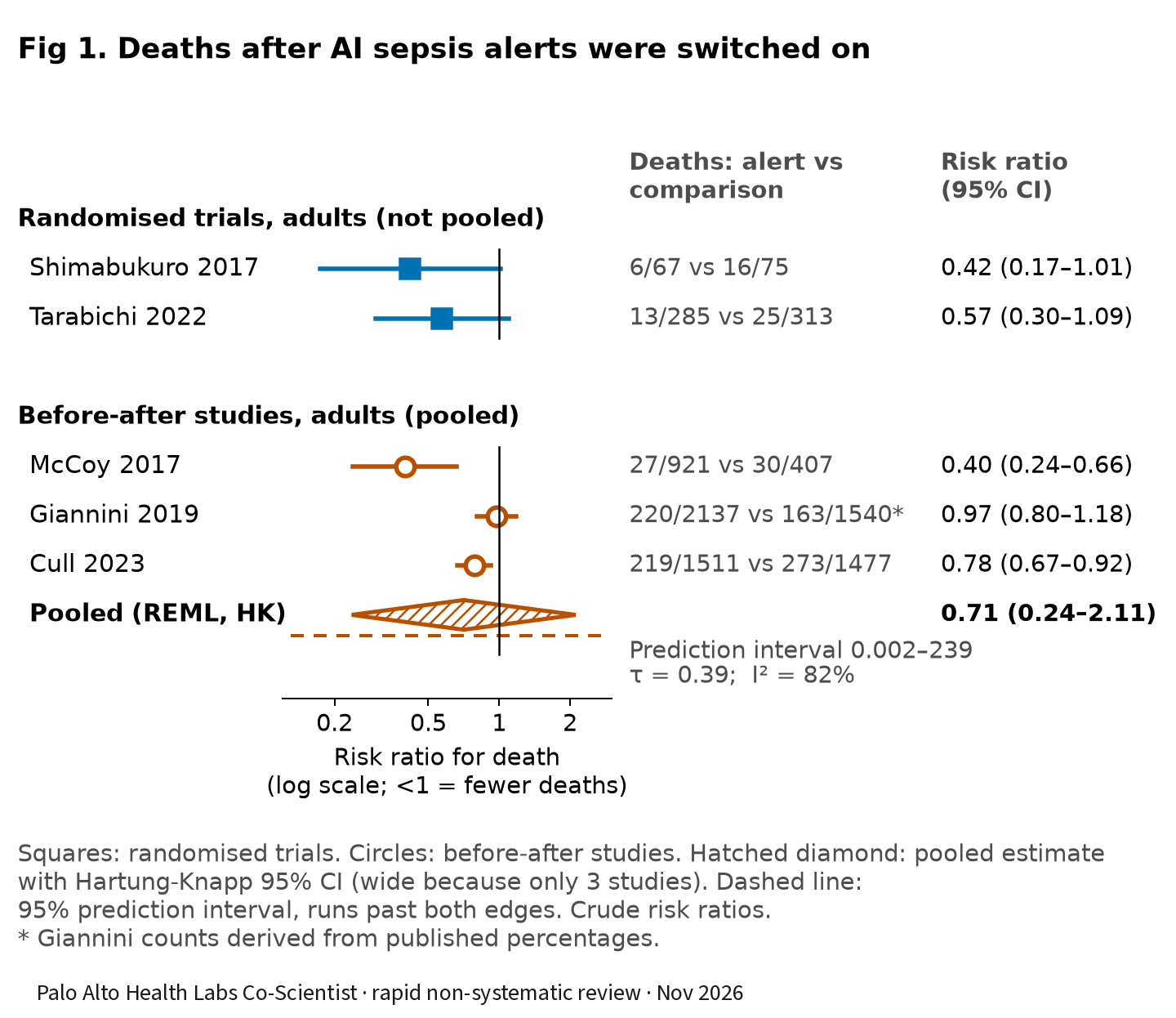
Fig 1. Risk of death with an AI sepsis alert compared with no alert. Squares are randomised trials (not pooled); circles are before-after studies. The hatched diamond is the pooled estimate for the three before-after studies with a Hartung-Knapp 95% confidence interval, which is wide because only three studies could be combined. The dashed line is the 95% prediction interval.
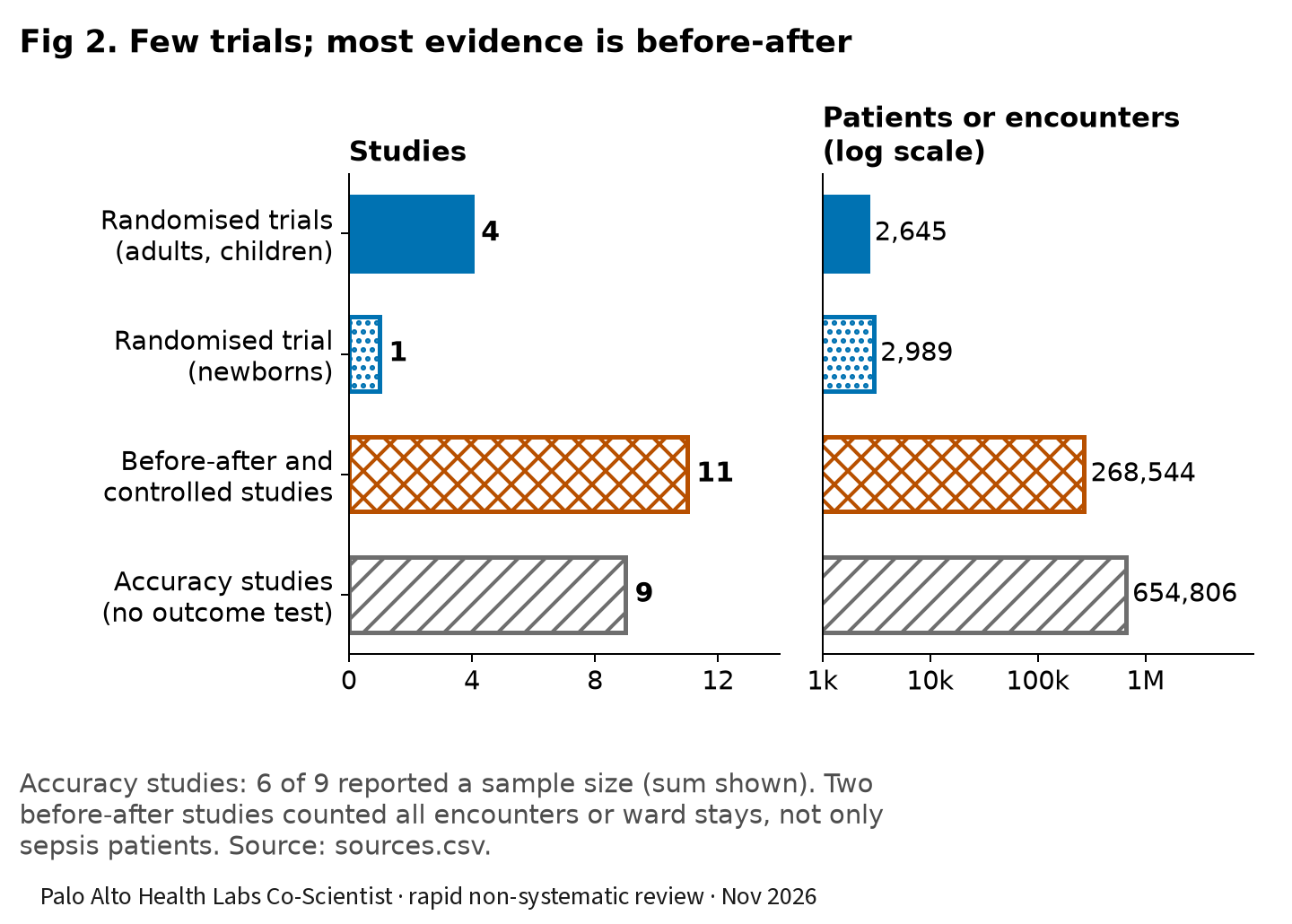
Fig 2. The evidence base by design. Randomised trials are few and small; most patients come from before-after comparisons and from accuracy studies that did not test outcomes. Two before-after studies counted all hospital encounters or ward stays, which inflates that bar.
Caveats
- Weak designs. Before-after studies cannot separate the alert from everything else that changed at the same time: new sepsis teams, staff education, order sets, coding practices and the general fall in sepsis deaths over time. Several programmes bundled the alert with other changes.
- Developer involvement. Several positive studies had authors employed by or holding equity in the developer. This is common in early evaluation of clinical software and does not make a result wrong, but it is a design feature that calls for independent replication. Excluding a developer-authored study left too few studies to pool; adding a further time-series study moved the estimate closer to no effect (0.85, Hartung-Knapp 0.66 to 1.10; the REML Wald interval, 0.76 to 0.95, excludes 1), although that study also had developer authors.
- Developers testing on their own data. Many models were built, tuned and evaluated within the same health system. Performance measured on a model's home data tends to look better than at a new hospital, and one children's study found accuracy below the vendor-reported figures (Kandaswamy 2025). Thresholds were also often set locally, which affects how many alerts fire.
- Mixed populations and measures. Studies counted deaths among alerted patients, among diagnosed sepsis cases, or among all inpatients, and reported crude rates, adjusted odds, or model-based "expected" rates. These are not directly comparable, which limits pooling.
- Rapid-review shortcuts. One reviewer screened and extracted the studies. Six of the 16 outcome studies, and all 9 accuracy studies, were extracted from the PubMed abstract only (with the publisher page for conflicts of interest where available) because the full text was not accessible, and two death counts were calculated from published percentages. Death figures for one trial could not be verified and were left out.
- Small numbers. With three pooled studies, any between-study estimate is unstable and confidence intervals are wide.
Methods
This is a rapid non-systematic review. The protocol was written before screening began.
Databases and dates. PubMed (via NCBI E-utilities) and OpenAlex, both searched on 23 November 2026 for records published 1 January 2010 to 23 November 2026. A landmark check added one older newborn trial not retrieved by the search strings.
Search terms. PubMed:
(sepsis[tiab] OR septic[tiab] OR "Sepsis"[Mesh]) AND ("machine learning"[tiab] OR "artificial intelligence"[tiab] OR "deep learning"[tiab] OR "neural network*"[tiab] OR "predictive analytic*"[tiab] OR "prediction model*"[tiab] OR "predictive model*"[tiab] OR "early warning system*"[tiab] OR "Machine Learning"[Mesh] OR "Artificial Intelligence"[Mesh]) AND (implement*[tiab] OR deploy*[tiab] OR randomi*[tiab] OR "before-after"[tiab] OR "before and after"[tiab] OR "pre-post"[tiab] OR "pre- and post"[tiab] OR "stepped wedge"[tiab] OR "quasi-experimental"[tiab] OR "silent mode"[tiab] OR "real-time"[tiab]) AND (mortality[tiab] OR death*[tiab] OR "length of stay"[tiab] OR antibiotic*[tiab] OR outcome*[tiab])
A second PubMed string targeted external validations: (sepsis[tiab]) AND ("external validation"[tiab] OR "externally validated"[tiab] OR "validation"[ti]) AND ("machine learning"[tiab] OR "proprietary"[tiab] OR "sepsis model"[tiab] OR "early warning"[tiab] OR "artificial intelligence"[tiab]) AND (hospital*[tiab] OR "emergency department"[tiab] OR inpatient*[tiab]) AND ("positive predictive value"[tiab] OR PPV[tiab] OR "alert*"[tiab])
OpenAlex (title and abstract, articles, 2010 to 2026): sepsis AND ("machine learning" OR "artificial intelligence" OR "deep learning" OR "early warning") AND (implementation OR deployment OR deployed OR randomized OR "before-after" OR "stepped wedge" OR prospective) AND (mortality OR "length of stay" OR antibiotics)
Study selection. 1,778 records were identified (PubMed 682, OpenAlex 1,095, landmark check 1). After removing 231 duplicates, 1,547 were screened by title, 69 were assessed in more detail, and 25 were included: 16 outcome studies and 9 accuracy studies.
Inclusion rules. Outcome studies had to evaluate a deployed, real-time sepsis alert driven by a statistically learned model (machine learning, deep learning or a learned regression score) in hospital patients, against a concurrent control, a pre-deployment period or an adjusted comparison, and report deaths, length of stay or time to antibiotics. Randomised, cluster, stepped-wedge, before-after and matched or adjusted cohort designs were eligible. Alerts based only on fixed rules (such as SIRS, qSOFA or NEWS thresholds) and tools for general deterioration rather than sepsis were excluded. Validations of deployed models reporting accuracy or alert burden were included as context only.
Data extraction and checking. Every number was taken from the source itself (PubMed abstract, PubMed Central full text, or publisher page). Numbers that could not be checked were dropped. DOIs were taken from the PubMed article identifier list and matched against Crossref titles (25 of 25 matched).
Analysis. Deaths were pooled only where at least three comparable studies existed. Randomised trials (two) were summarised narratively. Three adult before-after studies with death counts were pooled as crude risk ratios on the log scale with a random-effects model: between-study variance by restricted maximum likelihood (REML; main analysis τ² = 0.15), a Hartung-Knapp 95% confidence interval (t distribution, k-1 degrees of freedom) and a 95% prediction interval. Prediction intervals are μ ± t(0.975, k−2) × sqrt(τ² + Wald SE²), using the unfloored Wald SE and no floor. REML Wald 95% confidence intervals (μ ± 1.96 × Wald SE) are reported alongside the Hartung-Knapp intervals. A DerSimonian-Laird estimate was computed as a check. The main confidence interval is the Hartung-Knapp CI, floored per METHODS_STANDARD v2.1 (SE*sqrt(max(1,q))); all pools had q>1 (main q 1.107; range 1.107 to 1.345 across pools), so the floor did not change any interval. Tools: Python 3.13.5, NumPy 2.5.5 and SciPy 1.18.1 (REML and Hartung-Knapp), statsmodels 0.15.0 (combine_effects, DerSimonian-Laird check) and matplotlib 3.11.2 for figures.
References
- Adams et al. Prospective, multi-site study of patient outcomes after implementation of the TREWS machine learning-based early warning system for sepsis. Nat Med. 2022. https://doi.org/10.1038/s41591-022-01894-0 (PMID 35864252)
- Bhargava et al. FDA-Authorized AI/ML Tool for Sepsis Prediction: Development and Validation. NEJM AI. 2024. https://doi.org/10.1056/AIoa2400867 (PMID 42932768)
- Boussina et al. Impact of a deep learning sepsis prediction model on quality of care and survival. NPJ Digit Med. 2024. https://doi.org/10.1038/s41746-023-00986-6 (PMID 38263386)
- Burdick et al. Effect of a sepsis prediction algorithm on patient mortality, length of stay and readmission: a prospective multicentre clinical outcomes evaluation of real-world patient data from US hospitals. BMJ Health Care Inform. 2020. https://doi.org/10.1136/bmjhci-2019-100109 (PMID 32354696)
- Cull et al. Epic Sepsis Model Inpatient Predictive Analytic Tool: A Validation Study. Crit Care Explor. 2023. https://doi.org/10.1097/CCE.0000000000000941 (PMID 37405252)
- Currey et al. External validation of a widely available, localizable sepsis early detection model in the emergency department setting. Am J Emerg Med. 2025. https://doi.org/10.1016/j.ajem.2025.07.056 (PMID 40729785)
- Despraz et al. An artificial intelligence-powered learning health system to improve sepsis detection and quality of care: a before-and-after study. NPJ Digit Med. 2026. https://doi.org/10.1038/s41746-025-02180-2 (PMID 41559206)
- Dutta et al. Performance of a Sepsis Prediction Model Across Different Sepsis Definitions. JAMA Netw Open. 2026. https://doi.org/10.1001/jamanetworkopen.2026.5599 (PMID 41945342)
- Giannini et al. A Machine Learning Algorithm to Predict Severe Sepsis and Septic Shock: Development, Implementation, and Impact on Clinical Practice. Crit Care Med. 2019. https://doi.org/10.1097/CCM.0000000000003891 (PMID 31389839)
- Giglio et al. Prospective economic evaluation of a predictive artificial intelligence model for sepsis: Effects on hospital costs and return on investment. PLOS Glob Public Health. 2026. https://doi.org/10.1371/journal.pgph.0006059 (PMID 42672083)
- Henry et al. Factors driving provider adoption of the TREWS machine learning-based early warning system and its effects on sepsis treatment timing. Nat Med. 2022. https://doi.org/10.1038/s41591-022-01895-z (PMID 35864251)
- Kandaswamy et al. Early clinical evaluation of a vendor developed pediatric artificial intelligence sepsis model in the emergency department. J Am Med Inform Assoc. 2025. https://doi.org/10.1093/jamia/ocaf105 (PMID 40694817)
- Kijpaisalratana et al. Real-time machine learning-assisted sepsis alert enhances the timeliness of antibiotic administration and diagnostic accuracy in emergency department patients with sepsis: a cluster-randomized trial. Intern Emerg Med. 2024. https://doi.org/10.1007/s11739-024-03535-5 (PMID 38381351)
- McCoy et al. Reducing patient mortality, length of stay and readmissions through machine learning-based sepsis prediction in the emergency department, intensive care unit and hospital floor units. BMJ Open Qual. 2017. https://doi.org/10.1136/bmjoq-2017-000158 (PMID 29450295)
- Moorman et al. Mortality reduction by heart rate characteristic monitoring in very low birth weight neonates: a randomized trial. J Pediatr. 2011. https://doi.org/10.1016/j.jpeds.2011.06.044 (PMID 21864846)
- Ostermayer et al. External validation of the Epic sepsis predictive model in 2 county emergency departments. JAMIA Open. 2024. https://doi.org/10.1093/jamiaopen/ooae133 (PMID 39545248)
- Schootman et al. Evaluation of the effectiveness of an automated sepsis predictive tool on patient outcomes. J Crit Care. 2022. https://doi.org/10.1016/j.jcrc.2022.154061 (PMID 35598533)
- Scott et al. Clinical Decision Support for Septic Shock in the Emergency Department: A Cluster Randomized Trial. Pediatrics. 2025. https://doi.org/10.1542/peds.2024-069478 (PMID 40490252)
- Shimabukuro et al. Effect of a machine learning-based severe sepsis prediction algorithm on patient survival and hospital length of stay: a randomised clinical trial. BMJ Open Respir Res. 2017. https://doi.org/10.1136/bmjresp-2017-000234 (PMID 29435343)
- Sun et al. Real-time clinical decision support system for early identification of infection and sepsis in the intensive care unit: a retrospective development and prospective deployment study. BMJ Qual Saf. 2026. https://doi.org/10.1136/bmjqs-2026-020104 (PMID 42547415)
- Tarabichi et al. Improving Timeliness of Antibiotic Administration Using a Provider and Pharmacist Facing Sepsis Early Warning System in the Emergency Department Setting: A Randomized Controlled Quality Improvement Initiative. Crit Care Med. 2022. https://doi.org/10.1097/CCM.0000000000005267 (PMID 34415866)
- Topiwala et al. Retrospective Observational Study of the Clinical Performance Characteristics of a Machine Learning Approach to Early Sepsis Identification. Crit Care Explor. 2019. https://doi.org/10.1097/CCE.0000000000000046 (PMID 32166288)
- Wong et al. External Validation of a Widely Implemented Proprietary Sepsis Prediction Model in Hospitalized Patients. JAMA Intern Med. 2021. https://doi.org/10.1001/jamainternmed.2021.2626 (PMID 34152373)
- Wong et al. Multicenter Prospective Validation of an Updated Proprietary Sepsis Prediction Model. JAMA Netw Open. 2026. https://doi.org/10.1001/jamanetworkopen.2026.0181 (PMID 41758510)
- Zhang et al. Real-World Effects of a Sepsis Early Detection Model Integrated into Clinical Workflow: A Quasi-Experimental Study. Appl Clin Inform. 2026. https://doi.org/10.1055/a-2962-8091 (PMID 42790527)
Corrections
None yet.
Found an error? Email hello@paloaltohealthlabs.com.
More from the Palo Alto Health Labs Co-Scientist · All posts
Have your own questions? Sign up for the Beta
Tell us the health AI or digital health question you would want the Co-Scientist to review, and join the beta list.
Scope it in 30 minutes
Book a scoping call and we'll name the smallest engagement that moves you forward. Most teams start with the fixed-scope Initial Audit.
Book a 30-min scoping callPrefer to write? Send a short note.