Palo Alto Health Labs Co-Scientist
Disclosure: This is a rapid, non-systematic review. AI agents (Palo Alto Health Labs Co-Scientist) compiled and checked it. Humans have not validated it, and it has not been externally peer reviewed. The protocol was amended on 28 Oct 2026, after the initial results had been seen. The amendment widened the date window, added sensitivity analyses and added the AI-role subgroup, so these elements are post hoc (see Methods).
Abstract
Background: Several European screening programmes now use AI to support radiologists who read screening mammograms. We pooled prospective and real-world comparisons of AI-supported reading against standard double reading.
Methods: We searched PubMed and the web for studies with issue years 2024–26. Europe PMC was unavailable throughout the search period. We pooled log rate ratios with DerSimonian–Laird random effects and also report REML with Hartung–Knapp–Sidik–Jonkman (HKSJ) intervals and 95% prediction intervals (PIs). The AI role in the workflow was examined as an exploratory (post hoc) subgroup.
Results: Seven studies were included, covering about 768,000 women: one RCT, four prospective paired or concurrent studies, and two historical-control studies.
- Cancer detection rate (CDR): ratio 1.15 (95% CI 1.10–1.20; I²=38%; PI 1.06–1.22). REML+HKSJ gave 1.14 (1.08–1.20).
- Recall: too heterogeneous for a single pooled effect to be meaningful (I²=94%; PI 0.67–1.63). Recall fell with triage designs in some settings and rose with add-on or autonomous designs.
- PPV of recall: ratio 1.19 (1.03–1.37; I²=79%). Under REML+HKSJ the interval crosses 1: 1.19 (0.98–1.44), PI 0.74–1.92.
- Interval cancers: ratio 0.88 (0.65–1.18). This comes from one RCT.
Conclusion: AI support was associated with higher screen detection in all seven studies. Most of these studies were observational, and several were vendor-affiliated. Whether AI reduces interval or advanced cancers rests on one trial.
Introduction
Double reading is the European standard. AI can be used in three ways:
- to triage examinations within double reading;
- to act as an independent reader that clears examinations;
- to add an extra read on top of double reading.
Retrospective simulations are numerous. This review is limited to women screened live, compared with concurrent or historical real-world controls.
Methods
Protocol and amendment: The original protocol pre-specified a 2025–26 window, DerSimonian–Laird pooling, an RCT-only stratum, leave-one-out analysis and I².
Amendment 1 (28 Oct 2026) was made after the initial pooling. It:
- kept add-on-reader studies in the pool;
- widened the window to 2024–26, which added two historical-control studies;
- added Europe PMC, web and Scopus-indexed sources;
- treated single-reading comparators as sensitivity-only;
- added paired variances, PRAIM crude-versus-adjusted, and further sensitivity analyses.
AI role was added as an exploratory subgroup with three levels:
- (A) triage or support within double reading;
- (B) an independent AI reader that clears examinations;
- (C) an add-on reader.
Eligibility:
- Population: asymptomatic women in population screening.
- Comparison: AI-supported reading versus standard double reading, either paired on the same women, as a concurrent or randomised arm, or as a historical cohort from the same programme.
- Outcomes: CDR, recall, PPV of recall, or interval cancers.
Excluded were retrospective simulations, studies without results, and studies with non-screening outcomes. Named exclusions: a population-wide retrospective simulation (Radiol Artif Intell 2024); a small alternating-month study with 29 cancers (Eur J Radiol Open 2024); the ProFound pilot (risk scores only; Radiologie 2024); ScreenTrustMRI (MRI-selection outcome); and Norway AIMS and Victoria BRAIx (no results yet). Preprints were used in sensitivity analyses only. One comparison per study was pre-specified.
Conflict-of-interest definition: a study was counted as vendor-linked if it reported vendor funding or at least one author employed by or affiliated with the vendor of the evaluated AI. Institutional research agreements, advisory roles and other disclosures were reported but not counted.
Search and flow (PRISMA-style):
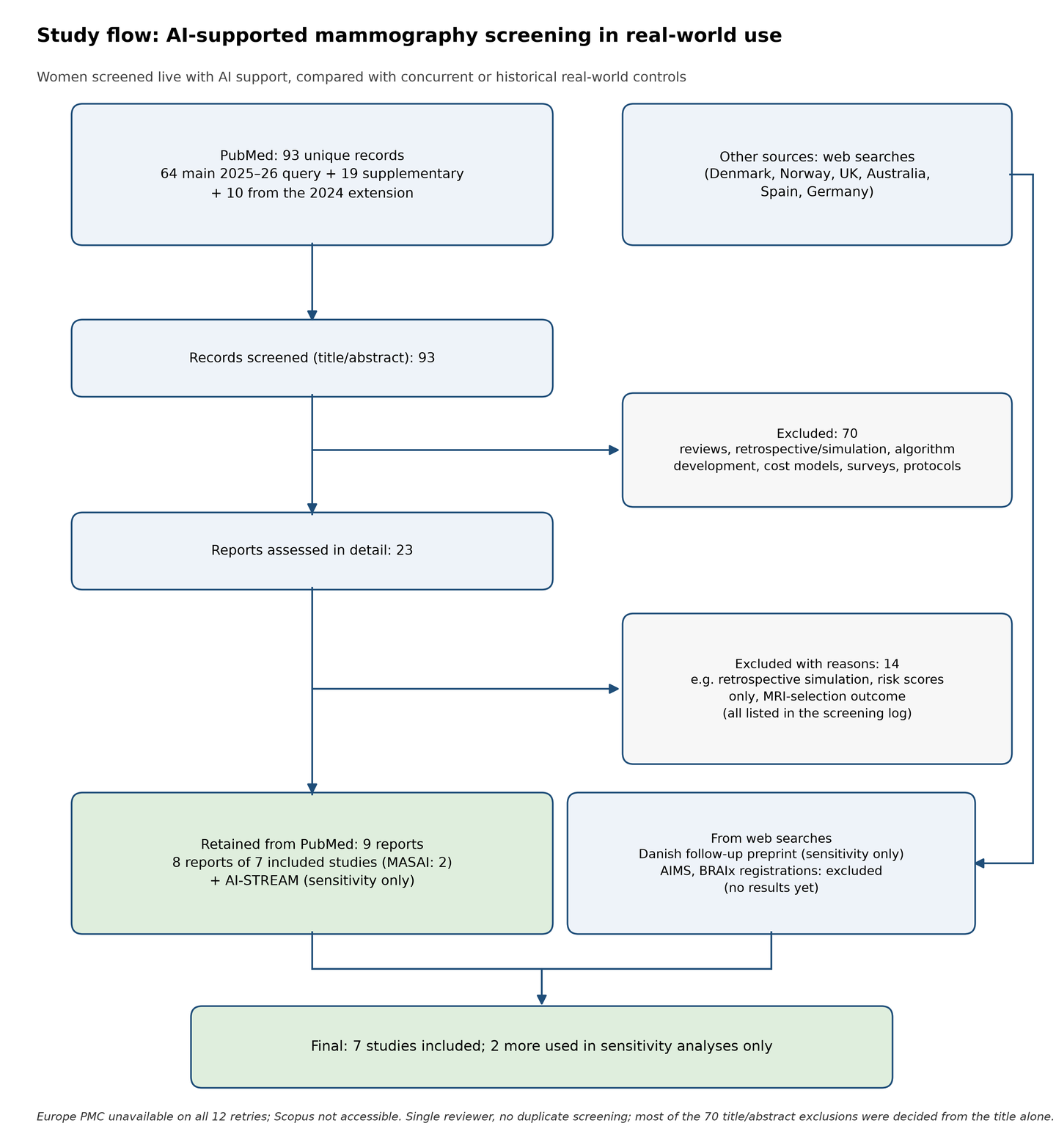
- PubMed records: 93 unique, from three saved queries:
- 64 from the main 2025–26 query;
- 19 from a supplementary 2025–26 query (83 in total in the initial search);
- 10 additional records from the 2024 extension.
- The PubMed 2024 extension identified Lauritzen 2024 and Elías-Cabot 2024. Web searches (Denmark, Norway, the UK, Australia, Spain, Germany) identified the Danish follow-up preprint and the AIMS/BRAIx registrations.
- Europe PMC was unavailable on all 12 retries. Scopus was not accessible directly.
- Per-stage counts: 93 PubMed records screened on title/abstract; 70 excluded (reviews/meta-analyses, retrospective or simulation studies, algorithm development, cost-effectiveness models, surveys, protocols and other non-eligible designs); 23 assessed in detail; 14 excluded with reasons; 9 retained: 8 reports of 7 included studies (MASAI has two reports) plus AI-STREAM (sensitivity only). Web searches added the Danish preprint (sensitivity only); AIMS and BRAIx were excluded (no results).
- Final: 7 studies included; 2 used in sensitivity analyses only.
- Every record and its reason is in the screening log. All screening was done by a single reviewer without duplicate screening or verification. Most of the 70 title/abstract exclusions were decided from the title alone, so eligible studies may have been missed.
Analysis:
- Effect measure: log rate ratios, pooled with DerSimonian–Laird random effects.
- REML+HKSJ confidence intervals (t with k−1 degrees of freedom, HKSJ-scaled SE) are reported alongside.
- Prediction intervals: PI = exp(μ ± t(k−2)·sqrt(τ²+SE²)), REML τ², unadjusted SE (Higgins/IntHout form).
- The HKSJ variance factor is floored at 1, so the HKSJ CI is never narrower than the unadjusted REML CI. Both the HKSJ CI and the PI use the REML τ²; the DerSimonian–Laird τ² is used only for the DL estimate. Analyses used custom code in Python 3.13 with NumPy 2.5.4 and SciPy 1.18.1; figures were drawn with Matplotlib 3.11.2.
- Heterogeneity is reported two ways: I² from Cochran's Q (DL) and I² from the REML τ². For CDR these are 38% and 15.5%.
- Study CIs are shown as published for PRAIM (adjusted CDR, recall, PPV; checked against the paper's Table 3) and for MASAI interval cancers. Pooling uses variances computed from these CIs.
Deviations from the protocol (beyond Amendment 1):
- REML τ², HKSJ confidence intervals and prediction intervals were in neither the original protocol nor Amendment 1. They were added during internal review.
- The HKSJ degrees of freedom were changed to k−1, and the HKSJ variance factor was floored at 1, during internal review.
- Europe PMC was added by Amendment 1 but could not be searched (unavailable).
- PRAIM: the adjusted (propensity-weighted) estimates are primary; crude estimates are a sensitivity analysis.
- Paired CDR variance used discordant cancers: var = (b+c)/(x_AI·x_DR).
- Paired add-on designs estimate the incremental yield of an extra read and cannot show a decrease. Their ratios are not directly comparable to randomised or parallel cohorts and are pooled across designs only for descriptive purposes.
Sensitivity analyses:
- Pre-specified in the original protocol: RCT only; leave-one-out.
- Added in Amendment 1 after the initial results were seen: independent versus paired variances; PRAIM crude; concurrent controls only; adding AI-STREAM; replacing Lauritzen 2024 with the Danish preprint; parallel-arm only; dropping both Córdoba studies.
Results
Included studies
| Study | Country | Design | AI role | Software | Women (AI / control) |
|---|---|---|---|---|---|
| MASAI 2025/26 | Sweden | RCT | A | Transpara 1.7.0 | 53,043 / 52,872 |
| PRAIM 2025 | Germany | Prospective concurrent (radiologist-chosen) | A | Vara 1.0.5→2.6.2 | 260,739 / 201,079 |
| Lauritzen 2024 | Denmark | Retrospective before/after (historical) | A | Vendor-affiliated co-author (ScreenPoint); product per full text | 58,246 / 60,751 |
| Elías-Cabot 2024 | Spain | Matched historical | A (detection support) | Transpara 1.7.0 | 11,998 / 11,998 |
| Elías-Cabot 2026 | Spain | Prospective paired | B | Transpara 1.7 | 31,301 paired |
| Lehnen 2026 | Germany | Prospective paired | C | Transpara 1.7.3 | 15,356 paired |
| GEMINI 2026 | UK | Prospective paired (live) | C | Mia (version not reported) | 10,889 paired |
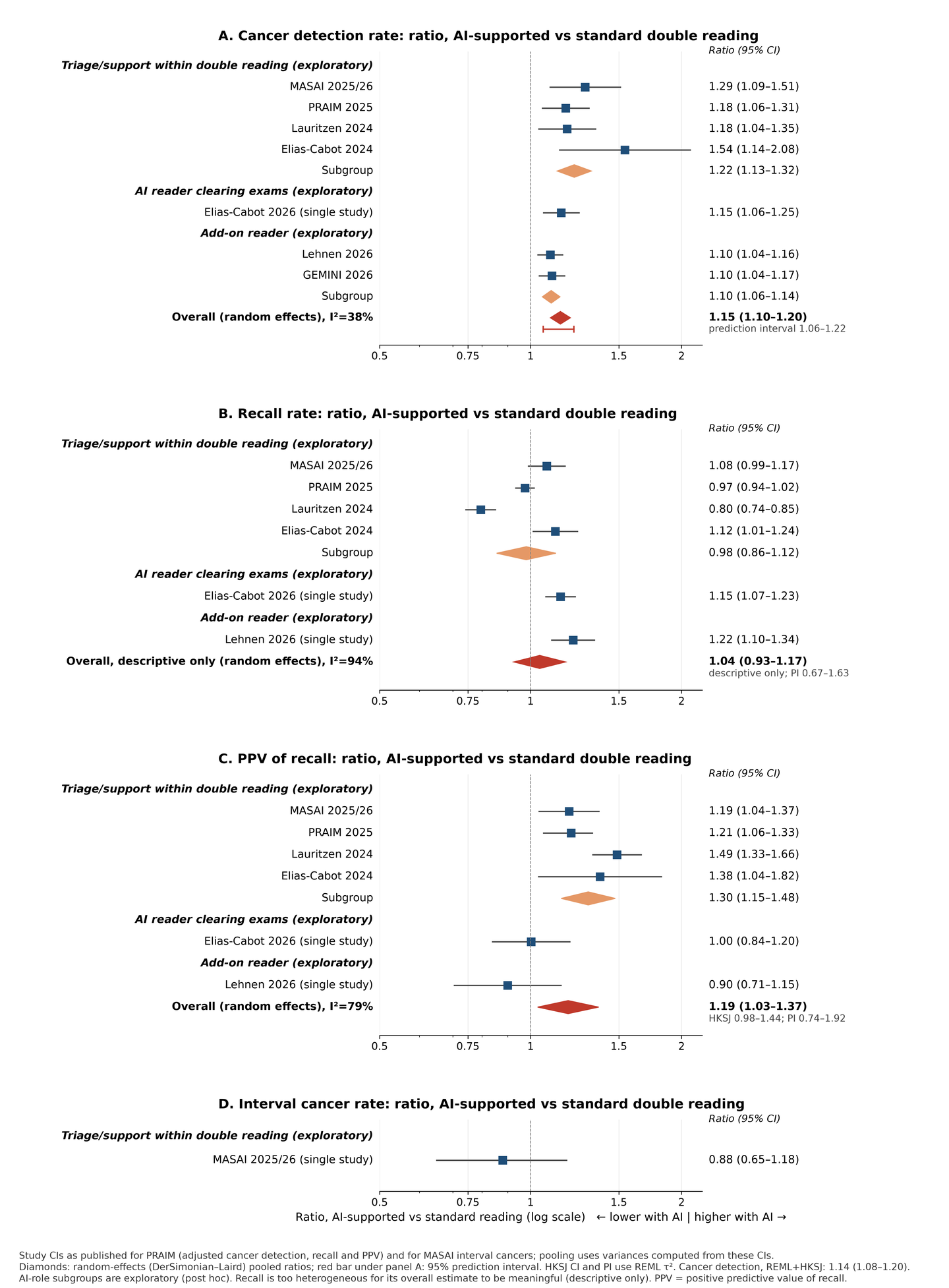
Figure 1 note: Study CIs shown as published for PRAIM (adjusted CDR, recall, PPV) and MASAI interval cancers; pooling uses variances computed from these CIs. HKSJ CI and PI use REML τ². CDR: REML+HKSJ 1.14 (1.08–1.20).
Cancer detection (Figure 1)
- Pooled: 1.15 (1.10–1.20), k=7, I²=38% (from Q; 15.5% from REML τ²); PI 1.06–1.22; REML+HKSJ 1.14 (1.08–1.20).
- By AI role (exploratory):
- A: 1.22 (1.13–1.32), k=4.
- C: 1.10 (1.06–1.14), k=2. With only two studies, REML+HKSJ gives 0.84–1.43.
- Role B is a single study (Elías-Cabot 2026: 1.15, 1.06–1.25) and is not pooled.
- Sensitivity analyses:
- Parallel-arm only: 1.22 (1.13–1.32), k=4. This is the same set as role A.
- Independent variances: 1.20 (1.12–1.27).
- PRAIM crude: 1.13 (1.08–1.18).
- RCT only (single study, MASAI; pre-specified; least confounded): 1.29 (1.09–1.51).
- Concurrent or paired controls only: 1.13 (1.08–1.17), k=5.
- Adding AI-STREAM: 1.14 (1.10–1.19), k=8.
- Danish preprint in place of Lauritzen: 1.15 (1.10–1.21).
- Dropping both Córdoba studies: 1.13 (1.08–1.18), k=5.
- Leave-one-out range: 1.13–1.17.
- Absolute difference (AI minus standard): 0.99 more cancers per 1,000 screened (95% CI 0.70–1.28; k=7; I²=21%). REML+HKSJ gives 0.96 (0.60–1.31), with a prediction interval of 0.54–1.37. Method: DerSimonian–Laird random-effects pooled risk difference from per-study counts. Paired designs use a paired variance; PRAIM uses its published adjusted difference, 1.0 (0.3–1.7) per 1,000. Study-level differences ranged from 0.65 to 3.17 per 1,000. As a cross-check, applying the pooled RR to the median control CDR (6.33 per 1,000) gives 0.93 (0.60–1.27).
Recall
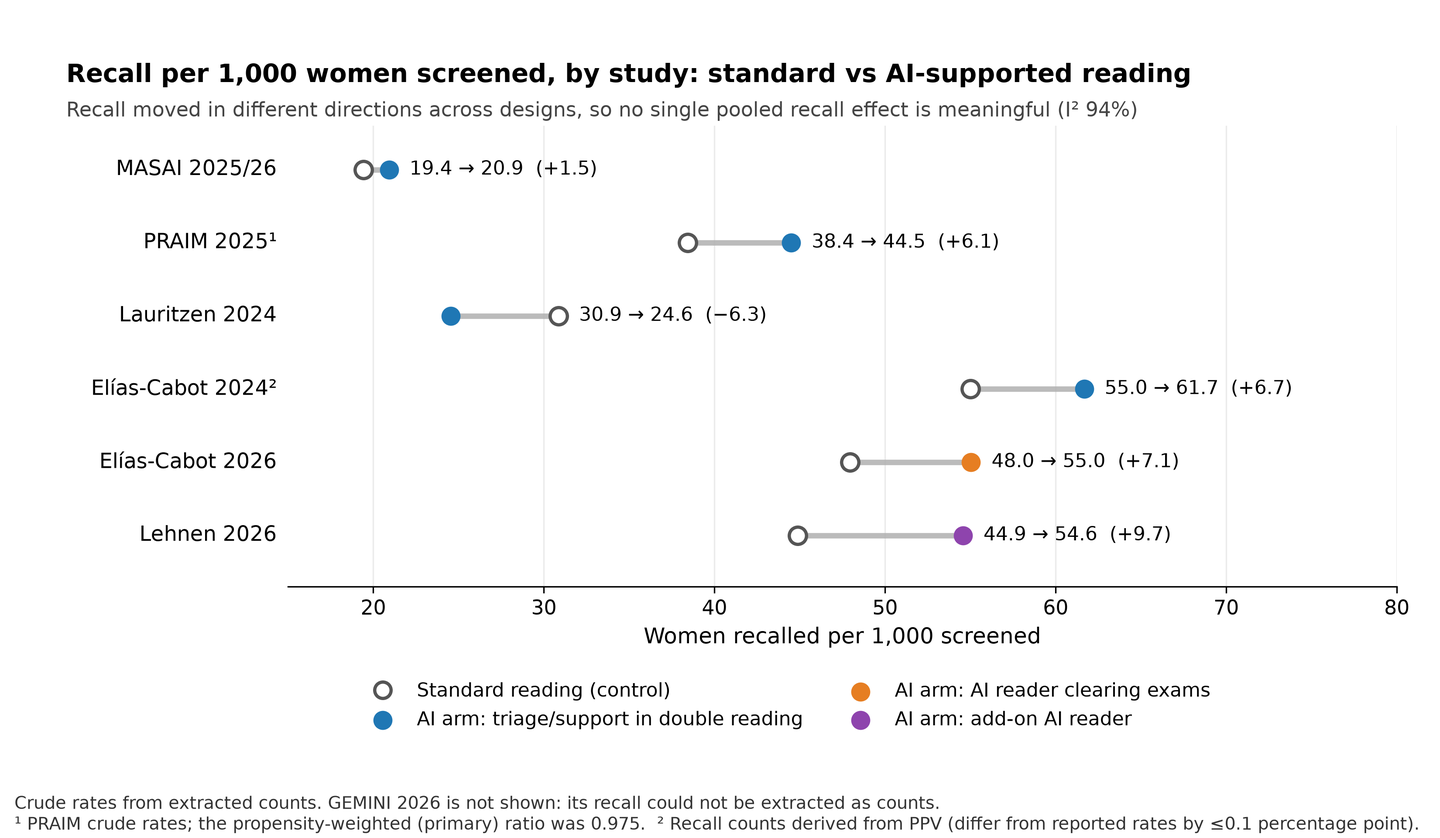
- Recall was highly heterogeneous: I²=94%, PI 0.67–1.63, DL 1.04 (0.93–1.17), REML+HKSJ 1.04 (0.89–1.23). No single pooled recall effect is meaningful.
- Role A studies ranged from 0.80 (Denmark) to 1.12 (Córdoba 2021–22).
- Single studies: Elías-Cabot 2026 (autonomous reader) 1.15 (1.07–1.23); Lehnen 2026 (add-on) 1.22 (1.10–1.34).
- GEMINI recall could not be extracted as counts.
PPV of recall
- Pooled: DL 1.19 (1.03–1.37), I²=79%. REML+HKSJ 1.19 (0.98–1.44), crossing 1; PI 0.74–1.92.
- Role A (exploratory): 1.30 (1.15–1.48), k=4; REML+HKSJ 1.07–1.59.
- Single studies: Elías-Cabot 2026, 1.00 (0.84–1.20); Lehnen 2026, 0.90 (0.71–1.15).
- PRAIM crude: 1.13 (0.93–1.37).
Interval cancers: MASAI (single study): 82/53,043 vs 93/52,872 (counts from the journal press release, consistent with the Lancet abstract rates). The published proportion ratio was 0.88 (0.65–1.18). This is consistent with non-inferiority, not a demonstrated reduction.
PRAIM, adjusted versus crude: Crude recall was higher with AI (44.5 vs 38.4 per 1,000), but the propensity-weighted ratio was 0.975. Radiologists chose case by case whether to use the AI-supported viewer, so case mix and reader behaviour differed between the groups. Weighting rebalances these differences, so we treat the adjusted figure as primary and also report the crude figure.
Design and conflict-of-interest tally
Designs: 1 RCT; 4 prospective paired or concurrent studies (PRAIM, Elías-Cabot 2026, Lehnen, GEMINI); 2 historical studies, one before/after and one matched-historical (Lauritzen, Elías-Cabot 2024).
Funding and conflicts of interest, by study:
- MASAI: public non-industry funding (Swedish Cancer Society, Confederation of Regional Cancer Centres, Swedish governmental clinical-research funding). The senior author reports an advisory board role (Siemens Healthineers), a lecture honorarium (AstraZeneca), chairing the Swedish national screening guidelines, and co-founding an AI breast-ultrasound start-up. In the 2026 report, one co-author heads a screening programme whose cancer registry has a research agreement with the vendor; the same co-author reports participating in the board of a PCORI-funded study comparing screening mammography with and without AI assistance.
- PRAIM: vendor-funded. Three authors are vendor employees. The vendor was involved in study design, data interpretation and writing. Participating radiologists were customers of the vendor.
- Elías-Cabot 2026: not industry-funded; one author is a vendor employee.
- Elías-Cabot 2024: one author is a vendor employee.
- Lauritzen 2024: one author has a vendor affiliation.
- GEMINI: three authors are vendor employees.
- Lehnen 2026: no relationships declared.
Five of seven had vendor funding or vendor-affiliated authors; a sixth (MASAI) discloses a co-author's institutional research agreement with the vendor.
Discussion
Every included study found higher screen detection with AI support. The single RCT (1.29, 1.09–1.51) is the only estimate free of confounding by indication; in PRAIM, radiologists chose case by case which examinations were read in the AI arm. Triage/support designs pair the detection gain with stable or lower recall and a higher PPV. Add-on and autonomous-reader designs (single studies) raise recall. The interval-cancer evidence comes from a single RCT and shows non-inferiority, not superiority.
Limitations
- This is a rapid, non-systematic review with a single extractor. It was checked by an AI agent, has not been validated by humans and has not been externally peer reviewed.
- Europe PMC was unavailable and Scopus was not searched directly. Screening was single-reviewer and largely title-based at the first stage, which raises the risk of missed studies.
- Widening the window to 2024 (Amendment 1, made after the initial results) added two historical-control studies (Lauritzen 2024; Elías-Cabot 2024). The AI-role subgroup is exploratory.
- Historical controls are subject to secular trends. In Lauritzen 2024, the median screening interval was 845 days before AI and 993 days with AI, which may inflate prevalent-cancer yield in the AI period.
- Elías-Cabot 2024 and 2026 come from the same Córdoba programme. Their periods appear distinct, but the readers and population overlap. Dropping both gives 1.13 (1.08–1.18).
- MASAI interval counts (82/53,043 vs 93/52,872) are taken from the journal press release (EurekAlert, re-checked 28 Oct 2026). They match the Lancet abstract's rates (1.55 vs 1.76 per 1,000) and its proportion ratio, 0.88 (0.65–1.18), which is the estimate used. The full-text tables were not accessed.
- Software versions: not reported for GEMINI and not verified for Lauritzen 2024. At least four of the seven studies evaluate the same software family.
- GEMINI recall could not be extracted, so GEMINI is absent from the recall and PPV pools.
- Elías-Cabot 2024 recall counts were derived from PPV. They differ from the reported recall rates (6.1% vs 5.4%) by ≤0.1 percentage point.
- The Elías-Cabot 2026 discordant counts (54/24) are inferred from the reported union of 252 cancers.
- Only one study reports interval cancers.
References
- Hernström V, et al. Lancet Digit Health 2025;7:e175–83. https://doi.org/10.1016/S2589-7500(24)00267-X
- Gommers J, et al. Lancet 2026;407:505–14. https://doi.org/10.1016/S0140-6736(25)02464-X
- Eisemann N, et al. Nat Med 2025;31:917–24. https://doi.org/10.1038/s41591-024-03408-6
- Lauritzen AD, et al. Radiology 2024;311:e232479. https://doi.org/10.1148/radiol.232479
- Elías-Cabot E, et al. Eur Radiol 2024;34:3958–66. https://doi.org/10.1007/s00330-023-10426-4
- Elías-Cabot E, et al. Nat Med 2026;32:1296–305. https://doi.org/10.1038/s41591-026-04277-x
- Lehnen T, Polenske D, Wichtmann BD, Lehnen NC. Eur Radiol 2026;36:4478–88. https://doi.org/10.1007/s00330-026-12359-0
- de Vries CF, et al. Nat Cancer 2026;7:484–93. https://doi.org/10.1038/s43018-026-01126-1
- Chang YW, et al. Nat Commun 2025;16:2248. AI-STREAM; sensitivity analysis only. https://doi.org/10.1038/s41467-025-57469-3
- Danish regional follow-up (preprint; sensitivity analysis only). Research Square 2025. https://doi.org/10.21203/rs.3.rs-7487727/v1
Corrections
None yet.
Found an error? Email hello@paloaltohealthlabs.com.
More from the Palo Alto Health Labs Co-Scientist · All posts
Have your own questions? Sign up for the Beta
Tell us the health AI or digital health question you would want the Co-Scientist to review, and join the beta list.
Scope it in 30 minutes
Book a scoping call and we'll name the smallest engagement that moves you forward. Most teams start with the fixed-scope Initial Audit.
Book a 30-min scoping callPrefer to write? Send a short note.