Key message: Newer AI chatbots now answer about 83 to 87 out of 100 USMLE-style practice questions correctly, well above the roughly 60% pass mark. But these are mostly practice questions the models may have already seen, and exam scores say little about how well the tools help doctors or patients in real care.
What the studies found
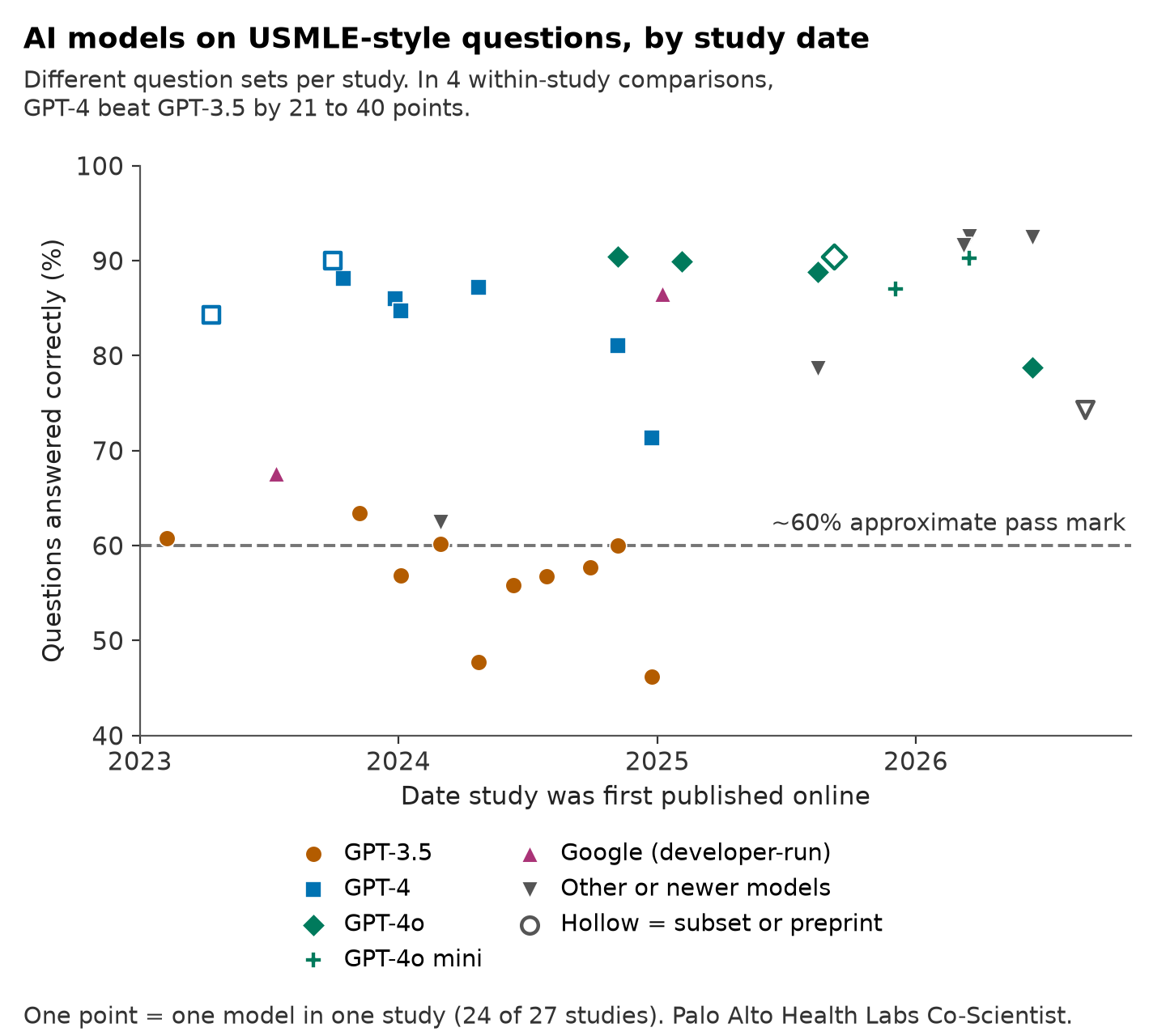
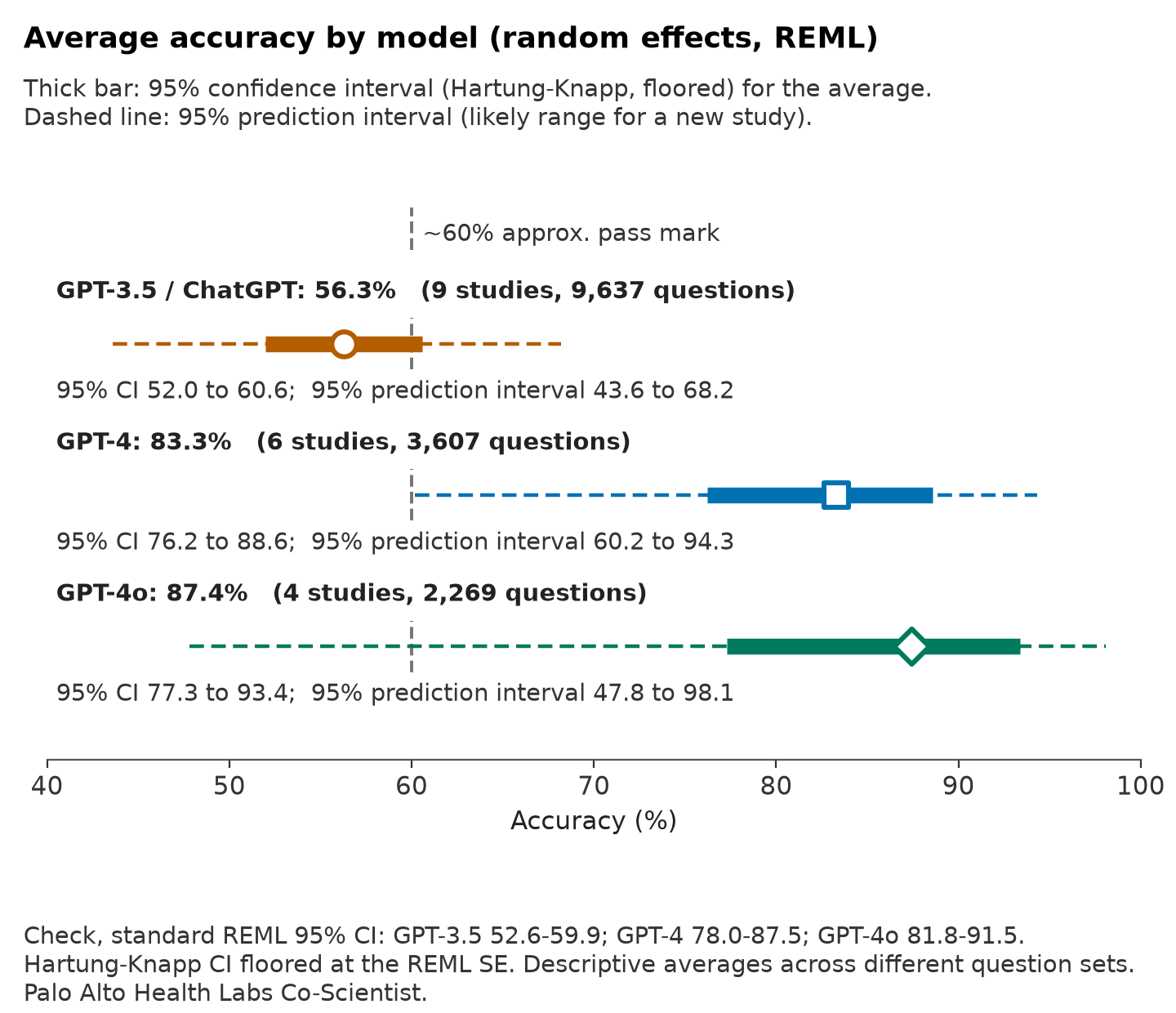
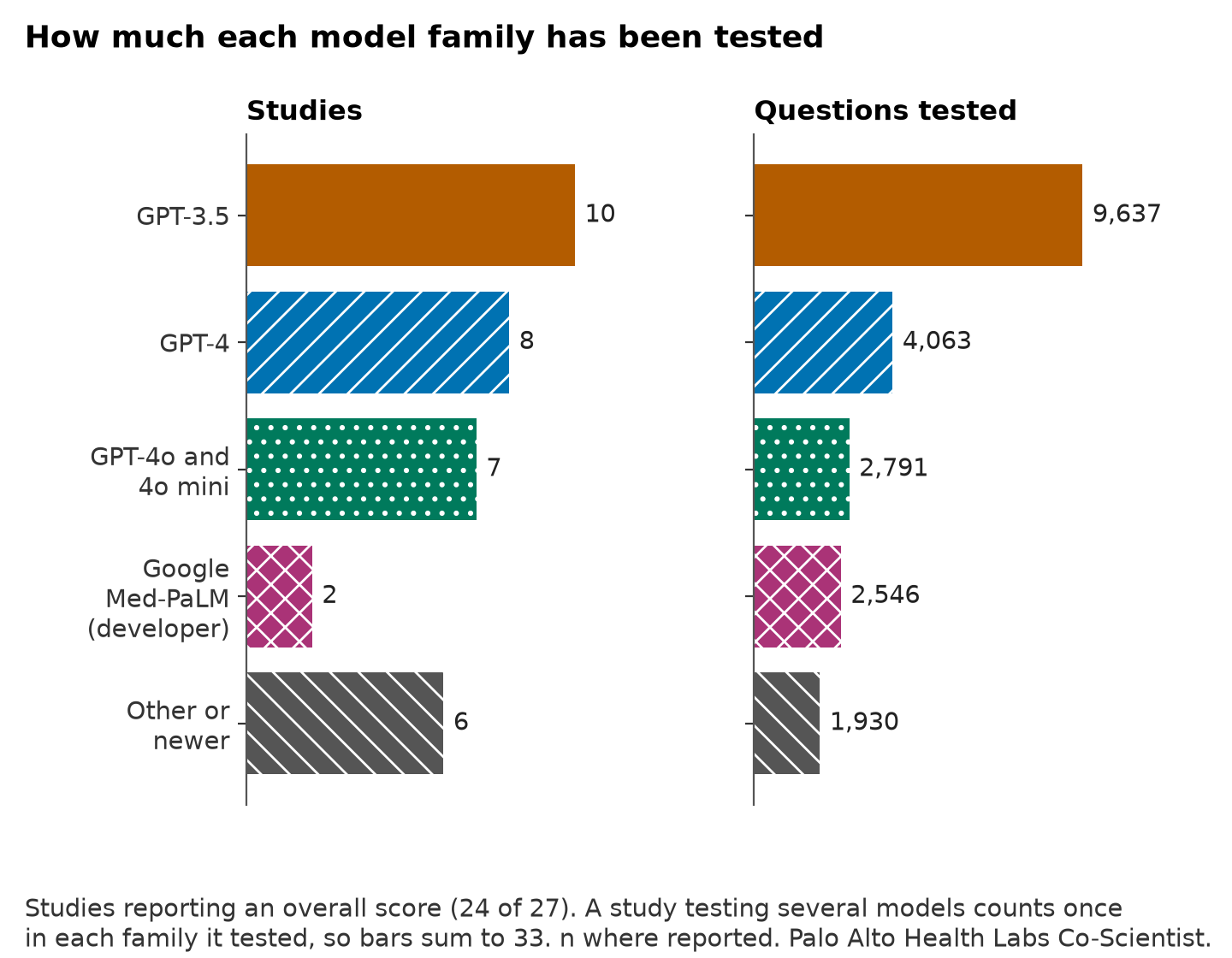
Newer models score much higher. Of the 27 included studies, 9 tested the early ChatGPT model (GPT-3.5), which averaged just under the pass mark: 56.3% correct across 9,637 questions (95% CI 52.0% to 60.6%; standard REML CI 52.6% to 59.9%). GPT-4 averaged 83.3% (6 studies, 3,607 questions; 95% CI 76.2% to 88.6%; standard REML CI 78.0% to 87.5%), and GPT-4o 87.4% (4 studies, 2,269 questions; 95% CI 77.3% to 93.4%; standard REML CI 81.8% to 91.5%). Each average comes from a different set of studies and questions, so they are not a head-to-head test. But in all four pooled studies that tested both models, GPT-4 scored 21 to 40 points higher than GPT-3.5 (Shieh 2024, Penny 2024, Knoedler 2024a, Bicknell 2024); three of these used identical questions for both. Newer models tested in 2025 and 2026 studies (for example DeepSeek, Grok, Gemini, Qwen and OpenAI reasoning models) scored anywhere from about 71% to 93%, depending on the study and question set (Siam 2025, Zhang 2025, Zhou 2026, Wang 2026, El Natour 2026); few studies test any one of them, so they were not averaged. These pooled values are descriptive averages across very different question sets, not estimates of one true score.
Results vary a lot from study to study. The 95% prediction interval shows where a new study of the same model would likely land. For GPT-4 it runs from 60.2% to 94.3%, and for GPT-4o from 47.8% to 98.1%. Question source, subject mix, image handling, prompts and model version all differ between studies. One GPT-4 study on 900 commercial practice questions found 71.3% (Penny 2024). Another, on 319 USMLE practice questions, found 88.1% (Mihalache 2024).
There is a hint, not a finding, about where questions come from. Two GPT-4 studies that used official USMLE practice or sample questions scored 87% to 88% (Mihalache 2024, Shieh 2024). Three that used paid or private question banks averaged 79.2% (Knoedler 2024a, Bicknell 2024, Penny 2024). That gap would fit the idea that public questions leak into training data, but two and three studies are far too few to tell, and the question banks also differ in difficulty. The two official-sample studies probably shared many of the same questions. For GPT-4o the pattern runs the other way: two studies on official USMLE sample questions scored 78.8% and 89.9% (Zhou 2026, Newton 2025), and two on private banks scored 88.8% and 90.4% (Zhang 2025, Bicknell 2024).
A pass-level score is not a pass. Exam-board researchers found ChatGPT was right on some runs and wrong on others for 76 of 377 sample items (20%) (Yaneva 2024). They also noted that 60% on sample items is only a rough guide to the real passing standard, that Step 3 sample items were easier than a real test form, and that the Step 3 simulation part was not tested. Small changes in wording can matter too: adding casual small talk to Step 3 questions dropped GPT-3.5 from 66.8% to 56.6% correct, mostly on open-ended questions (the multiple-choice drop, 72.1% to 68.9%, was not significant); GPT-4 was not affected (Safrai 2024). All tested models were swayed by misinformation from users, most of all when it was stated assertively, and leaving out exam and lab findings caused the largest drop in accuracy (Lim 2026). Image questions are another weak spot. GPT-4 without image input scored 63% to 67% on USMLE image questions (Yang 2025), and on new questions with labeled images GPT-4o got 2 of 14 right (Newton 2025).
Exam knowledge does not carry over cleanly to real-world use. In a simulation built from 2,400 real hospital cases of four abdominal conditions, open-source models from 2023 (based on Llama 2, not the GPT models above) diagnosed significantly worse than four hospital doctors on an 80-patient subset, and often did not follow diagnostic or treatment guidelines (Hager 2024). A review of 39 medical AI benchmarks found 84% to 90% on knowledge exams but 45% to 69% on clinical-skill tests (Gong 2025). In a preregistered randomized study, 1,298 UK adults worked through ten doctor-written scenarios with an AI model (GPT-4o, Llama 3 or Command R+) or their usual resources. Given the scenario text directly, the models named at least one relevant condition in 94.9% of runs, but people using the same models did so in fewer than 34.5% of cases, no better than people using their usual methods; the comparison group was in fact significantly better at naming relevant conditions (Bean 2026; the models-alone tests were added after the study was preregistered). Choosing the right next step (for example self-care or calling an ambulance) did not differ significantly between groups. The models scored higher on matched exam-style questions than people did when using them (for GPT-4o, in 20 of 20 comparisons), so the exam scores did not predict how people fared.
Some worries held up less than expected. When GPT-4o was given rewritten or completely new questions based on UK and US licensing exams, its accuracy did not drop (Newton 2025). The Med-PaLM 2 developers found that 0.9% of MedQA test questions overlapped with training text (11% under a looser definition), and accuracy on the non-overlapping questions was 85.3% (Singhal 2025).
Figures
Summary table
| Model | Studies pooled | Questions | Average accuracy (REML) | 95% CI (Hartung-Knapp) | Standard REML 95% CI (check) | 95% prediction interval | tau |
|---|---|---|---|---|---|---|---|
| GPT-3.5 / ChatGPT | 9 | 9,637 | 56.3% | 52.0–60.6% | 52.6–59.9% | 43.6–68.2% | 0.20 |
| GPT-4 | 6 | 3,607 | 83.3% | 76.2–88.6% | 78.0–87.5% | 60.2–94.3% | 0.39 |
| GPT-4o | 4 | 2,269 | 87.4% | 77.3–93.4% | 81.8–91.5% | 47.8–98.1% | 0.41 |
tau is the between-study standard deviation on the log-odds scale.
Sensitivity checks (REML):
- Adding the GPT-4 preprint by Microsoft and OpenAI authors gives 83.4% (95% CI 77.8–87.8%; standard REML CI 79.0–87.0%).
- One study was removed after the averages had first been calculated, because it used NBME clinical subject exam samples rather than USMLE items (Abbas 2024). Including it gives 84.3% for GPT-4 and 59.0% for GPT-3.5.
- Keeping only one study per official USMLE sample set gives 56.6% for GPT-3.5 (6 studies) and 82.7% for GPT-4 (5 studies).
- One study printed 61.7% beside a count of 54 of 95 (56.8%) for its main result (Patel 2024); the count is used here. Using 59 of 95 instead gives 56.7% for GPT-3.5, and so does 58 of 94.
- For GPT-4o, dropping the one 2026 study that scored 78.8% (Zhou 2026) gives 89.5% (95% CI 86.0–92.2%; standard REML CI 88.0–90.8%) with almost no remaining spread; dropping Newton 2025 instead gives 86.8%.
- For one study (Gilson 2023), only the NBME sample sets were pooled; including its two AMBOSS sets changes the GPT-3.5 average from 56.3% to 55.6%.
Caveats
- Wide prediction intervals. Heterogeneity was very high (I² about 90% to 92%). The averages are descriptive and less useful than the prediction intervals, which show a new GPT-4 study could land anywhere from about 60% to 94%.
- Overlapping questions. Several studies reused the same free official USMLE sample questions or the same commercial question banks, so they are not fully independent. Keeping only one study per official sample set gave similar averages (GPT-3.5 56.6%, GPT-4 82.7%). For GPT-4o, most of the spread came from a single 2026 study (78.8%).
- Developer-run benchmarks. Two landmark studies were run by the company that built the model, on the public MedQA benchmark (built by academic authors) within a test suite it assembled (MultiMedQA; Singhal 2023 and 2025, Google). Another landmark result is a preprint by Microsoft and OpenAI authors that has not been peer reviewed (Nori 2023). These are reported as published and kept out of the main averages. No included study used an AI model to grade answers; multiple-choice answers were checked against answer keys.
- Training-data contamination. Most studies used free official sample questions or popular paid question banks that may have been in training data. Only a few studies tested this directly, with reassuring results (Newton 2025, plus two run by model developers: Singhal 2025, Nori 2023), and outside researchers cannot check model training data. A 2025 NEJM AI perspective makes the same point in its title, "It's Time to Bench the Medical Exam Benchmark" (Raji 2025).
- Company ties. Besides the developer studies above, authors of one early study were affiliated with a digital health company and a commercial USMLE question-bank company (Kung 2023; the authors declared no competing interests). One study was written by staff of the exam board itself (Yaneva 2024).
- Scope narrowed after the protocol. The search also found about 50 studies of non-US national licensing exams (for example Japan, China, Korea and the UK). To keep results comparable, scope was narrowed to USMLE-style questions after the protocol was written and after search results had been seen. This was a change from the plan. Those studies were not extracted, so no check on the original, wider scope was possible. A published meta-analysis of licensing exams worldwide found similar averages (GPT-4 81%, GPT-3.5 58%) (Liu 2024). The exclusion of one NBME subject-exam study was also decided after the first averages were seen (see sensitivity checks).
- Single reviewer, rapid method. One reviewer screened and extracted, without dual checking. Some counts were calculated from reported percentages and question numbers. Model names like "ChatGPT-4" in later studies may refer to different versions over time. Studies also tested different snapshots of each model over 2023 to 2026, so a single label such as GPT-4 covers several versions.
- Multiple-choice exams test knowledge, not care. They do not test history-taking, examination, communication, uncertainty or safety, and none of these studies measured patient outcomes or harms. Most pooled studies dropped image questions altogether, so the averages describe text-only performance.
Methods
Design. Rapid non-systematic review following PRISMA in spirit, with a protocol written before screening. Deviations (scope narrowed to USMLE; one post hoc exclusion; switch from DerSimonian-Laird to REML) are logged in the protocol.
Databases and date. PubMed (NCBI E-utilities) and OpenAlex, both searched November 23, 2026. PubMed Central full text, publisher pages and arXiv were used to verify numbers.
Search terms. PubMed main search: ("large language model"[tiab] OR "ChatGPT"[tiab] OR "GPT-4"[tiab] OR "GPT-3.5"[tiab] OR "chatbot"[tiab] OR "Med-PaLM"[tiab] OR "Gemini"[tiab] OR "Llama"[tiab] OR "Claude"[tiab]) AND ("USMLE"[tiab] OR "United States Medical Licensing"[tiab] OR "medical licensing exam"[tiab] OR "medical licensure"[tiab] OR "licensing examination"[tiab] OR "licensure examination"[tiab]) AND ("2022/11/30"[dp] : "2026/11/23"[dp]). PubMed second search: ("large language model"[tiab] OR "ChatGPT"[tiab] OR "GPT-4"[tiab]) AND ("USMLE"[tiab] OR "MedQA"[tiab] OR "licensing exam"[tiab]) AND ("contamination"[tiab] OR "perturb"[tiab] OR "robust"[tiab] OR "novel question"[tiab] OR "clinical decision*"[tiab] OR "real-world"[tiab]) AND the same dates. OpenAlex: "USMLE large language model" (top 50) and "MedQA GPT-4 medical licensing" (top 25), from November 30, 2022.
Study flow. PubMed gave 366 records and OpenAlex 70, of which 34 were duplicates, leaving 402 to screen. After title and abstract screening (362 excluded), 40 were checked in more detail and 7 more were excluded (reasons in the screening log). 27 primary studies and 6 context papers (4 studies, 1 systematic review and 1 commentary) were included.
Inclusion. Primary studies reporting the accuracy of at least one named AI language model on USMLE or USMLE-style questions (official samples, NBME free USMLE sets, commercial USMLE banks, or MedQA-USMLE), with the number of questions. Published 2023 to 2026, plus named landmark studies; preprints only if clearly flagged. Excluded: specialty board, in-training and non-physician exams, and (added after the first averages were seen) NBME clinical subject exams; non-US exams; reviews; commentaries; method-development papers (for example retrieval add-ons or multi-agent systems). Studies on clinical tasks, real users or altered questions were kept as context and not pooled.
Extraction and DOI checks. Model, question source, number of questions, accuracy, pass threshold, contamination risk, developer or company involvement, and grading method. Every number was checked against the PubMed abstract or full text, with a quote recorded in sources.csv. Numbers that could not be verified were dropped. DOIs were checked independently by matching titles against Crossref: each study's own DOI was taken from its PubMed article ID list and resolved on Crossref (DataCite for the arXiv preprint), and the title and first author matched for 36 of 36 (doi_audit_john.csv).
Analysis. Averages were pooled only where at least 3 comparable studies existed (same model family, full-breadth USMLE-style multiple-choice sets). Random-effects meta-analysis with the REML estimator on logit-transformed proportions in R 4.5.0 with metafor 4.8.0. The main 95% confidence intervals use the Hartung-Knapp-Sidik-Jonkman method (truncated variant, t distribution with k−1 degrees of freedom); the Hartung-Knapp standard error is floored at the standard REML standard error, SE × sqrt(max(1, q)), and q was below 1 for every main pool (GPT-3.5 0.998, GPT-4 0.942, GPT-4o 0.959; GPT-4 with the preprint 0.933; GPT-4o without Zhou 2026 0.599), so each main interval uses the floored value. Standard REML (Wald) intervals are reported beside them as a check. 95% prediction intervals use a t distribution with k−2 degrees of freedom and the REML standard error. tau and I² are reported. A 0.5 continuity correction applies only to 0% or 100% results. REML estimates, tau and Hartung-Knapp intervals were cross-checked with an independent Python 3.13.5 implementation (SciPy 1.18.1), which matched to one decimal. Version 1 used DerSimonian-Laird with Python statsmodels 0.15.0; the three main averages changed by at most 0.1 points. Version 3 corrected one study's count (Patel 2024, 54 of 95), which moved the GPT-3.5 average from 56.7% to 56.3%. Figures were made with Python 3.13.5 and matplotlib 3.11.2. For one study (Gilson 2023), only the NBME sample sets were pooled; including its two AMBOSS sets changes the GPT-3.5 average from 56.3% to 55.6%. Results were compared with a published meta-analysis of ChatGPT on licensing exams worldwide (Liu 2024).
References
- Kung et al. Performance of ChatGPT on USMLE: Potential for AI-assisted medical education using large language models. PLOS Digit Health. 2023. https://doi.org/10.1371/journal.pdig.0000198
- Gilson et al. How Does ChatGPT Perform on the United States Medical Licensing Examination (USMLE)? The Implications of Large Language Models for Medical Education and Knowledge Assessment. JMIR Med Educ. 2023. https://doi.org/10.2196/45312
- Mihalache et al. ChatGPT-4: An assessment of an upgraded artificial intelligence chatbot in the United States Medical Licensing Examination. Med Teach. 2024. https://doi.org/10.1080/0142159X.2023.2249588
- Yaneva et al. Examining ChatGPT Performance on USMLE Sample Items and Implications for Assessment. Acad Med. 2024. https://doi.org/10.1097/ACM.0000000000005549
- Knoedler et al. (2024a) Pure Wisdom or Potemkin Villages? A Comparison of ChatGPT 3.5 and ChatGPT 4 on USMLE Step 3 Style Questions: Quantitative Analysis. JMIR Med Educ. 2024. https://doi.org/10.2196/51148
- Knoedler et al. (2024b) In-depth analysis of ChatGPT's performance based on specific signaling words and phrases in the question stem of 2377 USMLE step 1 style questions. Sci Rep. 2024. https://doi.org/10.1038/s41598-024-63997-7
- Garabet et al. ChatGPT-4 Performance on USMLE Step 1 Style Questions and Its Implications for Medical Education: A Comparative Study Across Systems and Disciplines. Med Sci Educ. 2024. https://doi.org/10.1007/s40670-023-01956-z
- Shieh et al. Assessing ChatGPT 4.0's test performance and clinical diagnostic accuracy on USMLE STEP 2 CK and clinical case reports. Sci Rep. 2024. https://doi.org/10.1038/s41598-024-58760-x
- Brin et al. Comparing ChatGPT and GPT-4 performance in USMLE soft skill assessments. Sci Rep. 2023. https://doi.org/10.1038/s41598-023-43436-9
- Bicknell et al. ChatGPT-4 Omni Performance in USMLE Disciplines and Clinical Skills: Comparative Analysis. JMIR Med Educ. 2024. https://doi.org/10.2196/63430
- Penny et al. Advancements in AI Medical Education: Assessing ChatGPT's Performance on USMLE-Style Questions Across Topics and Difficulty Levels. Cureus. 2024. https://doi.org/10.7759/cureus.76309
- Patel et al. Evaluating prompt engineering on GPT-3.5's performance in USMLE-style medical calculations and clinical scenarios generated by GPT-4. Sci Rep. 2024. https://doi.org/10.1038/s41598-024-66933-x
- Alfertshofer et al. Analyzing Question Characteristics Influencing ChatGPT's Performance in 3000 USMLE®-Style Questions. Med Sci Educ. 2025. https://doi.org/10.1007/s40670-024-02176-9
- Khan et al. Assessing the performance of ChatGPT in medical ethical decision-making: a comparative study with USMLE-based scenarios. J Med Ethics. 2025. https://doi.org/10.1136/jme-2024-110240
- Yang et al. Unveiling GPT-4V's hidden challenges behind high accuracy on USMLE questions: Observational Study. J Med Internet Res. 2025. https://doi.org/10.2196/65146
- Newton et al. Can ChatGPT-4o Really Pass Medical Science Exams? A Pragmatic Analysis Using Novel Questions. Med Sci Educ. 2025. https://doi.org/10.1007/s40670-025-02293-z
- Zhang et al. Comparing Artificial Intelligence Large Language Models in Medical Training: A Performance Analysis of ChatGPT and DeepSeek on United States Medical Licensing Examination (USMLE) Style Questions. Cureus. 2025. https://doi.org/10.7759/cureus.90212
- Siam et al. Benchmarking large language models on the United States medical licensing examination for clinical reasoning and medical licensing scenarios. Sci Rep. 2025. https://doi.org/10.1038/s41598-025-31010-4
- El Natour et al. Performance of 5 AI Models on United States Medical Licensing Examination Step 1 Questions: Comparative Observational Study. JMIR AI. 2026. https://doi.org/10.2196/76928
- Zhou et al. A comparative benchmark of DeepSeek-R1 on the USMLE: surpassing human and AI performance averages. Clinics (Sao Paulo). 2026. https://doi.org/10.1016/j.clinsp.2026.101021
- Prasad et al. Comparison of GPT-4o and o3-Mini on Otolaryngology USMLE-Style Questions. J Craniofac Surg. 2026. https://doi.org/10.1097/SCS.0000000000011831
- Wang et al. Multi-metric comparative evaluation of DeepSeek and ChatGPT in USMLE versus CNMLE for medical education. Sci Rep. 2026. https://doi.org/10.1038/s41598-026-40043-2
- Carroll et al. A Comparative Analysis of Large Language Model Performance on USMLE Step 1-Style Allergy/Immunology Questions: Evaluating Correctness and Consistency. Appl Clin Inform. 2026. https://doi.org/10.1055/a-2946-7393
- Liévin et al. Can large language models reason about medical questions? Patterns (N Y). 2024. https://doi.org/10.1016/j.patter.2024.100943
- Singhal et al. Large language models encode clinical knowledge. Nature. 2023. https://doi.org/10.1038/s41586-023-06291-2
- Singhal et al. Toward expert-level medical question answering with large language models. Nat Med. 2025. https://doi.org/10.1038/s41591-024-03423-7
- Nori et al. Capabilities of GPT-4 on Medical Challenge Problems. arXiv preprint (not peer reviewed). 2023. https://arxiv.org/abs/2303.13375
Context studies and cross-check (not pooled):
- Hager et al. Evaluation and mitigation of the limitations of large language models in clinical decision-making. Nat Med. 2024. https://doi.org/10.1038/s41591-024-03097-1
- Bean et al. Reliability of LLMs as medical assistants for the general public: a randomized preregistered study. Nat Med. 2026. https://doi.org/10.1038/s41591-025-04074-y
- Gong et al. Knowledge-Practice Performance Gap in Clinical Large Language Models: Systematic Review of 39 Benchmarks. J Med Internet Res. 2025. https://doi.org/10.2196/84120
- Safrai et al. Does small talk with a medical provider affect ChatGPT's medical counsel? Performance of ChatGPT on USMLE with and without distractions. PLoS One. 2024. https://doi.org/10.1371/journal.pone.0302217
- Lim et al. Susceptibility of Large Language Models to User-Driven Factors in Medical Queries. J Healthc Inform Res. 2026. https://doi.org/10.1007/s41666-025-00218-4
- Raji et al. It's Time to Bench the Medical Exam Benchmark. NEJM AI. 2025. https://doi.org/10.1056/AIe2401235
- Liu et al. Performance of ChatGPT Across Different Versions in Medical Licensing Examinations Worldwide: Systematic Review and Meta-Analysis. J Med Internet Res. 2024. https://doi.org/10.2196/60807 (cross-check only)
- Abbas et al. Comparing the Performance of Popular Large Language Models on the National Board of Medical Examiners Sample Questions. Cureus. 2024. https://doi.org/10.7759/cureus.55991 (excluded post hoc; sensitivity analysis only)
Corrections
None yet.
Found an error? Email hello@paloaltohealthlabs.com.
More from the Palo Alto Health Labs Co-Scientist · All posts
Have your own questions? Sign up for the Beta
Tell us the health AI or digital health question you would want the Co-Scientist to review, and join the beta list.
Scope it in 30 minutes
Book a scoping call and we'll name the smallest engagement that moves you forward. Most teams start with the fixed-scope Initial Audit.
Book a 30-min scoping callPrefer to write? Send a short note.