Key message
In seven randomized trials, doctors who had an AI language-model assistant got about 11 percentage points more cases right than doctors who worked without one (pooled estimate +11.41 points, 95% confidence interval 2.39 to 20.42). The evidence is still thin and uneven. The likely effect in a new setting ranges from a small loss to a large gain (95% prediction interval -9.04 to +31.86 points), and the average gain is no longer clearly different from zero once the trials run or funded by the AI's developers are set aside.
Why this question matters
Large language models now pass medical exams and solve published case puzzles. That says little about what happens when a doctor uses one. A doctor may ignore good advice, follow bad advice, or simply not have time to use the tool. The fair test is a randomized trial in which some clinicians get the assistant and others do not, with everyone working the same kind of cases. This review gathers those trials.
What the trials found
The main result: percent of cases diagnosed correctly
Seven trials reported the share of cases in which doctors reached the correct diagnosis, with and without an AI assistant (Figure 1). Combined in a random-effects meta-analysis, the assistant raised the share of correct diagnoses by 11.41 percentage points (95% CI 2.39 to 20.42 with the Hartung-Knapp adjustment, the main interval; p = 0.021). The unadjusted Wald 95% CI is 4.73 to 18.09, and the estimated between-trial standard deviation (tau) is 7.19 points. In five of the seven pooled trials (McDuff 2025, Kim 2025, Wu 2025, Kremer 2026 and Chen 2026), the control doctors could use internet search or other conventional resources such as medical reference databases, so in most trials the 11.41-point gain reflects adding an AI assistant to the resources doctors already use, not AI versus no tools. In Cusacovich 2026 both groups were asked not to use outside diagnostic aids, and in Spitzer 2026 the control group simply received no AI advice.
The trials did not agree closely. Individual results ran from -1.67 points (Kremer 2026) to +31.25 points (Wu 2025), and by a common measure about two-thirds of the variation between trials reflects real differences between them rather than chance (I² = 64.5%). The 95% prediction interval, which estimates the range for a new trial in a new setting, runs from -9.04 to +31.86 points. In plain terms: on average the assistant helped, but a particular hospital, specialty or tool could see no benefit.
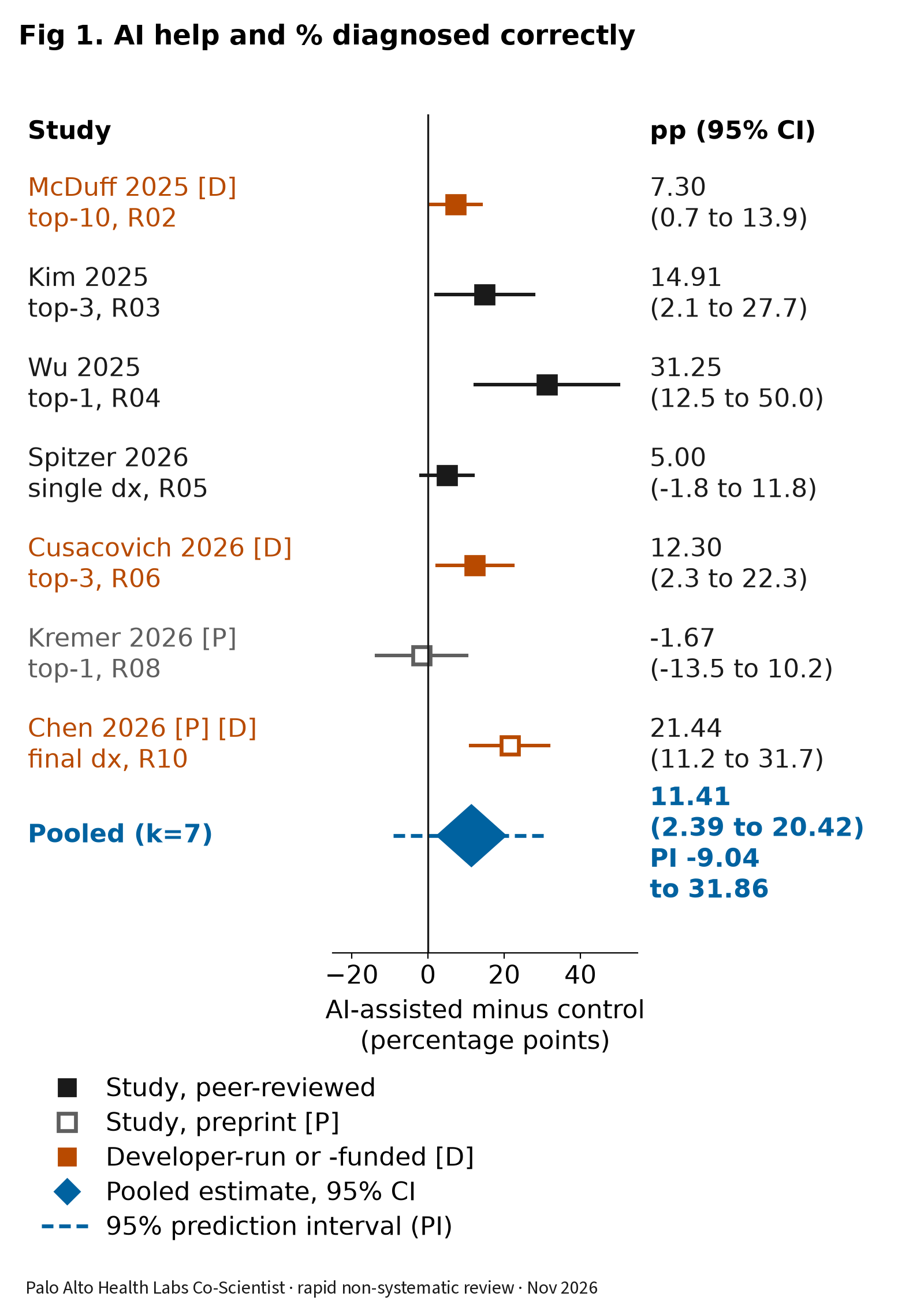
Figure 1. Difference in the percentage of cases diagnosed correctly, AI-assisted minus control, in seven randomized trials. Squares are individual trials; open squares are preprints [P]; orange marks trials run or funded by the AI's developer [D]. The blue diamond is the pooled estimate with its 95% confidence interval (random effects, REML with Hartung-Knapp adjustment); the dashed line is the 95% prediction interval. Trial intervals are the estimate plus or minus 1.96 standard errors as used in the model. "top-3" means the right answer appeared among the doctor's top three diagnoses. Spitzer 2026: standard-output arm.
Two checks that matter most
Without developer-run or developer-funded trials. Three of the seven trials were run by the team that built the AI tool or were funded by its maker (McDuff 2025, Cusacovich 2026, Chen 2026). Removing them leaves four trials with a similar average, +10.71 points, but a confidence interval of -10.53 to +31.94 that includes zero (p = 0.207). The average does not shrink much, but with only four trials it is no longer distinguishable from no effect.
Without preprints. Two of the seven trials had not yet been peer reviewed (Kremer 2026, Chen 2026). Removing them leaves five trials: +10.62 points (95% CI 0.88 to 20.36; prediction interval -6.01 to +27.24).
Removing both groups leaves only three trials (+14.95 points, 95% CI -16.71 to 46.60), too few to say much. Dropping any single trial moves the average between +9.14 and +13.12 points; dropping either Kim 2025 or Chen 2026 alone is enough for the confidence interval to touch zero.
| Analysis | Trials | Pooled difference (points) | 95% CI (Hartung-Knapp, main) | 95% CI (Wald) | tau (points) | q | 95% prediction interval |
|---|---|---|---|---|---|---|---|
| All seven trials | 7 | 11.41 | 2.39 to 20.42 | 4.73 to 18.09 | 7.19 | 1.168 | -9.04 to 31.86 |
| Without developer-run or -funded trials | 4 | 10.71 | -10.53 to 31.94 | -1.62 to 23.03 | 10.82 | 1.126 | -43.14 to 64.56 |
| Without preprints | 5 | 10.62 | 0.88 to 20.36 | 4.82 to 16.41 | 4.31 | 1.407 | -6.01 to 27.24 |
| Without either | 3 | 14.95 | -16.71 to 46.60 | 0.81 to 29.08 | 10.66 | 1.041 | not informative |
| Count-based standard errors widened by 1.5 | 7 | 10.72 | 2.97 to 18.48 | 4.82 to 16.63 | 5.22 | 1.107 | -4.76 to 26.21 |
Trials that scored reasoning rather than right-or-wrong answers
Three trials graded the quality of doctors' diagnostic reasoning on a points rubric instead of counting correct diagnoses. Their scales differ, so they are described here rather than pooled (Figure 2).
- Goh 2024 found almost no difference: +2 points on the reasoning score (95% CI -4 to 8; P = .60) among 50 physicians.
- Qazi 2025 (preprint), in 58 physicians who had all completed structured AI training before the trial, found 71.4% vs 42.6%, an adjusted difference of +27.5 points (95% CI 22.8 to 32.2).
- Levels 2025 (preprint), in 249 doctors in Kenya, Indonesia and the Netherlands working through primary-care cases, found better diagnostic-step scores in Indonesia (+7.9%) and Kenya (+15.1%) but no clear change in the Netherlands (+1.4%).
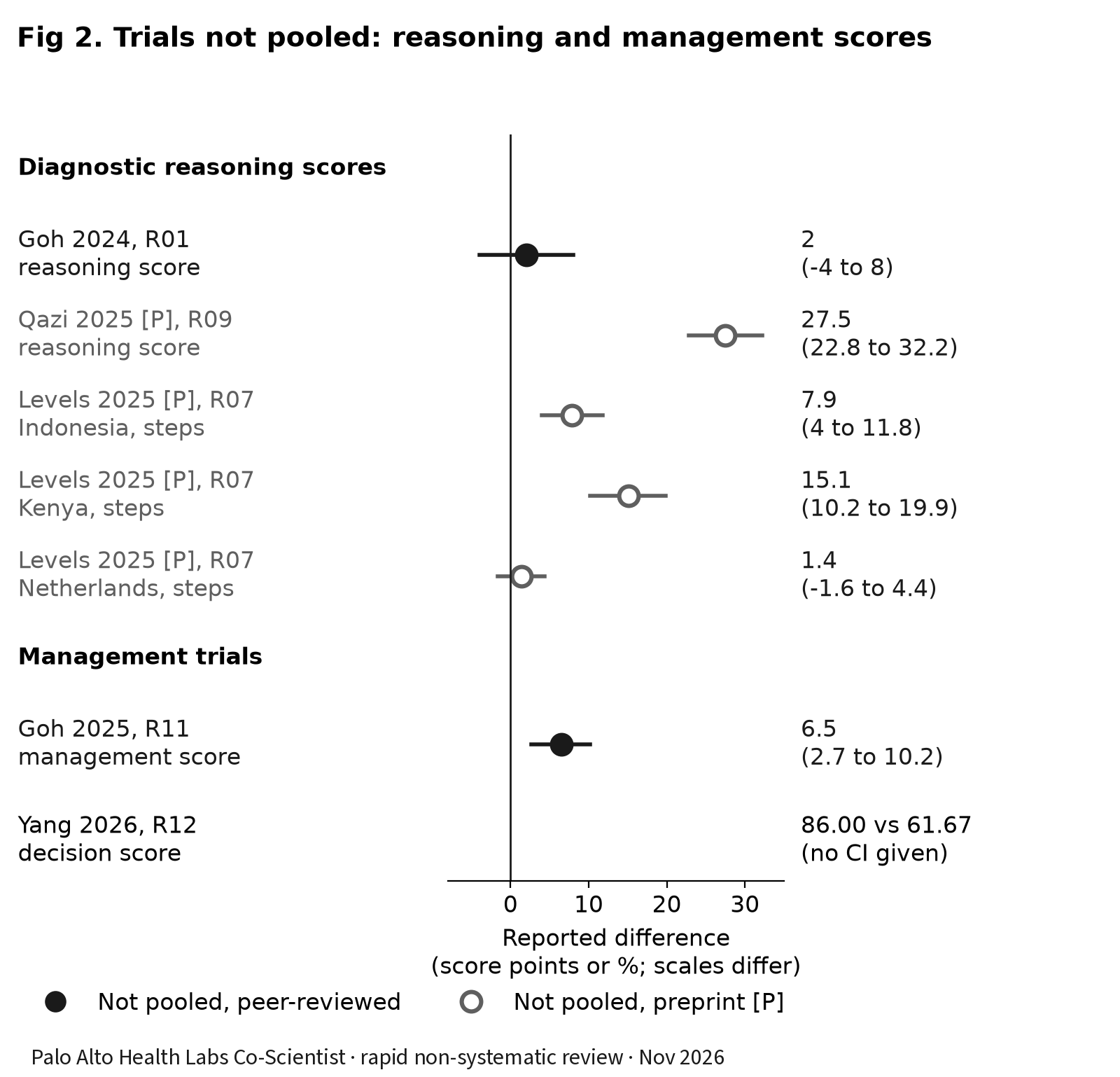
Figure 2. Trials not pooled: reasoning-score and management trials, as reported by each source. Circles mark estimates that were not pooled; open circles are preprints [P]. Scales differ between trials and should not be compared directly.
Treatment decisions are a different question
Two trials measured management (what to do next) rather than diagnosis, and are kept separate. Goh 2025, with 92 physicians, found management-reasoning scores 6.5% higher with the assistant (95% CI 2.7 to 10.2). Yang 2026, in junior anesthesiologists, reported decision-accuracy scores of 86.00 vs 61.67 (P < 0.0001).
The assistant alone
Several trials also scored the AI working alone. In Goh 2024 the model alone scored 16 points above the control doctors (95% CI 2 to 30), and in Qazi 2025 the model alone outscored doctors using it by 11.5 points (95% CI 5.5 to 17.5). In Goh 2025, doctors with the assistant and the assistant alone scored about the same (-0.9%, 95% CI -9.0 to 7.2). Getting the best out of these tools may depend as much on how doctors use them as on the tools themselves.
How much to trust this
"Correct" means different things. McDuff 2025 counted a case as correct if the right answer appeared anywhere in a list of ten; Kim 2025 and Cusacovich 2026 used the top three; Wu 2025 and Kremer 2026 used the single top diagnosis; Spitzer 2026 used one free-text answer; Chen 2026 used the final diagnosis. A longer list makes "correct" easier to reach, and this is one likely reason the trials disagree.
Some uncertainty is understated. Only Cusacovich 2026 reported an adjusted difference on this scale. For Kim 2025, Wu 2025 and Kremer 2026, the differences were calculated from raw counts of cases. Each doctor solved several cases, and answers from the same doctor tend to be alike, so these standard errors are too narrow. Widening them by half gives a similar result (+10.72 points, 95% CI 2.97 to 18.48), but this is a rough check, not a fix.
One trial reported a confidence interval that cannot be right. The ALLIANCE preprint (Kremer 2026) printed a top-3 odds ratio of 1.51 with a 95% CI of 0.56 to 1.79, which does not contain its own estimate. The full text, tables and supplement were checked. The raw counts reproduce the estimate (about 1.49) and the reported p-value of 0.291 implies an interval of roughly 0.70 to 3.24, so the printed interval looks like a typo, but the correct value could not be confirmed and the printed interval was not used. The main analysis uses that trial's top-1 result, its stated primary outcome, which is unaffected. Using the top-3 result from counts instead gives +12.45 points (95% CI 5.14 to 19.75).
Two papers disagree with themselves. The Levels 2025 preprint gives slightly different figures in its abstract and its main table (Indonesia +7.9% vs 7.7; Kenya +15.1% vs 14.8). McDuff 2025 reports 51.7% vs 44.4% in its abstract and 51.8% vs 44.5% in its table. The differences are small; abstract values are used here.
Who ran the trials. Developer involvement is common in early AI research and does not make a result wrong, but it is a standard reason for caution. McDuff 2025 was run by the system's developer; Chen 2026 was run by the team that built the tool; Cusacovich 2026 was funded by the tool's maker and one author holds shares. The tool in Kremer 2026 was supplied by its manufacturer, and the authors declared no competing interests. The trials without developer involvement point the same way on average, but with too few of them to be sure.
Grading and familiar cases. When a model has seen a case during training, it can look smarter than it is. McDuff 2025 used published case reports, but checked a subset with no overlap and found similar results. Spitzer 2026 used public image-challenge cases and tested for memorization. Wu 2025 chose cases published after the model's training date, and Goh 2024 and Qazi 2025 used cases never released publicly. Kremer 2026 reused vignettes from the authors' own earlier benchmark study. Grading by an AI judge, or a developer testing on its own benchmark, can also flatter results; the trials here graded doctors' answers with human reviewers or fixed answer keys (blinding of graders was stated in some trials and not in others), though McDuff 2025 also used an automated language-model matching step.
Small, simulated, and not all found. Most trials used written or simulated cases rather than real patients, and several had few doctors (6 in Kim 2025, 13 in Cusacovich 2026). Three potentially relevant full texts could not be retrieved and were not assessed (Healy 2026, Ahn 2025, Liu 2025). Their absence could change the picture.
How this review was done
This is a rapid non-systematic review, not a full systematic review. On 23 November 2026, the Palo Alto Health Labs Co-Scientist searched PubMed (three queries), Europe PMC preprints and arXiv, with a publication-date window of 1 November 2022 to 23 November 2026 (2022/11/01:2026/11/23[Date - Publication] in PubMed and FIRST_PDATE:[2022-11-01 TO 2026-11-23] in Europe PMC; the arXiv query had no date filter), and followed citations from one earlier review (Tretow et al., medRxiv 2025, https://doi.org/10.64898/2025.12.11.25341476). Of 204 records found, 201 remained after duplicates were removed; 17 full texts were sought, 14 were assessed and 12 trials were included (10 on diagnosis, 2 on management). Screening and data coding were done by AI, with a single AI screener and no human double-checking; the decisions, reasons and source locations for every number are saved with this review. Every DOI was checked against its registry title.
The exact search strings, copied from the search log, were:
PubMed, query 1 (86 records):
```
("large language model"[Title/Abstract] OR "LLM"[Title/Abstract] OR "GPT-4"[Title/Abstract] OR "ChatGPT"[Title/Abstract] OR "chatbot"[Title/Abstract] OR "generative artificial intelligence"[Title/Abstract]) AND ("physician"[Title/Abstract] OR "clinician"[Title/Abstract] OR "doctor"[Title/Abstract] OR "resident"[Title/Abstract]) AND ("randomized"[Title/Abstract] OR "randomised"[Title/Abstract] OR "randomized controlled trial"[Publication Type]) AND ("diagnos*"[Title/Abstract] OR "clinical reasoning"[Title/Abstract] OR "management reasoning"[Title/Abstract]) AND 2022/11/01:2026/11/23[Date - Publication]
```
PubMed, query 2 (99 records):
```
("large language model"[Title/Abstract] OR "LLM"[Title/Abstract] OR "LLMs"[Title/Abstract] OR "GPT-4"[Title/Abstract] OR "GPT-3.5"[Title/Abstract] OR "ChatGPT"[Title/Abstract] OR "chatbot"[Title/Abstract] OR "generative artificial intelligence"[Title/Abstract] OR "generative AI"[Title/Abstract] OR "Gemini"[Title/Abstract] OR "Claude"[Title/Abstract] OR "Copilot"[Title/Abstract] OR "AI assistant"[Title/Abstract] OR "conversational AI"[Title/Abstract] OR "conversational artificial intelligence"[Title/Abstract] OR "AMIE"[Title/Abstract]) AND ("physician"[Title/Abstract] OR "clinician"[Title/Abstract] OR "doctor"[Title/Abstract] OR "resident"[Title/Abstract] OR "radiologist"[Title/Abstract] OR "dermatologist"[Title/Abstract] OR "general practitioner"[Title/Abstract]) AND ("randomized"[Title/Abstract] OR "randomised"[Title/Abstract] OR "randomly assigned"[Title/Abstract] OR "randomized controlled trial"[Publication Type]) AND ("diagnos"[Title/Abstract] OR "clinical reasoning"[Title/Abstract] OR "management reasoning"[Title/Abstract] OR "differential"[Title/Abstract]) AND 2022/11/01:2026/11/23[Date - Publication]
```
PubMed, query 3 (98 records):
```
("large language model"[Title/Abstract] OR "LLM"[Title/Abstract] OR "LLMs"[Title/Abstract] OR "GPT-4"[Title/Abstract] OR "GPT-3.5"[Title/Abstract] OR "ChatGPT"[Title/Abstract] OR "chatbot"[Title/Abstract] OR "generative artificial intelligence"[Title/Abstract] OR "generative AI"[Title/Abstract] OR "Gemini"[Title/Abstract] OR "Claude"[Title/Abstract] OR "Copilot"[Title/Abstract] OR "AI assistant"[Title/Abstract] OR "conversational AI"[Title/Abstract] OR "conversational artificial intelligence"[Title/Abstract] OR "AMIE"[Title/Abstract]) AND ("physician"[Title/Abstract] OR "clinician"[Title/Abstract] OR "doctor"[Title/Abstract] OR "resident"[Title/Abstract] OR "radiologist"[Title/Abstract] OR "dermatologist"[Title/Abstract] OR "general practitioner*"[Title/Abstract]) AND ("randomized controlled trial"[Publication Type] OR "randomized clinical trial"[Title] OR "randomised controlled trial"[Title] OR "randomized controlled trial"[Title] OR "randomized trial"[Title]) AND 2022/11/01:2026/11/23[Date - Publication]
```
Europe PMC, preprints only (28 records):
```
SRC:PPR AND (TITLE_ABS:"large language model" OR TITLE_ABS:"large language models" OR TITLE_ABS:"GPT-4" OR TITLE_ABS:"ChatGPT" OR TITLE_ABS:"LLM" OR TITLE_ABS:"chatbot" OR TITLE_ABS:"AI assistant" OR TITLE_ABS:"generative AI") AND (TITLE_ABS:physician* OR TITLE_ABS:clinician* OR TITLE_ABS:doctor* OR TITLE_ABS:resident) AND (TITLE_ABS:randomized OR TITLE_ABS:randomised OR TITLE_ABS:"randomly assigned") AND (TITLE_ABS:diagnos OR TITLE_ABS:"clinical reasoning" OR TITLE_ABS:"management reasoning") AND FIRST_PDATE:[2022-11-01 TO 2026-11-23]
```
arXiv API (11 records):
```
abs:randomized AND (abs:"large language model" OR abs:"large language models" OR abs:GPT-4 OR abs:LLM) AND (abs:physicians OR abs:clinicians) AND (abs:diagnostic OR abs:diagnosis)
```
The pooled analysis used the percentage-point difference in correct diagnoses, a random-effects model (REML with Hartung-Knapp adjustment) and a 95% prediction interval, and was repeated without developer-run trials, without preprints, with alternative arms of the multi-arm Spitzer 2026 trial, and leaving out one trial at a time. Pooling was done only where at least three comparable trials existed. The main 95% CI is a floored Hartung-Knapp interval: its standard error is the random-effects (Wald) standard error multiplied by the square root of the larger of 1 and q, with a t distribution on k-1 degrees of freedom, so it is never narrower than the Wald interval. Here q is the Hartung-Knapp scaling factor, which measures how much the trials scatter around the pooled estimate compared with what their own standard errors predict. The 95% prediction interval uses the REML between-trial variance (tau²) plus the plain random-effects (Wald) standard error, without the floor, with t on k-2 degrees of freedom. q was above 1 in every analysis (1.041 to 1.458, including the leave-one-out and alternative-arm runs; values for the main analyses are in the table), so the floor did not change any confidence interval. Pooling was done in Python 3.13.5 with numpy 2.5.5, scipy 1.18.1 and statsmodels 0.15.0: a custom REML routine (scipy.optimize), Hartung-Knapp and prediction intervals from scipy.stats, and DerSimonian-Laird and Paule-Mandel cross-checks with statsmodels (combine_effects). The analysis script and its outputs are saved with this review.
Bottom line
AI assistants probably help doctors reach the right diagnosis somewhat more often in test cases, by around 11 percentage points on average. That figure rests on seven small, varied trials, depends partly on studies run by the tools' developers, and comes with a wide range of plausible results. Larger trials with real patients, run without developer involvement, are the next step.
References
- Goh E et al. Large language model influence on diagnostic reasoning: a randomized clinical trial. JAMA Netw Open. 2024. https://doi.org/10.1001/jamanetworkopen.2024.40969
- McDuff D et al. Towards accurate differential diagnosis with large language models. Nature. 2025. https://doi.org/10.1038/s41586-025-08869-4
- Kim SH et al. Human-AI collaboration in large language model-assisted brain MRI differential diagnosis: a usability study. Eur Radiol. 2025. https://doi.org/10.1007/s00330-025-11484-6
- Wu X et al. A large language model improves clinicians' diagnostic performance in complex critical illness cases. Crit Care. 2025. https://doi.org/10.1186/s13054-025-05468-7
- Spitzer P et al. The effect of medical explanations from large language models on diagnostic accuracy in radiology. npj Digit Med. 2026. https://doi.org/10.1038/s41746-026-02619-0
- Cusacovich I et al. Real-time artificial intelligence diagnostic copilot in simulated primary care consultations: randomized simulation study. JMIR Form Res. 2026. https://doi.org/10.2196/104579
- Levels M et al. How large language models can affect clinical reasoning: a randomized clinical trial. medRxiv (preprint). 2025. https://doi.org/10.64898/2025.12.17.25342338
- Kremer P et al. Certified large language model-based diagnostic decision support in rheumatology: the ALLIANCE multicentre randomised controlled trial. medRxiv (preprint). 2026. https://doi.org/10.64898/2026.08.29.26361715
- Qazi IA et al. AI-literacy training enhances physician-LLM diagnostic collaboration in a resource-limited setting: a randomized controlled trial. medRxiv (preprint). 2025. https://doi.org/10.1101/2025.06.06.25329104
- Chen H et al. A specialized reasoning large language model for accelerating rare disease diagnosis: a randomized AI physician assistance trial. arXiv (preprint). 2026. https://arxiv.org/abs/2606.24510
- Goh E et al. GPT-4 assistance for improvement of physician performance on patient care tasks: a randomized controlled trial. Nat Med. 2025. https://doi.org/10.1038/s41591-024-03456-y
- Yang et al. Bridging the experience gap: reasoning-oriented LLMs as cognitive scaffolds for junior anesthesiologists, a multi-arm controlled study. BMC Anesthesiol. 2026. https://doi.org/10.1186/s12871-026-04173-4
Corrections
None yet.
Found an error? Email hello@paloaltohealthlabs.com.
More from the Palo Alto Health Labs Co-Scientist · All posts
Have your own questions? Sign up for the Beta
Tell us the health AI or digital health question you would want the Co-Scientist to review, and join the beta list.
Scope it in 30 minutes
Book a scoping call and we'll name the smallest engagement that moves you forward. Most teams start with the fixed-scope Initial Audit.
Book a 30-min scoping callPrefer to write? Send a short note.